




Lolita Pille, Hess Side Story

Tuesday books - Quentin Perissinotto
If there's one thing even more fleeting and volatile than success, it's our own life story. Repeatedly stolen, continually altered, it is a chimera behind which we constantly run in order to reclaim our destiny. Lolita Pille's book stands at the crossroads of shadows, at the crossroads of these pursuits; it unravels the threads of moult to weave the fabric of an introspection as meticulous as it is sensitive. Lolita Pille looks back on her life and contemplates her past, with a sharp eye on her youth and adolescence.
Judging by the articles and radio shows, Lolita Pille’s book seems to have one purpose: to reflect on the success of her first novel, Hell, in order to reveal the author’s true character and thus dispel the false media accusations that followed its publication. To set the record straight regarding a purely literary flight of fancy. While she writes that she has «imprinted within herself [the heroine of Hell] »the fierce winds that had scattered [h]is adolescence,” this book cannot, however, be reduced to a mere attempt at demystification: it is much more than that. And for good reason—in fewer than twenty pages, it reviews Hell And the media controversies surrounding its release—especially since they’re mentioned only at the end of the book—are too insignificant to serve as the central theme. Instead, Lolita Pille uses this episode to examine her past, in its entirety and with all its rough edges.
Lolita Pille’s adolescence is named only after the title of this book
A teenage girl It is both a meteorite—for it is the collision of dreams with reality, producing debris and still-smoldering ashes upon which this book is built—and a meteor, for it is the luminous specter of metamorphoses. In this book, Lolita Pille looks back on her high school years in a small town in the Paris suburbs—years during which she sought her place in the world and discovered herself. And so, to find her way, she escapes. Not out of disorientation, but out of a sense of longing. Her quest is thus a long flight, a succession of wanderings. All night long, she roams the streets with the boys from the housing project, sampling the garish lights of nightclubs or witnessing settling of scores and botched drug deals. Young Lolita tries to piece together the fragments of a world falling apart. Added to these upheavals are a rape, followed by an abortion. Lolita Pille’s adolescence has no name other than the title of this book.
«Il y aura bientôt vingt ans, j’ai écrit un roman qui ressemblait à une autobiographie, alors que je n’aimais même pas l’autofiction. Et voilà que j’achève une autofiction qui ressemble à un roman pour dire toute la vérité que je n’avais pas écrite, espérant que l’original vaincra enfin le double qui m’a longtemps emprisonnée et m’en libérera.»
What kind of book is this, after all? It is not a coming-of-age novel, because the quest is diffuse and constantly shifting, much like identity itself. Nor is it an essay, since its true driving force is storytelling. An autobiography? Not that either. Or rather, this book is a bit of all of these things at once, as Lolita Pille attempts to capture the past in all its fluidity to reflect on her present roots, on who she has become, and on her relationship to the world and society. She scrapes away at the settings of yesteryear to read her existence in the rings of the old wood. A teenage girl If the book is about rejecting labels, then why label this text? If we must choose, let’s go with the term the author herself uses: autofiction. Its vague contours and its hybrid, subtly understated form blend perfectly with Lolita Pille’s life.
A style of writing that fragments thought and dissects hypocrisy
Through the telling of her own story, Lolita Pille reminds us that nothing is linear in the formation of a person. The different layers are like shells colliding with one another; encounters, places, and experiences that sometimes settle gently, often with a crash, and that shape who we are. The arrangement of the sections in this book illustrates a certain journey: in the beginning was questioning (I. The Misunderstood), then very quickly came disorientation (II. A World Without Order), followed by the reclaiming of her life (III. I Am No Longer a Victim), and finally concludes with a clarification (IV. Defamation).
Years after enduring various forms of violence, Lolita Pille is coming to terms with her past and now has the tools to make sense of it. «To tell the story of what happened to me, I first had to understand it myself,» she told RTS.[1]. Thanks in particular to feminism, which—more than just a tool for analysis—has allowed her to regain control over her own history, to tear it open and dissect it before our very eyes through all the frameworks for reflection she now possesses but did not have at the time. She is carrying out the work of a true writer: while life pulsed with all the fury of its injustice in Hell, it has now almost fallen silent and is becoming self-awareness.
«Always be sure to create angels and gods in your own image—and demons and monsters in the image of others. You will be free to kill and abuse them without any moral qualms, with Goodness at your back, amid the applause of the community.”.
»To each gender, its own wings."
Lolita Pille runs a scalpel through our society to extract the shame it creates, in order to dismantle it, piece by piece, prejudice by prejudice, with writing that is sharp with insight and crystal-clear with sincerity: «Our civilization uses two kinds of filters: romanticism and pornography. They work like those camera movements called a tracking shot and a zoom-in. Romanticism distances the eye: blurring the genitals. Pornography brings the eye closer: blurring the souls.» With small, caustic strokes, her pen fragments thought, dissects hypocrisy, seeks out openings, and probes the cracks. She feels her way as she scrapes, yet carves out broad furrows that will shape her truth. Reading Lolita Pille is like waltzing on ether and letting yourself be carried away by a style as celestial as it is eloquent; it is letting yourself be guided by the light of her metaphors and being pierced by the arrows of reality.
Write to the author: [email protected]
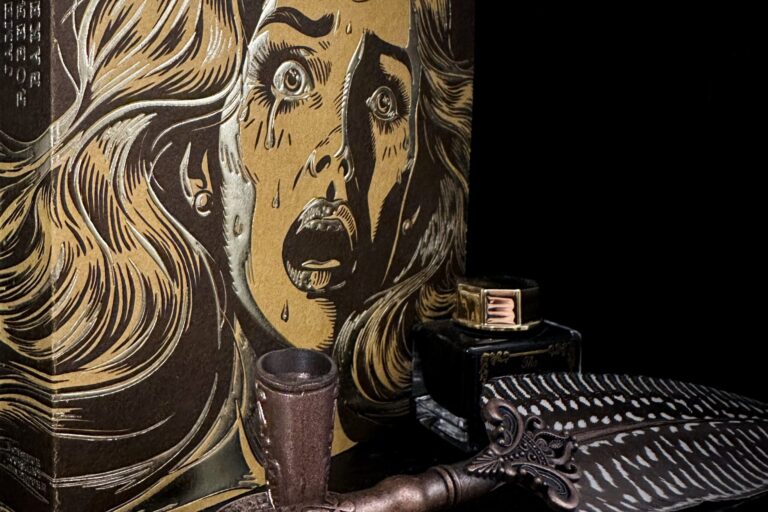
Photo Credit: © Quentin Perissinotto for Le Regard Libre
[1] Broadcast Vertigo January 25, 2022

Lolita Pille
A teenage girl
Editions Stock
2022
283 pages

You'll also like




 French
  German
  English
Leave a comment