





Viol et personnes de jadis: récit d’un malheureux «Soir de fête»

Tuesday's books - Lauriane Pipoz
In a multi-layered novel, French journalists Mathieu Deslandes and Zineb Dryef recount a family secret. The book is largely written in the first person, based on the former's investigation into his grandfather's origins. Placed in dialogue with current issues, the investigation of Party night deals not only with consent, but also with the emotions that a change in family history can arouse, and the delicacy of historical reconstruction.
Party night opens with the declaration of a birth at the town hall in 1923. The anecdote is an enjoyable read, enhanced by details that, while romanticized, add depth to the historical account. The book's chapters follow one another at a steady pace, alternating between two main periods: the rape of Mathieu Deslandes' great-grandmother at an annual ball, and his discovery of part of his origins.
The first, in the form of a novel, captivates the reader: the narrator introduces the characters, describes them, imagines their daily lives and their questions. Why was the ball the event of the year? How were single women perceived? What were the difficulties faced by «mother-daughters» in their families? These were central concerns in the early 20th century. Problems that cut across all social classes, from the French provinces to the City.
What was Deslandes' basis for recreating the people of the time? It all started with a statement made by his great-aunt, whom he met at a funeral. He then drew the threads of this almost century-old story by interviewing the protagonists of this epic. We follow him across the fields to meet cousins, neighbors and distant relatives.
He doesn't hesitate to share his impressions, but also his doubts: how much empathy can you have for family members who have long since passed away? Can we trust the testimonies of those interviewed? Does it call our identity into question? The author attempts to answer these questions with a touch of welcome humor in such a weighty subject, and even a touch of black humor, reminding us that a certain distance must necessarily be established between generations of the same family.
A story rooted in the present
But her investigation is not limited to anecdotes: the author has not hesitated to delve into the archives to verify the facts put forward. Without going too far into historical rigor, which would risk losing the readership - of which the author of this article, historian that she is, would clearly be a part - certain dates and the support of data contained in certain documents, fake or not, give a solid structure to support the subject. The story remains within the confines of the novel, which tells us of a tragic adventure, but one on which we need to take a step back.
«Like Molière's characters, the family members we evoke are reduced to one or two characteristics, those that have enabled them to stand the test of time. It's practical, it colors the memory. And it doesn't matter if the complexity of people is annihilated: a geographical boldness will turn you into an adventurer, a memorable quarrel will assign you a bad character, an «inconvenient» wife will make you a weak man. These are the risks of eternity.»
To this end, a final level comes into play, and not the least: the dialogues with Zineb Dryef, the author's companion, who brings another perspective to the notion of consent, central to this book. She puts her finger on an important fact, which is not new, but which is always worth remembering: the perception of this notion has of course evolved, but some of its problematic elements, such as its blurred contours, are still relevant today. This is borne out by the many books published on the subject, which continue to enthrall a wide readership, such as Vanessa Springora's recent and resounding testimony, Consent.
Read also | Consentwriting is undoubtedly a universal remedy
These dialogues could almost be seen as a third period in the story, that of the author's realization after his investigation. A realization that's hard to escape in the wake of the #MeToo wave, but which it's always good to illustrate with examples. And one that can be brought about by means other than responding to violence with violence. Literature is the perfect vehicle for this kind of approach.
Photo credit: © Jean-François Paganelli
Write to the author: [email protected]
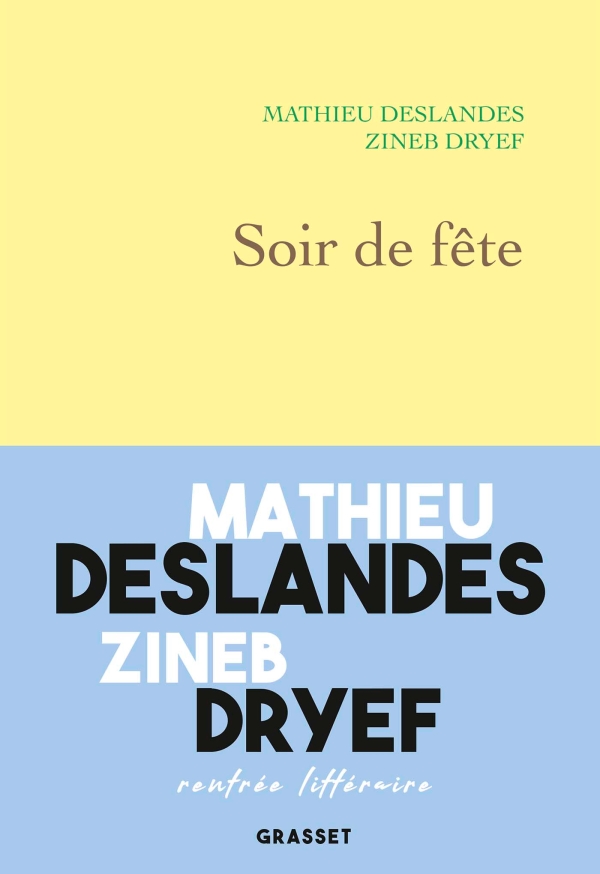
Mathieu Deslandes and Zineb Dryef
Party night
Editions Grasset
2019
240 pages
You'll also like





 French
  German
  English
Leave a comment