




«L'Ecole des femmes», the modern buzz of an «enlightened» man»

Les bouquins du mardi - The retrospective - Anais Sierro
What's the point of commenting on the form of his verses?,
To classic, impeccable applications?
So let's focus here on the substance alone,
Let's explore its senses and its secrets.
And even if my alexandrines aren’t actually alexandrines, it’s virtually impossible for the mind—having read a classical play—to shake off the automatic habit of following that meter rule. But while in this introduction I outline the form, this critique will focus solely on what makes this play by Molière a modern play: here is Arnolphe, in charge of Agnès’s education so that she may be married off as a simple-minded and good housewife, and here is Horace, in love with Agnès, who unconsciously vies for the heart of his beloved.
So I wondered how I could talk about a classic without simply paraphrasing all the articles and other high school exam prep materials you find online. Perhaps by setting aside the school stuff and focusing on the foresight of a playwright who was a forerunner of the Enlightenment…
«I claim that mine, though not particularly sublime in its clarity,
Even if I don't know what a rhyme is:
[...]
In a word, let her be utterly ignorant:
And that's enough for her—to speak well of you,
»To know how to pray to God, to love myself, to sew, and to spin."
Leaving school behind, certainly, but not entirely. How can we not discuss this topic, when even the title itself teaches us something? Women’s education in the 17th centuryth In that century, a woman’s education stood in contrast to that of men, which was scholarly and well-rounded. Educating a woman meant teaching her nothing more than how to run a household and, above all, how to suppress her curiosity and her thirst for knowledge. A danger in the eyes of men. Yet here, although he presents to us—through the words of his male characters—their horrendous expectations of a foolish woman, Molière hints at an obvious masculine vulnerability.
Through Arnolphe, the man—by exercising control over a woman’s (Agnès’)s upbringing—seems to believe he can also determine her integrity. But he forgets that a woman, even if she is foolish, is nonetheless similar to a man in what she possesses: a mind and a heart—and perhaps even more so, a spontaneity. Agnès, who claims to be foolish, pursues a love that seems to her to be just and redeeming.
Molière thus poses a question other than that of female power over men: isn’t education, at times, an obstacle to spontaneity? While in a world where an educated man seems to embody freedom, the spontaneity of a fool comes to challenge that very freedom’s status as a promise. How relevant this is today.
«A woman is, in fact, a man's soup;
And when a man sometimes sees other men
Who want to dip their fingers into their soup,
»He immediately shows extreme anger."
And to think that it is Alain, the peasant—who, in Arnolphe’s eyes, seems to be a simpleton—who teaches us such a lesson through his simple, vivid language. We can thus understand the strong reaction that many may have felt upon seeing this play’s staging. «Oh, blasphemy! Oh, immorality!» But if Molière had to respond—elegantly, it must be said—with two other plays, A Critique of *The School for Wives* and The Versailles Impromptu, let's not dwell here on critiques of social mores, but rather on those of the modernity that Molière portrays.
What I particularly liked about this play was how it moved away from classical theater by presenting characters with universal qualities. Let me explain. From deities to caricatures of men and women contemporary to the playwright, characters were typically defined by a strong identity—whether divine, historical, or otherwise. Molière, however, presents us with characters devoid of such a strong identity. True, their words, actions, and thoughts are true to their era, but they do not possess the specific traits of any particular contemporary figure. He caricatures neither kings nor men of letters; neither religious figures nor criminals; instead, he presents an ordinary man, an ordinary woman, and an ordinary story that addresses a situation to be denounced, brought to light, or even appreciated.
And that, dear readers, is what’s called modern theater. Molière, or a 21st-century directorth century, rooted in the classical form: this is what inspires me The School for Women.
While feminists might have interpreted this text as a call for women’s emancipation, Romantics as an ode to true and beautiful love, and historians as a reflection of 17th-century social customsth In that century, the theater lover in me preferred a style of theater that was strikingly modern. And this was more than 350 years before what we call «contemporary theater.».
«A woman of wit is a devil at scheming;
And as soon as her whim whispered softly,
For the sake of our honor, we must take the plunge.»
Write to the author: [email protected]
Photo credit: © François Boucher/Wikimedia Commons
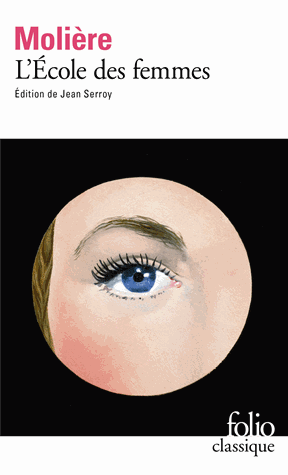
Molière
The School for Wives
Gallimard
2013 [1662]
207 pages
You'll also like





 French
  German
  English
Leave a comment