




«Se taire» is Mathilde's story
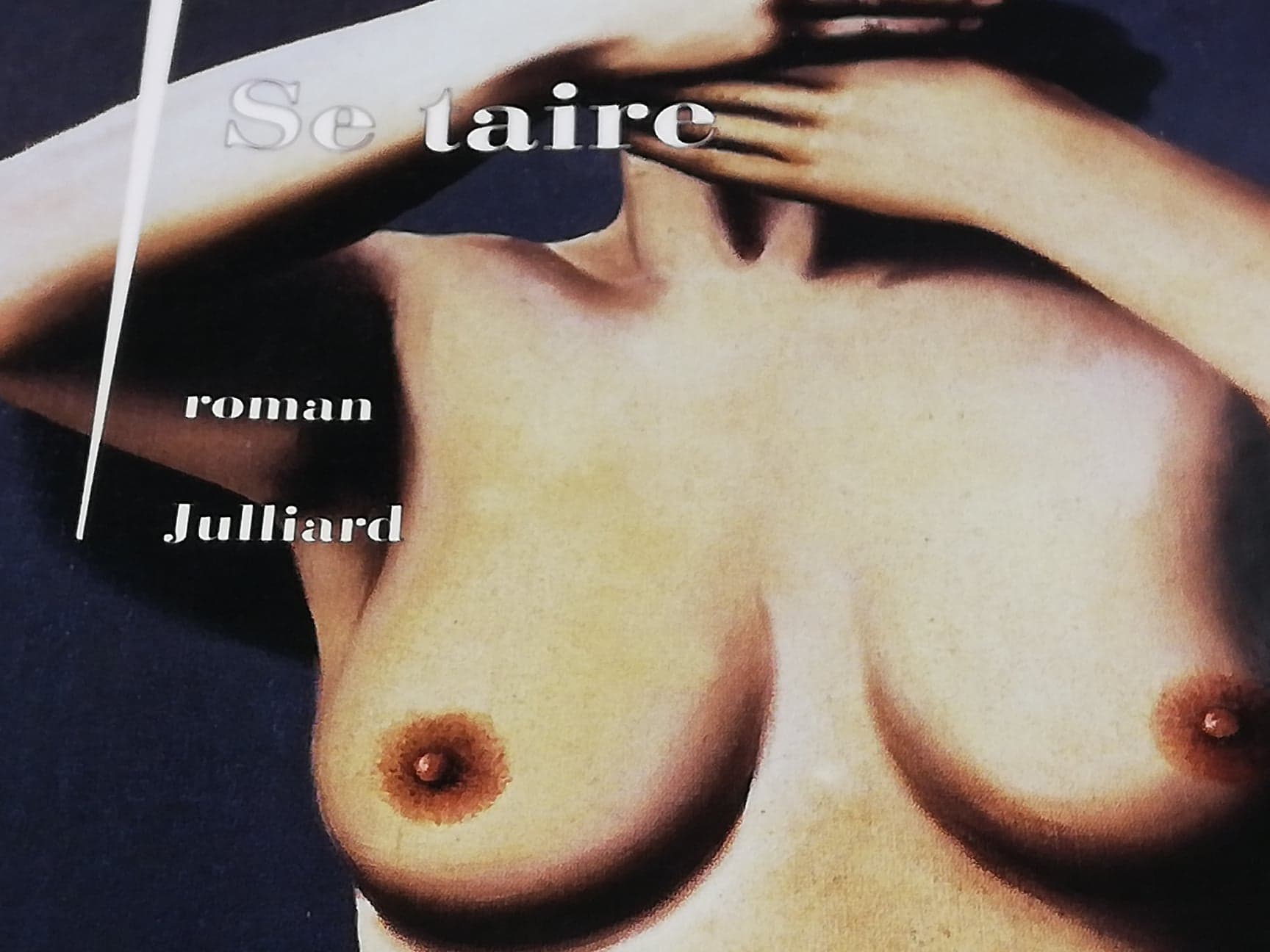
Tuesday books - Loris S. Musumeci
«Men were keeping a low profile; their voices were no longer heard—unless they served as spokespeople for militant feminism and showed themselves willing to offer up their testicles on a silver platter as atonement. The war between the sexes was in full swing, revealing a market growing at an exponential rate—one from which the print media, itself in its twilight years, intended to profit.»
Mazarine Pingeot places us in a historical context. What we might call «the #MeToo era.» She discusses it in the prologue to her novel, as if it were a thing of the past, even though it lies at the heart of our current society—of which she is a part. The distance she seems to create by using past tenses is, in fact, simply a way of helping us understand that her description of this weather is actually timeless.
Despite changes viewed as progress, the workings of the world—and the relationship between men and women—have always been governed by the weight of silence and the cry of instinct. «Behind the hubbub of the world, women’s suffering continued,» the prologue concludes. Everything has changed, yet everything has remained the same. Is this fate? It is up to the reader to decide at the end of the novel.
Mathilde and the History of Women
In the meantime, there’s Mathilde and her story, Mathilde and the history of women, Mathilde and her silence, Mathilde and To remain silent. Her background has all the makings of an exceptional story: the daughter of a popular, socially conscious singer, the granddaughter of a great poet who was a member of the Resistance during the Occupation. Yet her pain is commonplace, shared by so many other women.
At the age of twenty, she began a career as a photographer for a renowned magazine. She was sent to cover a leading figure in the political world who had been awarded the Nobel Peace Prize. A man of unshakable moral stature. But, as is often the case, apparent sanctity hides a true savagery. Mathilde, with her irresistible freshness, stirs something in this man who, in a single, swift, and direct scene, simply rapes her. Seeming to understand nothing of what has happened, the photographer gets dressed and takes the photos she needs. She leaves, greeted by a smiling, benevolent Nobel laureate. As if nothing had happened.
And yet, there is. Once the young girl realizes what has happened, her pain swells until it suffocates her from within. To remain silent, yet she must speak; the silence is unbearable. Her loved ones show her empathy, yet they make her understand that she stands no chance against a man like Nobel. Mathilde had to speak out of psychological necessity; now all she can do is remain silent and forget. To give up on justice and move forward. But how can one move forward when one is trapped in images that haunt us?
In the first person
Since the novel is written in the first person, we follow the protagonist from beginning to end. We grow with her, we suffer with her, and we come to understand—along with her—the manipulations men subject her to and the guilt-tripping rhetoric they hurl at her. Through Mazarine Pingeot’s writing, we thus become intimately acquainted with Mathilde. She is deeply endearing. And sublime: her fair hair, her slender figure, the description of her face and her desirable body—sometimes despite herself. While reading the novel, I sometimes felt butterflies in my stomach just thinking about her, so beautiful.
Thank you to the novelist who makes each of her words so evocative of meaning and imagery. Her writing is understated and precise, and among its qualities are the ability to convey a sensuality that shines through the pages and to vary the length of her sentences. Some passages burst forth with Mathilde’s anxieties. Others, with much longer sentences, convey at times a slow descent into a relational abyss, and at other times the quiet, normal continuation of life. It just goes to show that the two are linked. It just goes to show that the routine of silence is a trap.
Women's Psychology
From a substantive standpoint, we must continue to commend Mazarine Pingeot’s insight. She is, after all, well-positioned to speak about silence and family. She was, for a long time, the hidden—yet deeply loved—daughter of President François Mitterrand from his marriage to Anne Pingeot. She shows how the art of oratory—or art in general—can be passed down from generation to generation, but so too can the ability to remain silent. We suffer from the sins of our parents; the Greeks already said so in their time. We suffer under the weight of our name. We suffer because of the blood that flows through our veins. Yet this is our wealth. Without history, without heritage, and without a name, who would we be?
The author once again paints such an accurate portrait of the female psyche. People will surely tell me that the female psyche doesn’t exist, and that it’s merely the product of men’s malicious and offensive views of women. Yes, I know. I’m familiar with those theories, but I don’t care. I’ll say what I want. Especially since Mazarine is undoubtedly on my side.
A Two-Stage Approach to Sexuality
Female psychology, as we were saying. Through the beautiful Mathilde, we come to understand—or at least begin to grasp—the unique tension between the desire to please and the weariness of being possessed. We’re dealing here with a sort of two-fold sexuality that means Mathilde—knowing she is sensual and desirable—wants to approach men; she loves their eyes, she loves their chests; she needs love, just like everyone else. But at the same time, she cannot bear for a man to fall in love with her and take her. The man is a conquered man who believes himself to be the conqueror; he is a slave to his feelings and impulses who wants to be the dominator.
Mathilde’s weariness is that of all women. So is her rape. Because she is pure, and therefore the favorite target of perverts. Perverts in whom every man must recognize a part of himself. Because women drive us crazy, and sometimes we lose control. Because we lose control, and we think we can get away with anything. Because, in the end, love is nothing but a struggle—one from which Mathilde will emerge victorious. By finding the courage to confront her silence.
Write to the author: [email protected]
Photo credit: © Loris S. Musumeci for Le Regard Libre

Mazarine Pingeot
To remain silent
Julliard Publishing
2019
277 pages

You'll also like





 French
  German
  English
Leave a comment