



A story of Senegalese independence
Tuesday's books - Diana-Alice Ramsauer
«A privilege of our generation, hinge between two historical periods, one of domination, the other of independence». The fiction Such a long letter, by Mariama Bâ - considered one of Africa's first feminist novels - could be summed up in this quotation. This short work recounts the mourning of the Senegalese woman Ramatoulaye in the 1970s: her struggle against male oppression in the private sphere in a shifting context of post-colonial reconstruction. A book that opens the doors to a culture and a past, necessary for all Western feminists of the 21st century.th century.
Such a long letter by Mariama Bâ tells the story of Senegal in the 1970s through the destinies of three women. The first, the central character, Ramatoulaye, is a rebellious fifty-year-old who has let herself be carried away by the weight of tradition. Her best friend, Aïssatou, is the one who finally said «no». Finally, her daughter Daba reflects a new era in the making.
In this long, 165-page missive, Ramatoulaye describes her grief over the death of her husband to her friend Aïssatou, a fellow fighter and role model. In compulsory seclusion, she looks back on the life she spent with him, and how her world collapsed when he decided to take a young, manipulative second wife.
From freedom to motherhood
La quinquagénaire vient de passer un quart de siècle avec cet homme; lui a donné 12 enfants; s’est effacée au profit de ses moindres désirs. Si Ramatoulaye a terminé des études supérieures et est rapidement devenue enseignante, le récit semble murmurer qu’elle a abandonné sa carrière au profit de la vie familiale. «Je suis de celles qui ne peuvent se réaliser et s’épanouir que dans le couple. Je n’ai jamais conçu le bonheur hors du couple». Enfermée dans cette considération, elle encaisse ce deuxième mariage, alors même qu’il lui enlève tout: son mari la prive non seulement d’amour, mais il lui supprime la sécurité financière. Il meurt après avoir dilapidé sa fortune en faveur de cette nouvelle femme et de sa famille, avare de luxe et de reconnaissance sociale. «Je m’étais préparée à un partage équitable selon l’Islam, dans le domaine polygamique. Je n’eus rien entre les mains», regrette Ramatoulaye.
This woman, in many ways the alter ego of Mariama Bâ, refuses to accept the status of victim, and finds herself filled with new strength after the death of her husband. After forty days of mourning, suitors come knocking at her door once again, but she refuses to be dominated by another man - since the fate of marriage in this context is to lose freedom. She marks her limits and tries to rebuild her life, alone.
«I survived. I got rid of my shyness to face the cinema alone; I sat in my place, with less and less embarrassment as the months went by. The mature woman without a companion was stared at. I feigned indifference as anger hammered my nerves and held back tears fogged my eyes. I measured the thinness of the freedom granted to women by the astonished looks on their faces.»
A painful middle finger against polygamy
Best friend Aïssatou is in a similar situation, but with a different reaction. She, too, is faced with the second marriage of her beloved husband, to a very young, very beautiful woman. Yet she decides to leave, to start a new life, taking her children with her. First to Senegal, then to France and finally to the United States, where she becomes an embassy interpreter. Aïssatou does not accept the fact that this second wife was imposed on her without discussion or reflection. Polygamy is singled out: not as a bad practice in itself, but certainly more for what it reveals about relationships of domination and the lack of consideration given to women. Today, some Senegalese feminists are even claiming this lifestyle as their own. Nonetheless, in the seventies, Ramatoulaye admires this middle finger to tradition, this fighting stance.
Read also | L’orgie littéraire de Max Lobe
The last character, less present, is Daba, Ramatoulaye's eldest daughter. She represents a new generation that seems to have already freed itself. Her union is a choice. Marriage is not a chain,« she says. It's a reciprocal adherence to a life program.» Her husband knows how to cook rice as well as she does, and claims «Daba is my wife. She's not my slave, nor my servant». Daba represents Ramatoulaye's hope for a more egalitarian world. Yet this figure only appears at the end of the story, as if to symbolize the embryo of an opening, without actually being able to open up this part of the story. Not yet.
«Senegal offers a new face of rediscovered freedom».»
Through the voice of Mariama Bâ, this freedom is discovered by groping. Both the women and Senegalese society as a whole are moving towards a new organization of life in society, and there are no miracle recipes, like Aissatou and Ramatoulaye, who each live their drama in their own way, as best they can. This society to be remodeled is based on decades of occupation. But it has also been built on traditions, culture and religion: «Our current society is shaken to its very foundations, torn between the lure of imported vices and the fierce resistance of ancient virtues».»
Read also | Africa: The History That Is Denied It
Forty years on, while feminism is a word that no-one can ignore any more, the issues surrounding relationships of domination remain very similar. If certain notions, such as forced marriage or polygamy, are themes that speak to us very little in the West, the liberating foundation is, on the other hand, universal. The story, published in 1979, does not say whether this liberation was beneficial, nor whether decolonization was successful - we know today, with a little hindsight, that many issues remain unresolved.
This is where Such a long letter by Mariama Bâ is powerful: it's a tale of transition, not a book of solutions. One of the first to unearth women from the dark caves where they have too often been left. It evokes hope: a cry against human exploitation and the notion of «woman-object». It is a manifesto for freedom of choice without constraints or unhealthy power relationships. It is a strong voice for challenging traditions that favor the powerful. And finally, it is a pamphlet for a better representation of diversity at the head of the state. In short, an intimate and eminently political story... with all the disillusions that can entail.
The final word goes to Ivorian playwright Koffi Kwahulé - and he says it in 2020 - Mariama Bâ's work has highlighted a fundamental principle: the status of women in society must be seen as one of Senegal's (and Africa's) great battles. For as long as this issue remains unresolved, no matter how hard we work on the social, economic or cultural fronts, the country will never really have achieved freedom.
Write to the author: [email protected]
Photo Credit: © Domaine Public
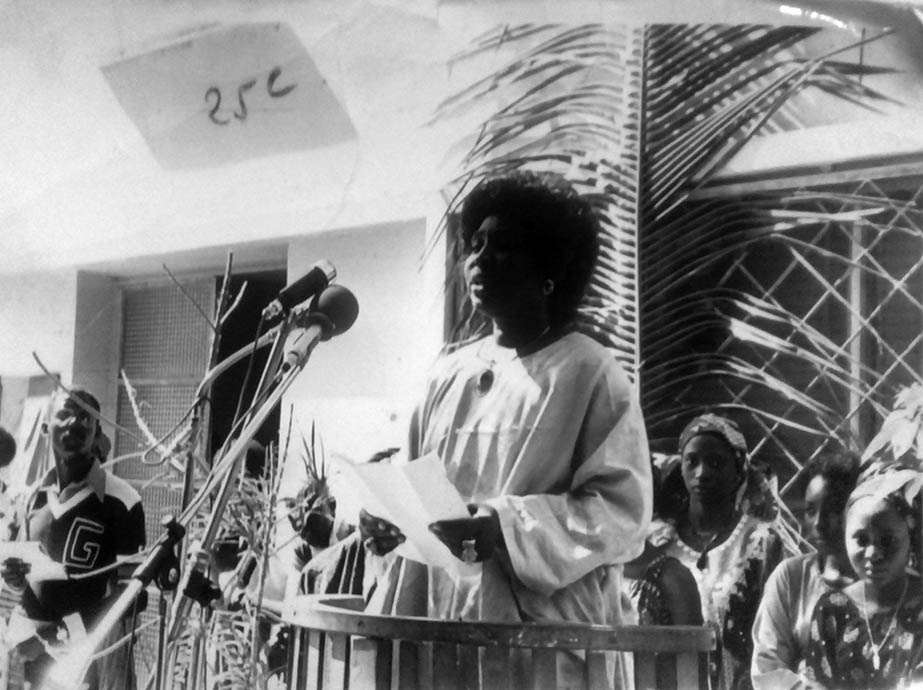
Légende: Discours de Mariama Bâ à l’Ecole normale de Rufisque. Date inconnue.

Mariama Bâ
Such a long letter
Les Editions du Rocher/Serpent à plumes
2001 [1979]
165 pages
You'll also like


 French
  German
  English
Leave a comment