








«Avec toutes mes sympathies»: un Renaudot de l’essai en recherche
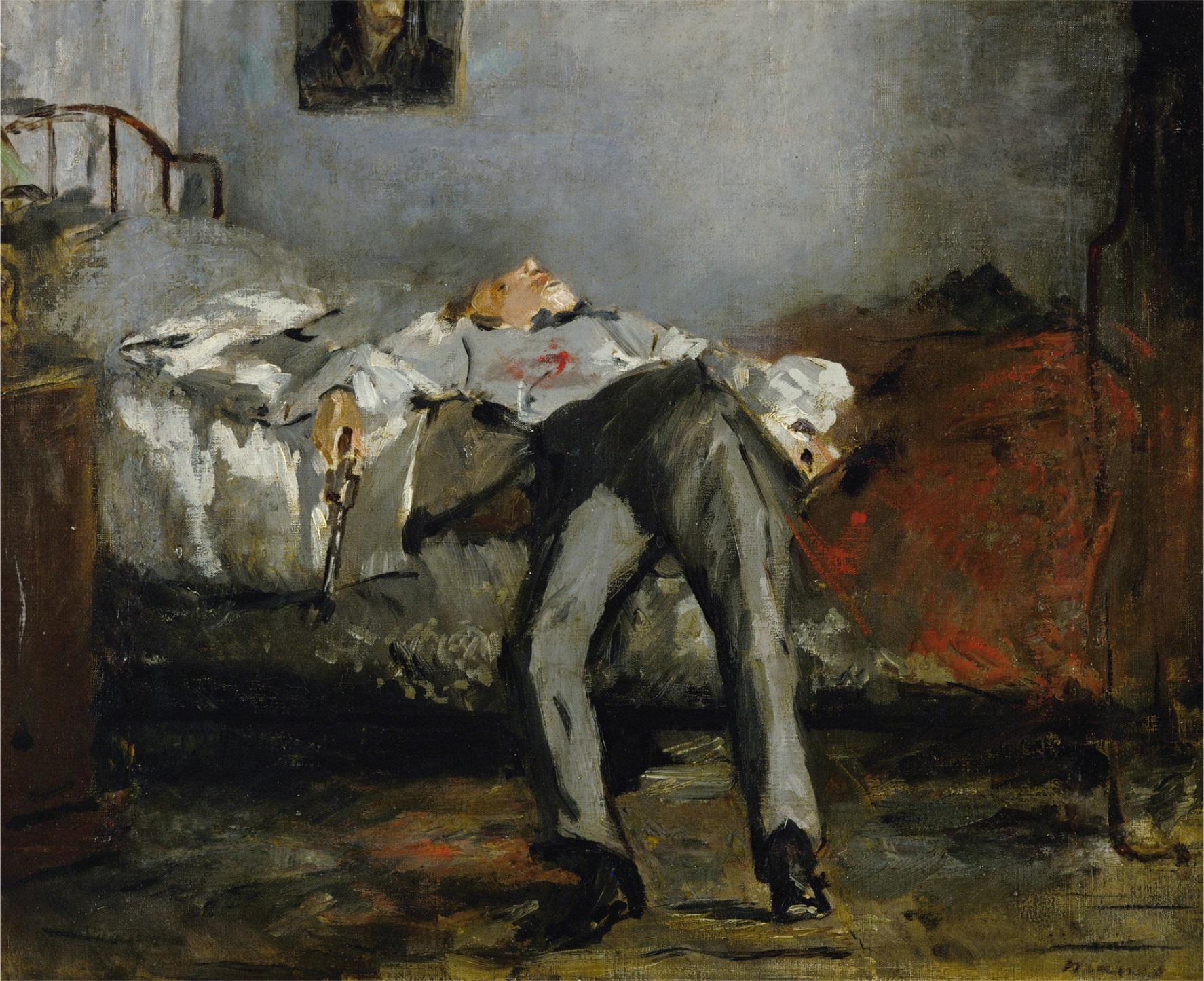
DGA593052 Suicide, 1881 (oil on canvas) by Manet, Edouard (1832-83); Buhrle Collection, Zurich, Switzerland; (add.info.: Edouard Manet (1832-1883), Suicide, 1881. Artwork-location: Zürich, Sammlung Bührle (Art Museum)); De Agostini Picture Library / E. Lessing; French, out of copyright
An overview of some of the major literary prizes - episode #
Le Regard Libre N° 48 - Loris S. Musumeci
We just love her. His gentle voice and sense of nuance brighten up our Sunday evenings listening to the radio show Le Masque et la Plume on France Inter. Olivia de Lamberterie, a renowned literary critic, takes up the pen to write in her turn. Not a novel, but an essay, a collection of memories and thoughts, recounting the suicide of her brother Alex, on October 14, 2015 in Montreal.
One might have expected a critic to emphasize style. In fact, not at all. In fact, that’s the aspect she seems to have neglected the most in her book. Not that it’s poorly written—on the contrary—but the words flow effortlessly. They’re straightforward. She says what she has to say in a natural way. It’s as if she were telling us about her brother in person, face-to-face over a cup of coffee.
My deepest sympathies is brimming with sincerity. The reader simply follows Olivia de Lamberterie through the pages, without even feeling the need to ask why or how her brother committed suicide. The author tells us what she wants, the way she wants, and that’s just fine. We’re drawn into her words and experience alongside her the tragic story she’s telling us. We witness her daily life, and she shares with us the small steps that make up the journey of her life as a literary critic, a mother, and a woman.
«I’ve worked my fingers to the bone, but I’m a literary critic. I read as naturally as I breathe; I have my rituals—I start on page 66 to see if the book is worth it, and then I devour it. I love this parallel existence, this augmented reality. Reading is the perfect refuge for someone like me who lives in a liminal space. Between the lice-removing shampoo in my sons» hair and *The Call of the Wild*. Between the comfort of my childhood and the boldness of my choices. Between my younger friends and the older men I’ve loved—at this point, I don’t even know how old I am anymore.”
Of course, Olivia de Lamberterie’s account is deeply moving. Not only because the tragedy of suicide looms over it like a sacred and terrifying king, but also because she did not write this book in her brother’s place, nor even for her brother. It is not really a tribute, insofar as she addresses him in her thoughts in an attempt to understand—while nevertheless accepting, with resignation, his act. This book is therefore not a eulogy but a quest. A search for solace during painful moments, such as breaking the news to his parents.
«I arrive in front of my parents‘ building. I think someone’s going to kill our mother. It’s 9:30 when Caroline, Chloé, and I ring the doorbell. Three Fates. Mom opens the door, and in a flash, the astonishment on her face gives way to terror, and one of us—I don’t know which—whispers just ’Alex.» The name hangs in the air, shatters on the doormat; no explanation is needed. Our mother falls—literally collapses—Dad catches her and carries her to the couch. She hides her face; she can’t make a sound. I’ve never seen anyone so utterly devastated by grief.”
A quest for authenticity—and the reader has plenty to laugh about at times. The author lets loose in a way that’s only possible in moments of crisis, and scrutinizes all those expressions and attitudes we adopt today simply because they’re trendy or when we don’t know what to say. The title «My deepest sympathies» brings a smile to one’s face, since this expression of condolence is used only by Quebecers. It creates misunderstandings and surprise, while adding the necessary lightheartedness to a painful story. In short, here comes a breath of fresh air that slaps the verbal precautions of political correctness right in the face. Thank you, Olivia!
«I don’t know how people do it. Yesterday, a girl explained to me: ‘This weekend, I’m sending the kids to my parents’ house and I’m giving myself permission to take an Argentine tango class.» But can’t she just say she wants to dance? Everyone talks like they’re in a self-help book. Everyone is ‘allowing’ themselves to do things. Taking yoga classes. Valuing themselves. Organizing community events, vegan dinners, concerts with the neighbors. Recharging. As for me, I eat gluten and don’t feel like I belong to this 100 percent organic crowd […] I want to scream and get into a fight with the first person I see, to spit out their nonsense to these people who think they’re so special. To throw your suicide and a rare roast beef right in their vegetarian faces. They seem so strange to me, these well-fed people, busy pampering their guts as if death didn’t exist. Will their coffins be eco-friendly?”
A search for the right words. To tell her brother just how much she loves him. All the happiness his presence has brought her. All the affection she feels for her family. To say just how wonderful Alex was. And all the acceptance she feels for a gesture reasonably absurd which was the choice of a man—his little Alex—who had to leave because «life isn’t for me.»
«Was my brother born unhappy, or did he become so, consumed by his own misfortunes and a life he found unbearable, given how much his objective reality—‘I have everything I need to be happy’—clashed with his perception of it? Pointless despair was slowly killing him, his guilt preventing him from enjoying what he had built: a lasting love, a harmonious family, and a job that was, all things considered, satisfying.»
Write to the author: [email protected]
Photo credit: © Wikimedia CC

Olivia de Lamberterie
My deepest sympathies
Editions Stock
2018
254 pages
You'll also like




 French
  German
  English
Leave a comment