




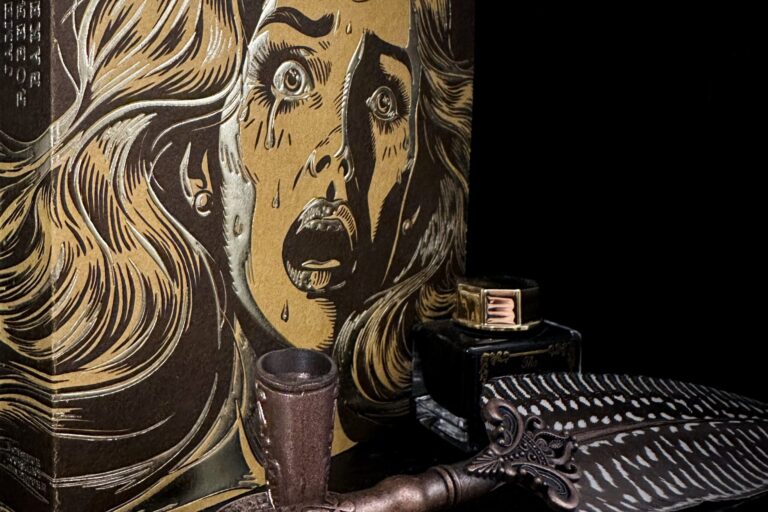
«Unicorn»: #BeYourself #CommeToutLeMonde

Maëla, 20, is a mediocre literature student. Her life is punctuated by social networks. From the Facebook of Lisa, Kilian's new girlfriend, to the channels of famous female youtubers and the Instagram accounts of her favorite rapper Mowgli and her bear Balloo - two omnipresent figures in the book - Maëla is hooked. With her Iphone 6, the young woman is convinced that she holds the key to fame and a radiant future made of rhinestones and glitter. She strives to stage her life as scrupulously as awkwardly, from her daily bowl of cereal to her new haircut.
Yet neither her mother, nor her roommate Marilou, nor her coworkers at Carrefour City—and certainly not Laura Chareau, her literature teacher—seem to take her seriously. Until one fine morning when Maëla wakes up to discover that the number of her followers It's gone viral, and her comments now number in the thousands: she just won the contest launched by Mowgli to appear in his new music video!
The unicorn is a legendary creature, often mentioned in various tales dating back to Ancient Greece. Associated with the ideas of virginity and purity, it symbolizes spiritual seeking as well as the duality of human nature. A large, magical white horse, the unicorn captivates with its grace, power, and divine nature. It is also the’emoji which Maëla chose as her emblem to set herself apart from her sisters, an emblem adopted by the fans of the young woman—her followers – as a rallying cry. We see this idea of duality in Maëla, who dreams of grace and the divine, but who later begins to doubt her choices more and more, to the point of preferring the wild bear to the unicorn.
Si le titre de ce roman est plutôt aguicheur, il n’en va pas de même pour ses premières pages. On y fait la connaissance de Maëla, jeune caissière pas forcément très belle, qui enchaîne les échecs à la fac’ à grand coup de 1 ou 2 sur 20 à ses travaux et dissertations. Toujours amoureuse de son ancien petit copain, Kilian (#KilianIsTheNewKevin), elle s’endort le soir sur la musique de son rappeur préféré:
«Cyprine and codeine—I gave your dreams back to the vermin"
In your teu-cha, I found my heart
On Insta, I'm totally into your laid-back vibe
Back in the hood, I knew what it was like to go hungry
»On your tongue, I taste platinum blonde."
Now, I love irony! But here, the author paints a rather unflattering portrait, frequently slipping into crude caricature, where the succession of clichés renders the characters impersonal and not particularly likable. The hopes I had for this novel have deflated like a cheese soufflé fresh out of the oven!
That said, I don’t like to give up on a book halfway through, and—more importantly—I absolutely have to write a review by Tuesday, so I’m sticking with it. I’m plowing through this first part, where I learn that young people are obsessed with their new pairs of sneakers and their appearance, that social media is nothing but a facade that doesn’t always reflect reality, and that the 19thth This century is nothing but vanity.
Fortunately, the second half of the novel is much more interesting. For starters, the clichés become less obvious. Maëla has won the Instagram contest, which propels her into the spotlight she’d been hoping to occupy. Something extraordinary is finally happening in her life, and she’s determined to rise to the occasion and live up to her new responsibilities. The pace picks up, the reading becomes a whirlwind—I can’t wait to find out what happens next!
Our Emma Bovary 2.0 is then overwhelmed and crushed by the weight of her new obligations. Already a slave to social media, she struggles to cope with this sudden fame and her responsibilities toward her community in the virtual world. Maëla needs more and more filters to appreciate herself—like a drug that allows her to feel and love, to feel alive and valued. Her fantasies and her quest for an ideal raise more and more questions, until she begins to doubt what she truly wants.
Read also: Antonia, a Madame Bovary in 1960s Palermo
Maëla’s descent into hell highlights our struggles to live in the present moment—here and now—as we’re constantly encouraged to possess more in order to appear better. What are we really looking for? Are we doing this to escape boredom, to avoid facing our deepest fears, or to fill an inner void? Like our modern-day heroine, we tend to compare ourselves to the image others project of themselves—an image that often leaves us feeling like we’ve failed.
How can we find our identity and our place in this hyper-connected world, where it’s so easy to be led to believe that the grass is definitely greener on the other side? Isn’t it easier, then, to be and act like everyone else? How can we assert our individuality in a liberalized society that seeks to impose on us a single, standardized version of happiness and photoshopped? In the Land of emojis With all these unicorns and glitter filters, wouldn’t it be better to do as that very well-groomed bear does and follow that good old advice: «It doesn’t take much to be happy»?
Nora Sandor
Unicorn
Editions Gallimard
2019
211 pages
Write to the author: [email protected]
Photo credit: © Amélie Wauthier
-
 Standard subscription (Switzerland)CHF100.00 / year
 -
Support subscriptionCHF200.00 / year
You'll also like




 French
  German
  English
Leave a comment