



Castorf's incendiary language

Unpublished article - Ivan Garcia
This season's eagerly awaited show at Vidy, Bajazet. Considering Theater and the plague after Jean Racine and Antonin Artaud is still playing at the theater until November 10. Directed by Frank Castorf, the play's actors are astonishing, and it proves to be a spectacular work, despite a few moments of incoherence and a considerable running time for the spectator.
On this first Friday in November, the atmosphere at the Théâtre de Vidy is electric for the performance of Frank Castorf's new creation. The former director of Volksbühne from Berlin tackles a text by the poet of French classicism, Jean Racine. After a fine introduction to the show by Eric Vautrin, dramaturge of the Théâtre de Vidy, who explains, among other things, the aesthetics of Castorf's theater and its biases to the audience (also read: Eric Vautrin: «Racine's resonance with today's world is striking».»), the audience enters the room and finds itself under the fire of alexandrines and videos. An exhilarating moment.
A fable complex
At the start of the play, two characters take center stage. Acomat (Mounir Margoum), the empire's grand vizier, and Osmin (Adama Diop), his «faithful» servant. They engage in an intense exchange that explains the situation at the Sultan's court. In a nutshell, here's the tale we're told: in the seraglio of Grand Sultan Amurat, while the latter is away fighting in Babylon, a strange conspiracy takes place. Acomat feels threatened by the Sultan and wants to overthrow him in his absence by placing Bajazet, the Sultan's brother, on the throne. Aided in his plans by Osmin, Acomat intends to use the love that Roxane, the Sultan's favorite and holder of power, feels for Bajazet, who is locked up by the Sultan, who fears him, to ensure that this lover ascends the throne.
But Bajazet, eternally indecisive, loves Atalide, a princess of the court, and cannot bring himself to love Roxane, even to save his own life. As for Acomat, far from being the archetype of virtue virtue, by handing Bajazet over to Roxane, Acomat seeks to marry Atalide... we can see, the plot is a complex one, charting the relationships (and power) relationships. Firstly, Castorf has chosen an all-French cast Castorf has chosen an all-French cast to ensure the high quality of the Racine text. In this regard we'd like to highlight the actors' fine vocal performance on these alexandrines.
Actors actors
Listening to them, we get the impression that the alexandrine, usually very artificial, becomes supple and simple, like spoken language. For us, the two characters (and actors) with the greatest mastery of it are Bajazet (Jean-Damien Barbin) and Osmin (Adama Diop). The former, with his tone and heavy voice, has a slow but striking prosody, which makes his verses easy to hear; the latter, with a faster, more piercing voice, transforms the alexandrine into a form of rap with a fiery, short and fast verb.
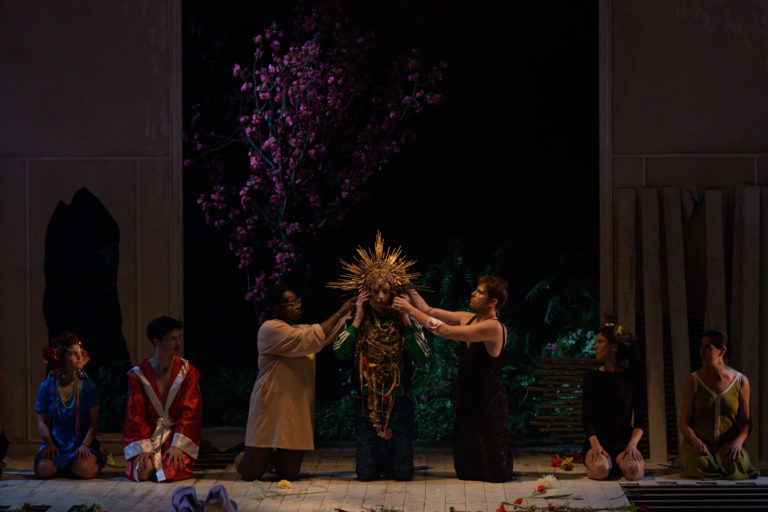
On the whole, all the actors energy and stage presence. This is is further enhanced by certain characterizations visible in the costumes used. Each character has a specific costume. Osmin, the the servant, is dressed in a qamis of the brand Louis Vuitton and a turban. Acomat, weary of his qamis, strolls in a sort of sort of training golden, which gives it an air of kaid suburbs. In the same vein, Bajazet's first appearance on stage shows him dressed as an Islamic fundamentalist, declaiming his alexandrines under his veiled face.
The costumes highlight clichés or commonplaces we might expect from this fantasized Orient divided between Islam and luxury. Similarly, Roxane (Jeanne Balibar) first appears on stage, mute, dressed in leather leather and braids, before appearing - in the second half of the show - in a with a red jacket, blond hair and... a bra with nipple covers are signed Dolce & Gabbana.
In this staging, as mentioned above the actors put in an outstanding performance. Frank Castorf, whose working method is to ensure that the actor's individuality is preserved. individuality of the actor, is a true success. However, it seems to us that the interact very little with each other. Most of the time, they they address the audience or the camera, as if they were unable to really enter the fable, which begs the question of how the director intended to wanted to show this play.
The Castorf« dramaturgy»
The set design, by Serbian by Serbian designer Aleksandar Denic, features a giant screen suspended in the air a tent and a shed, as well as a giant silhouette in the effigy of Amurat, the Sultan, whose eyes sometimes light up. Never physically present on stage his mere name, evoked by the various characters, makes him heavy and anchors him in this zone of conflict. More discreet are details such as the brand logo Opel adorn the the back of the stage. It's in this space, which is both open and enclosed (the tent/cabin) that the various protagonists move around.
Castorf's dramaturgy relies, in part, on the judicious use of video to immerse viewers in enclosed spaces. When the characters enter the shed, for example, the audience can only see what they're doing by looking at the giant screen; cameras, and sometimes a cameraman, are used to film the characters and show this to the audience. A hallmark of Castorf's dramatic conception, the use of video seems to be based on a desire to multiply points of view and reveal to us the other side of the stage. In other words, the place where people and things are no longer in the limelight, but reveal their dark side.
Perhaps this is the director's intention, as a keen reader of the works he adapts, to show what the classical age has always concealed: the off-stage. Within the dramatic corpus of the XVIIth In the twentieth century, because of the famous unities of time, action and place, a great deal of action takes place off-stage and is therefore not shown on the stage, but narrated - via speech - by the characters to the audience. Castorf's use of video complements the classic works, allowing us to see these off-stage intrigues and encounters, and give us certain interpretations of them.
These scenes, set in the tent or shed, also reveal certain characteristics of the characters: their penchant for cigarettes and alcohol, or their return to normal language. For example, when Atalide (Claire Sermonne) is looking for her two companions (Osmin and Acomat), the video shows her entering the shed and seeing Osmin reading an article about the knitters of Chailly in the newspaper. 24 heures, and Acomat, who keeps an edition of the newspaper Le Temps featuring Emmanuel Macron on the front cover.
Another fundamental feature of Castorf's dramaturgy is his exemplary use of the soundtrack, consisting mainly of rock and English-language songs, to underline certain moments and create an audience bond with the scenes shown. At times, however, the show's logic seems incomprehensible or even off-kilter. At times, we alternate between scenes of Bajazet and other, more poetic scenes, which probably relate to Antonin Artaud's career, in particular his radio program «Pour en finir avec le jugement de Dieu» ("To put an end to the judgment of God"). The latter scenes, concerning Artaud, are often hectic and less structured than the scenes from Bajazet, This creates a certain amount of confusion for the public and their understanding of the drama.
Racine and Artaud, the Molotov cocktail of language
In the words of Eric Vautrin, the dramaturge at Vidy, «Artaud literally summons language to, he says, to be reborn to himself, to become who he is.» In a scene from Castorf's Castorf's play, Bajazet-Artaud is taken by Osmin and Acomat to the garden shed and electrocuted. Left for dead, he removes the tape from his mouth and... speaks. mouth and... speaks. It seems that language is a means of rebirth. Of self-discovery.
In Castorf's work, supported by Racine and Artaud, language is incendiary; it burns, it explodes. And for good reason, the play contains very few moments of silence. In fact, they are virtually non-existent, as all the characters prevaricate, argue, soliloquize, monologue, exchange, plot... Language is king. One of the few moments when it isn't: the final scene, where the screen shows us a video of the Osmin-Acomat duo driving a boat across Lake Geneva to flee their country. Betrayed by Osmin, Acomat also ends up dead: on stage, the end of speech inextricably leads to death.
In about four hours, the Bajazet by Castorf, combined with Antonin Artaud, proves to be one of the great shows of this season - and perhaps of recent years. By bringing together two authors, Jean Racine and Antonin Artaud, whom tradition usually distances, the former director of the Volksbühne delivers a grandiose reading of this French classic, turning it into a work that makes you think and feel. This is precisely what the spoken word can bring in terms of conflict and freedom. At the end of the performance, the spectator may not have understood or grasped everything, but he or she will remember something that shook the neurons and the guts.
See our November issue, Order here, Our interview with Eric Vautrin, dramaturge at the Théâtre de Vidy
Write to the author: [email protected]
Photo credit: © Mathilda Olmi
-
 Le Regard Libre - Nº 56CHF10.00
 -
 Digital subscriptionCHF50.00 / year
 -
Standard subscription (Switzerland)CHF100.00 / year
-
Support subscriptionCHF200.00 / year

You'll also like

 French
  German
  English
Leave a comment