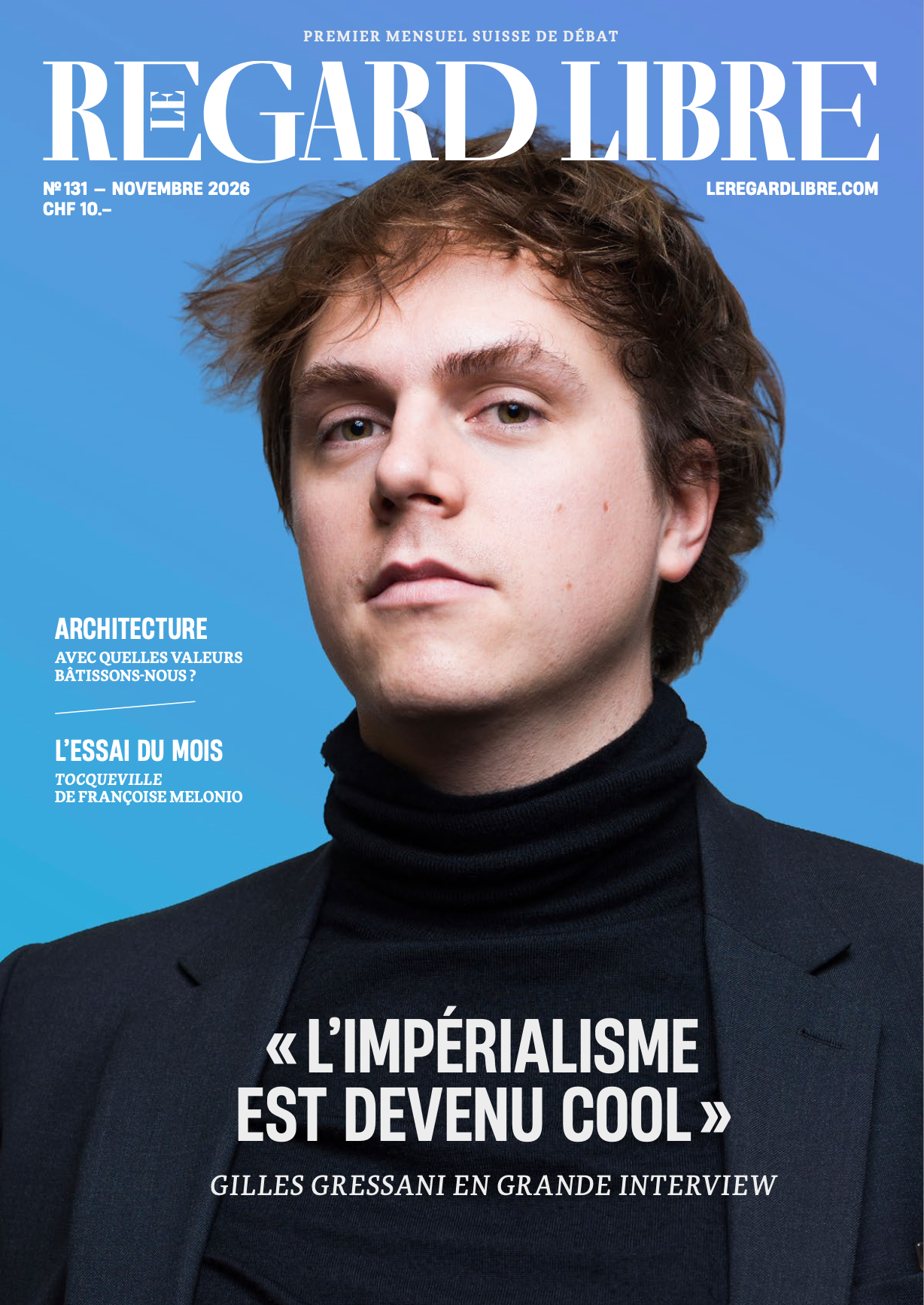




Liberalism today

Le Regard Libre N° 7 - Jonas Follonier
Interview with Frédéric Jollien, President of the Swiss section of European Students For Liberty.
Le Regard LibreWhat is liberalism?
Frédéric Jollien: Liberalism is a political philosophy that affirms the natural rights of every human being. The principle underlying this right is that every individual is the owner of himself and his own labor. It condemns aggression, which is defined as an infringement upon another’s property against his consent.
Liberalism aims to reduce or eliminate any coercive action by individuals against other individuals. While this principle goes without saying when it comes to acts committed by individuals acting alone (armed robbery, murder, etc.), it is unfortunately ignored when such acts are carried out by officials or majorities (war, taxation, inflation, etc.). Its political struggle is therefore to inform citizens of all the effects of legal coercion and to combat it. Liberalism does not subscribe to the cult of democracy as it is perceived today. Whether a minority is persecuted by a king or by the democratic consent of the people makes absolutely no difference. For a liberal, the true essence of democracy is the individual’s sovereignty over his or her personal life. Benjamin Constant offered an excellent explanation of liberalism by distinguishing between the “freedom of the Ancients”—which holds that freedom is the ability to cast a vote—and the “freedom of the Moderns”—which asserts the right to exercise one’s private independence.
Is liberalism currently in a phase of extinction, or on the contrary in a phase of expansion?
It is generally reappearing after an XXth It's an absolutely detestable century for this school of thought. There are the American libertarian movements (an Anglo-Saxon word for liberalism without being equated with liberalism (of the socialist-leaning Democratic Party). In Africa, the liberal movement is gaining significant traction among young people. In Europe, it is primarily the Eastern European countries (with the exception of Russia) that are experiencing a strong resurgence of philosophical and political liberalism. This revival is still barely visible in politics. The West, on the contrary, is the scene of an anti-capitalism that has become mainstream Although this must be qualified based on local circumstances. I’ve noticed, above all, impressive progress among young people. Although the number of activists is negligible, their consistency and intellectual depth are very much evident. The internet has provided access to knowledge, enhanced debates, and fostered the significant growth of an activist community unlike anything seen before.
A new niche was born, a rather theoretical and advanced movement: the’anarcho-capitalism. What does this doctrine advocate? The law of the jungle?
For centuries, liberals have argued that the state has no legitimacy in certain areas (such as religion or dress) and that individual freedom must be guaranteed. This led, in particular, to the creation of the Declaration of the Rights of Man and of the Citizen, which was specifically intended to limit the power of states. Liberals remained convinced, however, that the state played an essential role in guaranteeing the freedoms they defended. For example, if religious freedom was to be protected, a neutral intermediary was needed to prevent people from imposing their religions on one another. The state was seen as the indispensable guarantor of individual freedoms. Anarcho-capitalism argues that we must do away with these so-called «sovereign rights» and that competition among judicial systems and security firms is not only feasible but entirely desirable. This is not a new movement. One of the first to theorize it was Gustave de Molinari, a 19th-century Belgian economistth century. This represents the ultimate culmination of political liberalism: the outright abolition of the state. This movement has drawn considerable inspiration from American individualist socialism and today also incorporates the ideas of David Friedman, for example. The law of the jungle is the law of the strongest, the law of violence. Liberalism, on the contrary, upholds every person’s natural rights to their legitimate property. This is the exact opposite of barbarism and the law of the strongest. For those with little intellectual integrity, the «law of the jungle» argument makes it easier to win over the masses. An analysis of political discourse shows that this fallacy has been widely used to justify many forms of despotism. And unfortunately, this is still the case today. It is important to understand what is meant by the terms «order» and “jungle.” Personally, I would rather defend the Swiss jungle than North Korean order.
In your opinion, does the traditional left-right divide make sense, or should we fundamentally reform our conception and practice of debating ideas and politics?
The left-right divide is not tied to political philosophy but to the prevailing ideological trend. Currently, the right is associated with civil interventionism (strong police, border control, cultural preservation, etc.) and relative economic liberalism, while the left is economically interventionist but relatively supportive of civil liberties (same-sex marriage, drug legalization, etc.). Historically, this has not always been the case. Liberals completely distance themselves from this divide and criticize its intellectual irrelevance. Since government decisions give priority to economic issues, liberals are generally classified as right-wing, but you’ll find them siding with the left on other issues or, at times, standing completely alone.
Today, many politicians, intellectuals, journalists and ordinary citizens are denouncing a certain overemphasis on the importance of the individual over the common good. What do you think of this criticism?
That’s a ridiculous fallacy. One cannot be pitted against the other. The current trend is indeed to cry out against selfishness and individualism while glorifying a «common good» that cannot be defined. Yet the common good cannot be a good if it does not improve individual well-being. The «collective» whole is made up of its individuals. The people and society are abstractions that have neither consciousness nor defined characteristics. Who are these people who would be capable of defining society’s “common good” in place of the individuals who make it up? It is appalling to observe that the more problems escalate, the more these fallacies gain traction. One cannot think of certain historical events without shuddering with anxiety. What horrors have been committed in the name of these ideas.
In your opinion, are the Liberals currently in the minority or in the majority among the Swiss population?
It depends on your point of view. Politically speaking, there are none, or very few. People tend to expect a lot from the government and to lobby to defend their livelihoods. This is the system in which they live, and they are willing to put up with it. As Bastiat said, «The government is that great fiction through which everyone tries to live at everyone else’s expense.» But in everyday life, they are imbued with liberalism: they do not tolerate theft, for example, and they collaborate freely, trade with one another, and help one another. In reality, the population does not realize that their political actions are exactly the opposite of their core values. They would never go knocking on their neighbors’ doors to confiscate food from them. On the other hand, they are willing to pass laws (food protectionism, bans on certain types of food, etc.) that will send police officers to do it for them. It is quite strange that individuals grant rights to an external entity—the state—that they would never grant to themselves.
Is man by nature a capitalist?
We must always define the terms we use to ensure we understand each other clearly. Capitalism refers to private ownership of property. A capitalist is defined as a person who accumulates capital (assets, whether in monetary form or not) to improve their well-being—either today (by borrowing and earning interest) or tomorrow (by reinvesting or covering unforeseen losses). Yes, humans are capitalists, and so are their bodies: they store resources for future use. This is not even unique to the human species—it is characteristic of all living beings. But be careful: capitalism is not necessarily liberal. Capital can be accumulated through aggression just as much as through labor. It is important to make this distinction because capitalism or liberalism are often equated with corporatism, slavery, or other forms of aggression.
Is the Liberal-Radical Party liberal? Is it radical?
It is always important to distinguish clearly between a political party and political philosophy. A political party exists first and foremost to win elections. The ideas it advocates generally lack any real philosophical coherence. You’ll often hear parties advocate for confederalism and cantonal autonomy, only to trample on those principles in the next referendum by invoking democratic rules and the federal majority rule. Currently, no party is truly liberal. While the PLR claims to represent a certain brand of economic liberalism, it regularly proposes subsidies for one sector, regulations for others, and bailouts when «necessary.» The same goes for civil liberties: same-sex marriage does not currently have majority support, drug legalization isn’t even on the table, and religious freedom is being seriously challenged by a minority. Is the PLR more liberal or radical? That’s a difficult question to answer. Even in the past, the Liberal Party was liberal only in comparison to the others. As for the Radical Party, it cannot be said to adhere to a genuine political philosophy: it is the product of a fusion between French Jacobinism, religious liberalism, the early tenets of socialism, and concessions made to conservatives in order to advocate for constitutional federalism. It is the product of history rather than of reason. But the PLR has changed, is changing, and will continue to change.
Can you be both conservative and liberal?
Yes, absolutely. Conservatism is not fundamentally a political doctrine. One can be conservative and still refuse to impose one’s views on others. A liberal conservative must be logical and consistent. If he disapproves of same-sex marriage, that does not mean he should prevent individuals from entering into marriage contracts with one another. If they disapprove of new technologies, they have no right to use the power of the state to prohibit others from using them. Similarly, if they wish to have a religious symbol in their children’s classroom, they have no right to impose it on everyone through the compulsory school system. On the other hand, he can assert his right to provide his child with a religious education or his right to refuse the imposition of new technologies. He is the master of his own life and property. Freedom implies the ability to enter into contracts voluntarily with others and the right to refuse them. Liberalism is therefore not a moral dogma and is fully adaptable to individual choices. In a liberal world, conservatives can have their own schools and churches, and socialists can establish their kibbutzim and live in freely chosen communities.
Write to the author: [email protected]

You'll also like


 French
 German
 English
1 comment
[...] Read also: «Liberalism today» [...]
Leave a comment