



«Dark is the Night»
Fribourg International Film Festival - Loris S. Musumeci
«During my term, I will put an end to the drug problem.»
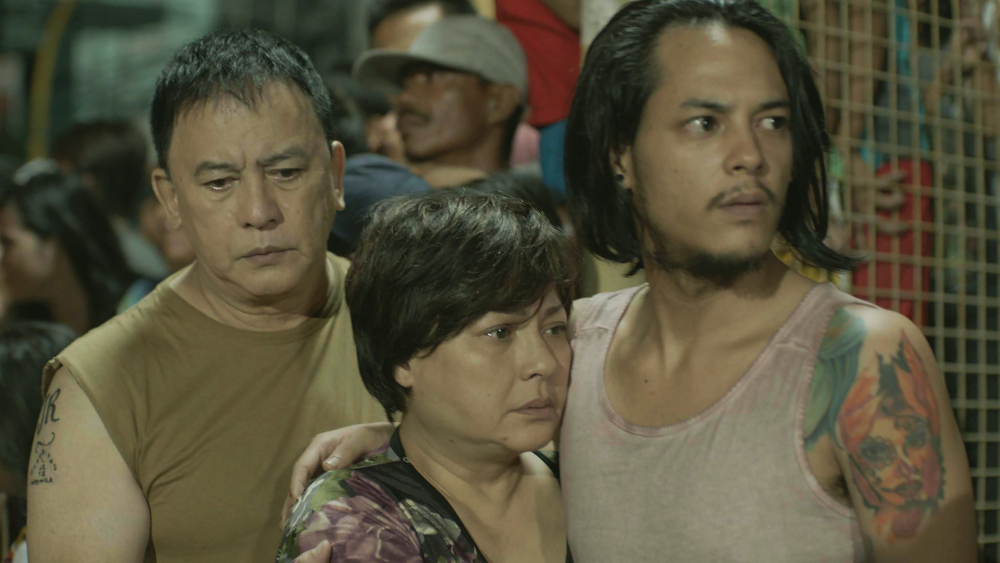
Lando (Phillip Salvador) sings a happy «Happy birthday to you!» at karaoke. Sarah (Gina Alajar), his wife, laughs. Alan (Felix Roco), their son, mingles with the few other friends present for the occasion. Shots suddenly interrupt the party. The police run into the street. A young boy flees; he is promptly shot dead. The crowd gathers around the corpse. The victim's mother comes running. She screams in despair: «My son is a drug addict, not a dealer! Crushed.
Following the previous day's episode, Lando and Sarah recommend the utmost caution to their only son, who is using. In addition, the couple has decided to withdraw from a mafia-like circle of deal. The latter takes advantage of his precarious situation to find discreet hands in the drug trade. The risk is twofold: that of President Duerte's frantic, merciless fight, and that of the criminal group that has left, offering them no protection. The day of danger doesn't even pass when Alan disappears. His parents look for him everywhere, in panic, in their sad Manila shantytown.
Un cinéma porté par l’expérience
Dark is the Night accumulates good processes that give it flesh and power. Its director, Adolfo Borinaga, has already made a name for himself in Philippine and even Asian cinema. At the age of thirty-nine, his talent as an observer has been elevated by a number of achievements that have given him proven experience. In both sound and image, the details faithfully serve a serious, topical theme: Duerte's menacing crackdown on drugs.
Throughout the film, the President's voice rumbles over the radio. He speaks directly in the first person, assailing «I'm going to kill you», «shame on you», «I'm going to find you». The tone is set from the outset, as is the pace. The viewer is constantly followed by this strong, dictatorial, sizzling voice. It immerses the entire film in permanent anguish. There's no respite: day or night, Duerte's militia can catch you, whoever you are, wherever you are.
Une caméra à l’épaule pour un effet documentaire
The photography duly collects close-ups of frightened faces, particularly Sarah's, revealing her constant droplets of sweat. However, this is not the major directorial skill. It's the handheld camera that does the subject the most good. At a run or with quick steps, it follows the protagonists, sometimes trembling, always agitated. Clearly, this gives Dark is the Night a perfectly legitimate documentary aspect. What's more, the filming takes place several times from a hidden corner, placing an obstacle in the image that accentuates the camouflage. Sarah and Lando appear to be being watched and spied on.
As for the subject itself, it's bound to touch and revolt. Clearly, Duerte's policies are bloodthirsty and deserve to be denounced. At the same time, Borinaga exposes the dilemma of the poor slum dwellers: to survive financially, they must dealer, but in dealant, She risks death at any moment. Police corruption is not spared from the scenario either.
Dénoncer jusqu’à l’excès
Nevertheless, the film is so intent on showing, telling, denouncing and shouting that it sins of excess. This error is directly reflected in the acting and the layout of the story, especially at the end. The opening scene already featured an anonymous mother mourning her dead son. But as the plot progresses, these mothers, wives and grandmothers multiply until they overshadow the main family.
Unfortunately, it's hard to take in the overflow of misery without feeling an ounce of weariness. What's more, everyone pours out their sadness and sense of injustice at the repressive regime, to the point of becoming pathetic, maudlin and caricatured. More sobriety, simplicity and calmness in the acting would have better carried the film, which has many qualities. Without overdosing on its shortcomings, Dark is the Night loses power, but its message remains engraved in the eyes and veins.
«You are banished.»
Write to the author : [email protected]
Photo credit: © Dark is the Night
You'll also like

 French
  German
  English
Leave a comment