




«Et moi je vis toujours», the posthumous novel by Jean d'Ormesson
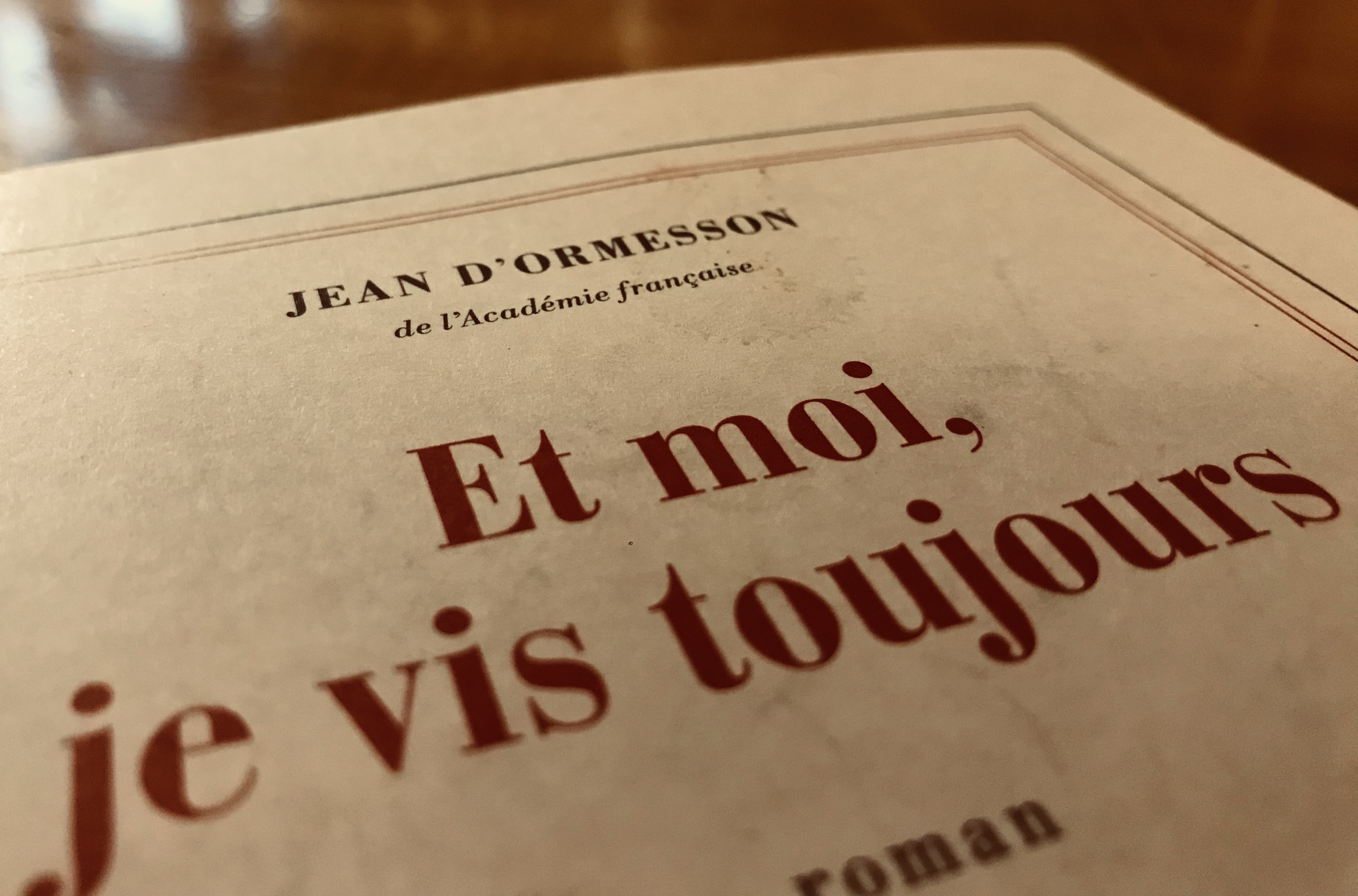
Unpublished article - Jonas Follonier
For a long time, I wandered in a dark forest. I was almost alone. Few neighbors, no friends. No parents, so to speak. I barely knew my mother, who had given me her milk. I didn't have much time to get attached to her. My father was never around. He went for walks, chased girls, fought and hunted.
Who is the «I» in this incipit? It's the «I» in Jean d'Ormesson's novel, published a few days after his death. And I'm still alive, This is an inevitably moving work, since the man was no longer alive when the book was published. The narrator embodies the role of history, being in turn a man who lived by gathering and hunting, a companion of Alexander the Great, a servant in a tavern on Mont Sainte-Geneviève. An idea, as always with the academician, at once childish, amusing and - it has to be said - a little heavy-handed.
I'm no longer up to the task. I'm overwhelmed by my own destiny. I see conquerors and emperors born and grow, decline and die. I become attached to some, I become attached to others. Passions, ideas and the wildest adventures spring up everywhere.
There aren't really any crazy adventures on these pages, because what Jean d'Ormesson tells us about are the great moments in world history, those that every intellectual knows by heart. The beginnings of philosophy, the fall of the Roman Empire, the Summa Theologica of Thomas Aquinas, the invention of the printing press, the quarrel between the Ancients and the Moderns, the wars of religion, the triumph of science, the rise of industry, progress, the totalitarianisms of the 20th century, and so on.th century. In short, nothing new under the sun. Nonetheless, Ormesson's travels are light.
Ravenna, liberated from Ostrogothic occupation by Justinian, is the place to look for the last traces of Roman grandeur that emigrated to Byzantium. Ravenna is a gloomy city, where the spectre of its famous banquet still looms large.
His «famous banquet»: it's easy to imagine Jean d'Ormesson saying this sentence aloud, especially when you have Laurent Gerra in mind, who always used to say, imitating the writer: «Chateaubriand? Mais j'ai très bien connu, Chateaubriand!» D'Ormesson himself laughed at this parody. He seems to have embraced and appreciated it, to the point of using this comic device for an entire novel, the last of his life. This novel is a general novel-world, but if you pay close attention to the text, you'll notice a few small pearls and courageous jabs thrown in by the former director of the Figaro:
In Troy, I was torn between Trojans and Greeks, between Achilles and Hector. In Arabia, almost two thousand years later, I hesitate between the friends and enemies of the Prophet. In his everyday, private life, Mohammed was a gentle, affable man, even-tempered and conciliatory. But when his God comes into play, he becomes ferocious. Islam is not a religion of love and peace, but of violence and war. War against infidels. But also war between Arabs and between Muslims. All Arabs, all Muslims, are brothers. But they are enemy brothers.
A welcome lucidity for a man considered a priori to be a smooth, mainstream author. We will also have smiled benevolently when, after explaining the relativism expressed for the first time in Europe by Montaigne, the narrator makes this little remark in the following paragraph, this time in the skin of a woman: «I was not connected with Montaigne. Ronsard, on the other hand-I don't want to boast, but I'm very attached to the truth-was a friend.» As you can see, Jean d'Ormesson chooses his heroes all the same, and his novel appears more like an intellectual autobiography than a history of the world.
Hope and anguish. Comedienne. Tragedienne. I'm capable of anything. I can take on any face. Boèce was me, and The golden donkey, was me. Troy, Carthage, Baghdad, Auschwitz, Dresden, Hiroshima, that was me, and Offenbach, that was me. Evil, suffering, death, that's me, and gaiety, that's me. The good thing about me is that I'm a consummate comic. What I like most of all is to laugh myself to tears.
An interesting read, which we finish with a tear in our eye. «Don't judge me too harshly,» History tells us, Jean tells us, on the last page. «I'm worth more than these random, patchy memories which, not content with seizing my voice, are, despite their ambition, just another book among the others».
Write to the author: [email protected]
Photo credit: Jonas Follonier for Le Regard Libre

You'll also like




 French
  German
  English