




Corrosion of the useful

Le Regard Libre N° 40 - Giovanni F. Ryffel
Since we've been living in the society of the spectacle, we've witnessed the trivialization of thought to such an extent that language, which is supposed to convey it, has itself become hackneyed. Words are used indiscriminately to signify concepts that are increasingly vague, but that sell well. The concept of utility, and the notions that go with it, suffer the same fate, all the more so as they are the spearhead of consumer propaganda that industries can scarcely renounce. Perhaps we can shed some light on the subject.
«I need a new iPhone!» says the young man who wants to look good in society. «You really need a new car! these are the adverts» injunctions. «He absolutely has to download the latest version of WhatsApp», comments the person who can't stand it when one of his friends can't be reached at all times. All these «must-haves» seem to suggest imperative needs, even necessities.
The influence of advertising on changing concepts
Today, we sell mind-boggling quantities of computers, programs, the most bizarre household appliances - there are even portable deep fryers! - on the pretext that it's useful; but in the way they present their product, salespeople have to make this usefulness seem like a necessity, because it's supposed to meet a need that we have - «or maybe not!» comes the common sense retort.
In reality, none of these objects is really useful in the strongest sense of the word. On the one hand, utility is not necessity, but neither is it convenience. Explanations: advertisements - and unfortunately, we ourselves - repeat that many products are useful, without stopping to consider for a moment what they mean. To sell them, they are even obliged to assert a presumed need for the product. This can sometimes go so far as to actually create the need, so that the necessity to buy the product is imposed. This is how «fashions» are born: a fashion is skilfully created, for example in clothing, which will generate a social context in which anyone who doesn't own a certain skirt feels excluded. A desire for revenge will follow, creating a negative feeling for which the geniuses of sales have already found the answer: a skirt similar to and above all accessible to the expenses of your social class, so that your wallet is emptied and your ego filled. And all this for a few brief moments, just long enough for the hysterical disease of wanting to look good to subside, until a new need is imparted or taught to me. In this way, the link between necessity and utility has been blurred, mainly for commercial reasons.
Now, if the acid of advertising simplifies and confuses the meaning of the word «useful» in its relation to necessity, this also has consequences for the links this word has with the notion of convenience; simply because in language, as in life, these notions are close and connected. Shifting the meaning of a word means that all other similar terms have to change their respective positions in relation to the void that has been created; in the same way that removing a player from a soccer team means that the coach has to change the overall strategy and the role of each player. So, in presenting useful objects as necessary, we lose sight of the fact that most of the time, these are merely convenient objects.
Is it useful or convenient?
Utility comes from the same origin as the word «tool», which is why all its meaning is linked to the notion of service. What is useful therefore follows in the wake of a hierarchy: what is useful is a means to an end. As a means, it is necessary for it to exist. Therefore, a certain utility, as the use of something to achieve the prescribed end, is necessary. On the other hand, the fact of using this or that other means, one more, the other less adapted to fulfilling their duty as means, is a matter of the greater or lesser degree of utility.
When the means to an end has the same utility as another similar means, but allows for secondary benefits - i.e. not directly ordered to the end we set out to achieve, but to other derived ends, which accompany the main end or process - then we can speak of convenience. For example, if I want to travel from Fribourg to St. Gallen - this is the purpose of my action - then there is necessarily a means to this end. But not all means are equally useful, since they are all more or less adapted to the main end. If the aim is simply to reach the city of St. Gallen from Fribourg, then I can say that the train is more useful than the plane, because the former is better suited to short distances within Switzerland than the latter. On the other hand, a train and a car are just as useful as my own legs or my bike.
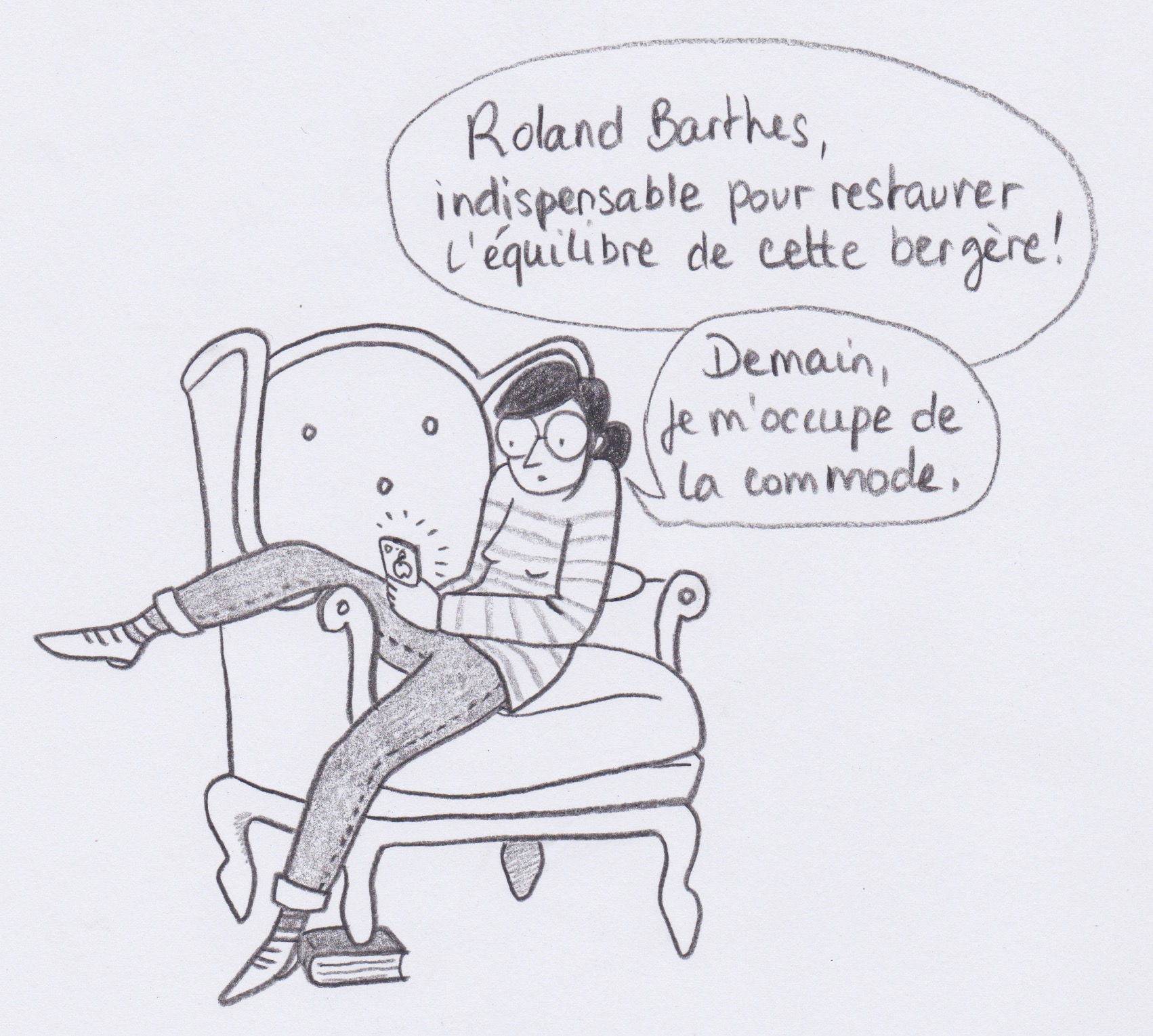
Drawing by Amélie Wauthier for Le Regard Libre
If means are equally useful, i.e. ordered to their end, then I can distinguish between the more convenient means and the less convenient ones. I will base my assessment on their ability to respond to secondary ends derived from the main end or process; for example, with regard to the process of going to St. Gallen, I can see that the problem of fatigue may arise: the train will then certainly be more suitable, and therefore in this sense more convenient, than a lead bicycle. As for a derived secondary purpose, we could think of the need for freedom of movement or physical exercise: the bicycle would then be more convenient than the train.
A question of justice
Now that we're aware of some of the deeper meanings of these words, we can combat the iniquitous «semanticide» concerning them. Getting to grips with the correct notion of words is very important in this case, because justice is at stake. Indeed, where we speak of utility, we always speak of choice, and choice means human freedom, commitment, responsibility for a result, positive or negative. We are responsible for the means we choose to implement to meet real needs. Necessity is what cannot not be. Thus, the need to drink, to eat and to live are all necessities to which we must respond by implementing certain means, the choice of which falls to us.
But we also have a responsibility to make choices about what is useful or even barely convenient. If justice is the virtue of giving everyone their due according to what they need to become what they should be - just as I need water to live and become myself - then it's easy to see that confusing these notions can only lead to a catastrophe that calls on our responsibility. Yes, because a veil of false beliefs stands between us and what is really «due» for there to be justice. Just as you don't need Word to write, let alone become Dante, Calvino or Bossuet rather than Keats or Camõeş, so the aboriginal populations had no need to know about bank accounts to live humanely and justly.
We're always further away from the essential, from what we need to be ourselves, with the excuse that what's useful or necessary is only convenient. Children no longer play with earth, wood and stones to train their intelligence with the senses, but play video games that require only the movement of their thumbs. A fine advance that structures the brain like that of a mollusc. At the heart of the question of utility, then, lies a question of freedom and justice.
This justice is killed with a little anaesthesia, easily obtained thanks to commodities: these are deeply addictive, and like all addictions, they create oblivion. It's easy to overlook the corrosion of the meaning of words, the assassination of their significance, which allows us to slip into the shadows leading to the belief that without an iPhone, we'll never be able to call someone; that Facebook is really useful for communicating with friends, even though the primary functions of the iPhone and Facebook are now minute. They have now been overtaken by the mass of functions that serve secondary purposes, such as finding out as quickly as possible where the nearest store is to do your shopping... necessary and indispensable.
Write to the author : [email protected]
Crédit photo : ©
You'll also like




 French
  German
  English
Leave a comment