




«On Chesil Beach», a drama that speaks to the heart

On Chesil Beach opens on breathtakingly beautiful tracks, with the warm timbre of a saxophone as the soundtrack. A jazzy moment between joy and melancholy, foreshadowing the musical dimension that will be central to the film. This English drama, directed by Dominic Cooke, is an adaptation of the 2007 novel by Ian McEwan - the same author whose novel My Lady was also brought to the big screen a week ago.
Read also | «My Lady, when a young Jehovah's Witness refuses a blood transfusion».»
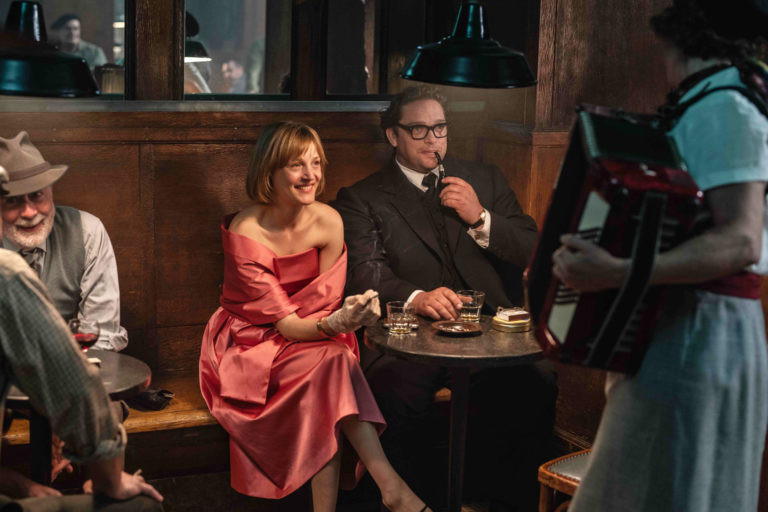
The film focuses on a young couple in England in the early 1960s. Edward (Billy Howle) and Florence (Saoirse Ronan) have just married and are about to begin their wedding night at an inn in Dorset. Both are equally inexperienced in love: it's a first, and the fear freezes the blood of Mr. and Mrs. Howle alike. The film, which can be understood in three stages, first gives us a glimpse of this tense evening, opening the doors to intimacy.
The Doors to Intimacy
It's all about the sexual intimacy of the newlyweds. And to get to the heart of this intimacy, the film doesn't need to show us any private parts: without us seeing anything, at least nothing juicy, it's their gestures, their looks, their silences, that make us feel their unease. Edward's mouth trembles when Florence suggests the name Chloé if they ever have a daughter. He struggles to find the words to take her to bed: «I love you. You're so... I have to kiss you.»
There's also a certain comic quality to this first part of the film, as in this dialogue: «You know what, I'd like to take your stockings off. - I think I'd better do it myself.» Edward smiles awkwardly. These intimate moments are particularly well done. Another example of comedy is the presence of the staff to serve the meal in the bedroom. The couple are uncomfortable; the waiters laugh under their beards. But as we soon realize, this slapstick comedy conceals a tragedy, and the viewer's laughter soon gives way to pity.
The intimate also manifests itself in this face-to-face encounter, which brings everything to the surface. Florence admits to Edward that he scares her when he gets angry. It's only in an intimate relationship, where the two people know each other, have to face up to who they are and tell each other the truth, that they can capture his feisty nature. In addition to the film's polished cinematography, this intimacy also manifests itself through memories: throughout the evening we witness a series of flashbacks we discover the past of the two lovers and the different stages of their encounter.
Florence comes from a wealthy family with old-fashioned values. The snobbery of this aristocratic circle is particularly evident in a very realistic exchange between Florence and her father about Edward: «And what does his father do? – A commoner or one of our own? – Something like that, yes.» Obviously, the answer is that Edward comes from a modest, rural background. His father is an elementary school teacher, which raises an eyebrow from Florence’s foolish mother. As for Edward’s mother, she lost her mind following an accident, which adds another dimension to the drama. The marriage of the two spouses is therefore nothing short of a miracle.
The crisis
But when the time comes to do what needs to be done, things don't go well and Florence, mad with rage, runs off to the beach. It's a crisis. The fear of sex has taken on such importance that it will be fatal for both lovers. This is the second part of the film: an argument that goes far, very far, not without some clumsy dialogue. By way of illustration, Edward calls his wife a slut: it's not clear what this adds to the film. Ironically, this lyrical use of the swear word «bitch» takes place on the beach.
We have to talk about the beach, since that's the film's title. We understand that it's this destructive moment for the couple that will be the climax of the story. The sea takes on an interesting symbolism, with the wind of argument, the waves of anger, the pebbles of finality and, soon, the foam of regret. Everything, everything will relate to this beach later on. But perhaps the moment that first makes a deep impression on the viewer is when the young husband, after a night of solitary drunkenness, returns home and his father, who understands at once, says to him, with the most apt sadness, «My God, my son.»
True love, tragic love
The film is first set in 1975. Edward, with his «hippie» rocker look from the seventies, has become a vinyl dealer. The scene in which a young girl buys him a Chuck Berry record is heartbreaking. It's a good thing the author of this article was alone in the theater: shedding such big tears goes back to the Flood. This is followed by an equally moving scene in which Edward tells his story to the babacools all around him: «Everything fell apart that night on the beach. And...» We'll leave the rest to suspense.
The film’s final scene, set in 2007, once again brings tears to the eyes. Although the makeup used to age the actors is clearly a flaw, emotion is truly the defining element of this final moment in the drama. It’s impossible to remain unmoved by Mozart’s sublime music, the tragedy of a life, and the injustice of reality. Only emotion can move us when faced with the Romeo and Juliet narrative, even if it’s the umpteenth time we’ve seen it. The passion between Romeo and Juliet is a great love and a tragic love. Great because it is tragic? Tragic because it is great? Perhaps both.
Write to the author: [email protected]
Photo credit: © Impuls Pictures

You'll also like



 French
  German
  English
Leave a comment