




Country in Johnny Hallyday's repertoire

Although it is rarely acknowledged or recognized in his body of work, country music serves as the backdrop to Johnny Hallyday’s repertoire. For anyone looking to make some wonderful discoveries, it’s well worth delving into this facet of the rocker’s artistry. Country music has always been a part of him, and it’s quite possible that Johnny’s artistic world can be understood through the lens of this musical genre.
«I’m a pop singer who’s been reshaped by rock »n’ roll,” Johnny Hallyday declared, in a well-chosen phrase, during a TV interview in 1974. But Johnny was more than just that. Johnny embodied a multitude of genres, which can be divided into two categories: the musical genres he adopted to please his audience, and those he truly loved and never actually abandoned.
Country music is one of Johnny’s favorite genres. First of all, we mustn’t forget that country music, along with rhythm and blues, is one of the roots of rock ’n’ roll, as the French rocker himself says in The Promised Land, Philippe Manœuvre's account of his 2014 American tour:
«Back in the day, country music was all about acoustic guitars and pedal steel. Today, they’ve electrified everything—guitars and fiddles. Country is the mother of rock »n’ roll and the blues. Even in the early days, rock ’n’ roll was a mix of country and rockabilly.”
Johnny was a true connoisseur of country music. Above all, he was a huge fan of the artists who dedicated their entire careers to this genre, with Garth Brooks at the very top. «I listen to Garth Brooks, but the French don’t really listen to country music,» Johnny Hallyday remarked to his buddy Philippe Manœuvre. That sentence says it all: if we don’t necessarily think of country music when we think of Johnny, it’s because it’s not a genre the French are particularly fond of. So Johnny didn’t make it a central part of his musical world. Rock mixed with French chanson—that’s what he has worn and which led him to ultimately performed. But be wary of career summaries; Hallyday sprinkled country songs throughout his entire repertoire—when he wasn’t releasing an entire album of them!
Two entire albums of country music
Johnny has released no less than two country albums. Country-Folk-Rock in 1972 and The Promised Land in 1975.
It all began with his meeting with Michel Mallory, who became his regular lyricist for about ten years. Mallory, who was just as passionate about country music as Johnny Hallyday, wrote an entire album of songs for him that delved into the American style they both loved. The result is an admirable, raw, and cohesive work, featuring gems such as My hand to the fire, Hello US USA (soundtrack of the film I gave it my all and composed by the boss himself!), Nothing beats that girl or Joe, the city and me. The atmosphere is exactly what one would imagine in the United States that Johnny fantasized about so much—the very same place where the singer received his musical education and which, like a brilliant magician, he in turn brings to life. In fact, he truly lived it to the fullest—in those parts, in that country music—as he recounts on RTL in 2013:
«When I'm driving my car and listening to country music, I really feel like I'm in the United States—you can really sense the wide-open spaces.»
Three years on Country-Folk-Rock, Hallyday and his lyricist Mallory are back with The Promised Land, an album recorded during their stay in Nashville. A delightfully clichéd album! It features backing vocalist Nanette Workman, whom Johnny had spotted performing with Joe Cocker—an artist he admires and who most certainly inspired his vocal style. He borrowed the song from Lee Lewis Got You On My Mind and adapts two songs by Kris Kristofferson. Above all, in this album Johnny accentuates all the clichés of the country music and the Western genre—he’s even wearing a cowboy hat on the album cover. And so the «I» in the songs urges listeners to «watch out for the Indians» and to «[take] your horses, your wife, and your kids» to venture out on the westward journey and the gold rush…
A very telling anecdote, relayed by Le Point, Johnny will force Nanette Workman and Michel Mallory to record their own albums on site. Passion passion passion!
«It was a wonderful time when Johnny lived only for music,» recalls Jean-François Chenut in the same article from the Point. However, despite the quality of this 1975 album, it didn’t really achieve much success, although that’s still commendable for a country like France, which isn’t particularly fond of country music. Hallyday, as he does so well, then followed it up with a mainstream album, just as he would do many years later with The Wait in 2012, following the mixed success of the rock 'n' roll and blues album Never alone (2011). The album is once again a monumental work, but country music has given way to French pop. It is Behind Love (1976), featuring the song of the same name, as well as other cult titles such as Don't play rock 'n' roll for me, Requiem for a madman and Gabrielle.
Read also | Tribute to Jean-Philippe Smet
While these songs enjoyed immediate success and a far greater posterity than the tracks from Country-Folk-Rock, this album is by no means a misstep in Johnny’s discography. An attentive listener will notice that, regardless of the era, Hallyday has always made a point of slipping country ballads or more upbeat folk-country songs into albums of a completely different style—ranging from blues to the smoothest pop.
For example, the pearl I cried over my guitar in the album I love you, I love you, I love you (1974), consisting entirely of ballads, William's America, present on the posthumous album, or The city of lost souls in Destination Vegas (1996), a sublime ballad that also appears on the remastered compilation Johnny History - Country (2012). When you really think about it, it’s precisely that variety that makes it possible to include a country song on a rock, blues, folk, or pop album.
When Johnny lets loose
There is musical value in this little-known selection of the roughly 1,500 songs (!) recorded by Johnny. Or rather, the appeal of «Hallyday-style» country music lies not so much in their music than their musicality. This is a very important point, as musicality depends, in a way, on the sonic and artistic atmosphere created by the singer. When listening to songs that are unknown to the general public, such as The Story of Bobby Mc Gue or Joe, the city and me, or better-known titles such as Nothing beats that girl, The Gold Rush or The Promised Land, you find the same vibe—that of a kid giving it his all to live out his own version of America. In his country albums, Johnny lets loose. Much like he was able to let loose, in a different genre, with the psychedelic blues on the album River... open your bed, released in 1969.
Read also | In 1969, Johnny Hallyday's psychedelic blues
In reality, he’s just one Johnny among many. Johnny Hallyday—and this was his strength—reinvented himself with every new era, embracing every musical genre, every attitude, and every physical look. He said so himself. One constant, however: his delightfully redneck side, which sometimes manifested itself through the America of the cowboys a belief he held until his death—sometimes through his love of simple things, even amid the greatest luxury, and sometimes through his risqué remarks bordering on sexism, which can be found in the lyrics of his country albums, of all places, and even more so in his stage presence. It’s not that Johnny didn’t love women. He just loved them differently than his friends did. Friendship meant everything to him.
What is Johnny getting at with these kinds of songs? He wants to put on a show, of course. He wants to convey emotions, too. But he’s also undoubtedly trying to stir up a hornet’s nest of “good taste.” It’s been said time and again, even here: Johnny has adapted to every era. But he’s adapted—no doubt unconsciously—to each era so that he can always remain at odds with it. Look at the wave of peace and love: Johnny, this anti-hippie, has always made fun of these oddballs. Just look at his latest collaborations with the hugely popular Yodelice: Johnny took the opportunity to play the good old rock ’n’ roll he loves. Playing with fashion trends to better draw people toward his first and true loves: that was Mister Johnny’s greatest strength.
Write to the author: [email protected]
You have just read an open-access article. Debates, analyses, cultural news: subscribe to support us and access all our content.
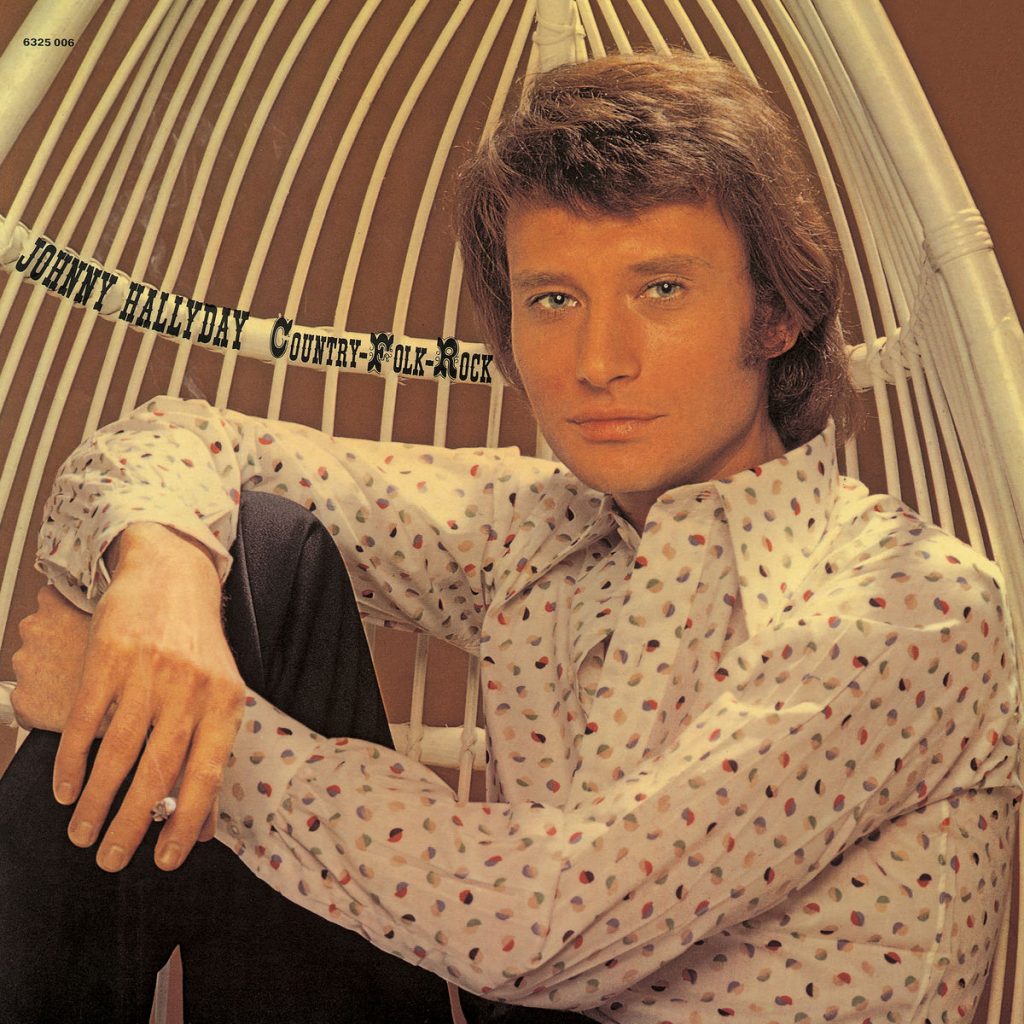
Johnny Hallyday
Country-Folk-Rock
Mercury
1972
13 titles

Johnny Hallyday
The Promised Land
Mercury
1975
13 titles

You'll also like



 French
 German
 English
1 comment
Thank you for this wonderful article. I enjoyed (re)discovering Johnny’s country music, and I shared “Joe, la ville et moi” with my students in preparation for Country Music Day, which is coming up in two days, on September 17.
Leave a comment