




«American Beauty, when love has no age limit

Cinema Wednesdays - Special edition: Love in the movies - Loris S. Musumeci
«Love has no age, it is always incipient.» Blaise Pascal
Sam Mendes is off to a strong start. In addition to the recent 1917 (2020) or the James Bond Skyfall (2012) and Spectrum (2015), he has directed a number of other films, all very good, including Les Noces Rebelles (2008) with the duo titanic DiCaprio Winslet. But his first feature remains his best to date. The year 1999 saw the birth of a brilliant director and a brilliant film in equal measure. American Beauty received the standing ovation it deserved, winning several Oscars, including Best Picture and Best Director.

And yet the film tells the most banal story of the average American family. With the exception that the main character and narrator announces in voice-over that in less than a year, he'll be dead. This main character is Lester (Kevin Spacey), the family man who introduces himself, again via voice-over at the beginning of the film, as those closest to him consider him: «My wife and daughter consider me a miserable loser.»
Read also: Uncut Gemsa loser with a winner's smile
From pitiful loser, scorned by his family and his boss at the newspaper where he has worked for fourteen years as a freelancer, Lester decides to become a "man of the people". winner. Stop the submission! Stop living a shitty life, with a shitty family, with a shitty boss, in a shitty little house, in a shitty neighborhood, with shitty neighbors. Lester wants to assert himself in front of his wife Carolyn (Annette Bening), while trying to find the girl he loved in her, and finally wants a little respect from his daughter Jane (Thora Birch), with whom he is simultaneously trying to renew a bond of friendship.
In short, Lester wants to finally start living. Free, happy, carefree and handsome. All because he's fallen in love with a dreamy teenager, Angela (Mena Suvari). Problem number one: Angela is Jane's best friend, which is kind of awkward. Problem number two: both girls are aware of Lester's passion for love - Angela, flattered, plays along; Jane, on the other hand, is so ashamed she wishes her father were dead. Problem number three: a series of misunderstandings that will mean that «in less than a year», Lester will be dead. Murdered.
A comic tragedy
American Beauty may tell the tragic story of an average American, but it doesn't shy away from humor. It's worth noting that the film is situated somewhere between an auteur film, for its richness in terms of artistic image work and symbolism, and a comedy, through the change in Lester's character as he awakens from a long sleep of slavery. The source of Lester's comedy lies primarily in the identification he enables the viewer to make. In the end, the rather silent, rather submissive, rather despised father of the family finds himself in the outright Lester. loser at the beginning of the film. And then he'd dream of daring to rebel like him. It's a real pleasure, and one that makes you laugh out loud, to see Lester violently throw the asparagus dish against the dining room wall so that his wife and daughter will finally listen to him. Or watching him play with a remote-controlled car in his living room, to the fury of his wife. Lester is comical insofar as he embodies so many men's dreams of rebellion.
The second source of comedy: obvious social satire. American Beauty doesn't denounce, but rather exposes the hypocrisy of a well-ordered family life and a happy, harmonious marriage, with a certain lightness that's not lacking in power. Indeed, the film's most hilarious sequence plays completely on satire. Carolyn forces her husband to accompany her to a business party for the real estate agents of which she is one. When the couple find themselves able to greet Buddy, the king of real estate, who becomes Carolyn's lover the very next day, she is ashamed of her husband; seeing her shame, he adds to it.
«Carolyn: Oh Buddy! How nice to see you! This is my husband, Lester.
- Buddy: Nice to meet you!
- Lester: We met last year.
- Buddy: Sorry, I don't remember.
- Lester: Oh, that's all right. I wouldn't remember me either.
- Carolyn: Oh honey! Don't be silly. (Nervous laughter)
-Lester: All right, my love. I won't play the fool. I'll do absolutely anything you want, just like a good husband.
(Lester grabs his wife's head, kisses her languorously, as Buddy and the others around them look on in embarrassment).
- Lester (with an inordinate grin): We have a healthy, harmonious marriage.»
The third source of comedy: misunderstandings. A series of misunderstandings and unspoken words, which are the direct source of Lester's murder. Here, the scenes in question are made comical through formal work. In particular, the alleged homosexual relationship between Lester and his young neighbor, who goes to school with his daughter. While he is rolling a joint for her, the play between on-screen and off-screen, with what we see and what we don't see through the windows, the neighbor's father, who is observing them, believes that his son is performing oral sex on Lester. The neighbor's father looks out his window to see what's happening beyond the windows at Lester's house. The scene is one of great skill. It also seems a clear and successful homage to Courtyard window (1954), a character who sees everything through his neighbor's window without seeing everything.
Beyond the comic aspect, there's the cinematography. American Beauty is as much a comedy as it is entertainment, as it is a film with a philosophical background, offering a reflection on American society, as it is a true auteur film. The integration of amateur camera footage is both innovative and daring. And it's an audacity that has paid off: the dance of the plastic bag under the amateur camera's gaze has gained a cult following. As for reflection, it's all about beauty. What is a person's true beauty? How can we really see it? It's also about life in the mode of the’American Dream. Which leads to the title of’American Beauty. It's American society, and indeed Western society, that is questioned, in its relationship with beauty, particularly the beauty of women, in its way of living enslaved to the ideal of an American dream that has instead turned into a nightmare.
The red that says it all
But at the heart of the film is love, and what it provokes. Not that the film is romantic; in fact, it's deliberately anti-romantic. Love is central in the sense that it is the film's trigger, that it occupies the role of the great deserter between Lester and Carolyn, that it offers itself up as a discovery for Jane, that it deceives and anguishes the Angela character, with whom Lester is in love.
Lester rediscovers his taste for life, and at last for real, thanks to or because of his love at first sight for Angela. In essence, the story makes Blaise Pascal's dictum its own: «Love has no age, it is always in its infancy». Lester is reborn by the passion that overwhelms him. In being reborn, he returns to youth; it's not for nothing that he's fallen in love with a teenager in her prime. Who, moreover, embodies the perfect model of the american beautyblonde, slim, young, superficial and, above all, a cheerleader.
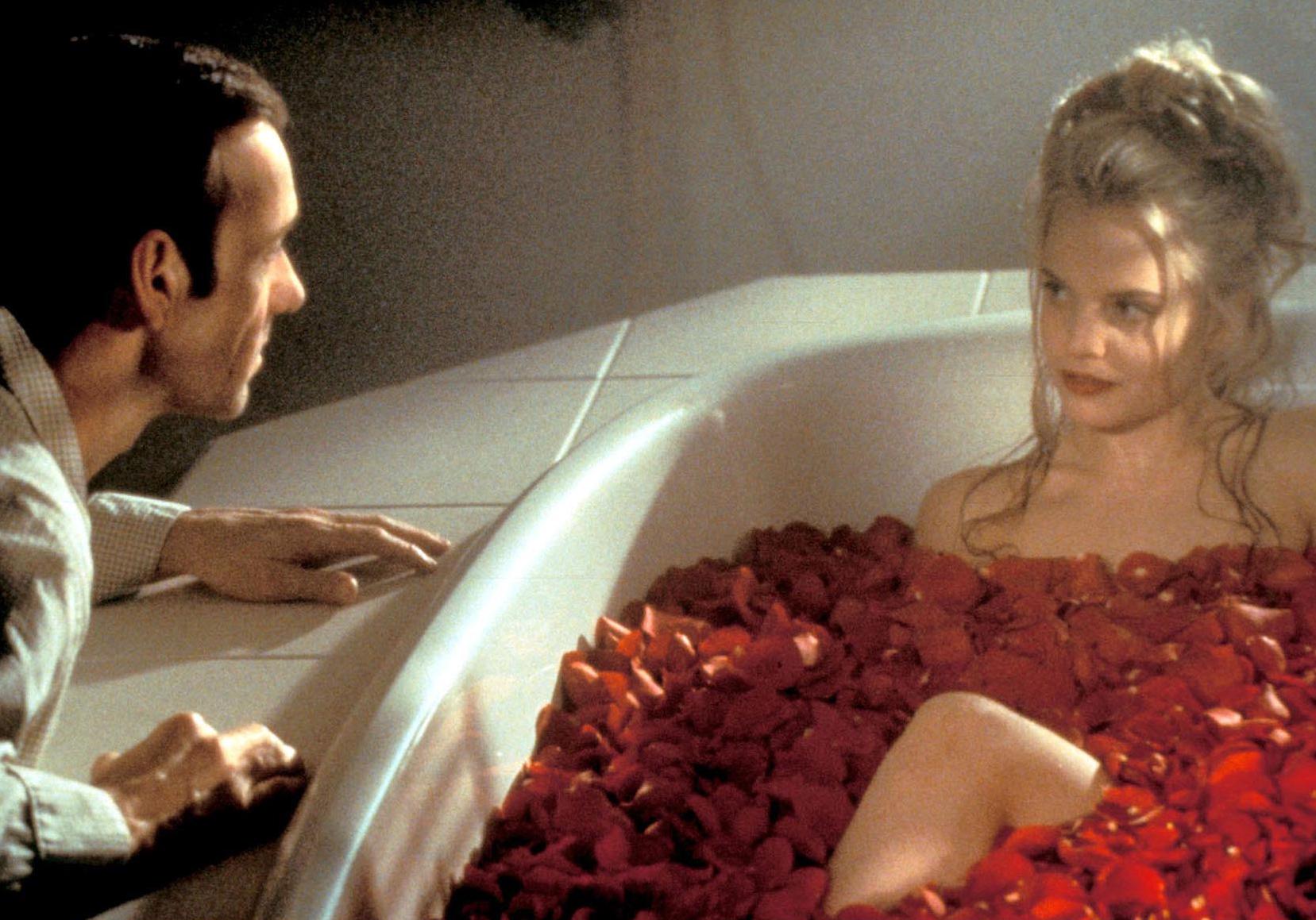
He falls in love with her when she dances. Originally, he had come to see his daughter. But the camera, internal to Lester's gaze, gradually shifts from his daughter to Angela. General shot of the dancers. Then Angela. Jane again for a moment. Then Angela. Last general shot. And Angela. Angela. Angela. The camera palpitates to the rhythm of Lester's heart. Only Angela remains. Then comes the film's red thread: phantasm.
The dreamlike sequence alternates between Angela, alone on the dance floor, and Lester, alone in the audience. He sweats with excitement. The dancer's gestures become increasingly sensual, and just as she's about to reveal her pretty, firm breasts, rose petals invade the shot. Phantasm is the thread red of the film, the love that beats within Lester fills his eyes with rose petals. red, and from the rose petals will come blood, always red, on a wall. The color red speaks for itself. Lester also buys the car of his dreams during his crisis. I don't need to tell you what color it is. The red of love, the red of rebirth, the red of death, recounts the last year of Lester's exhilarating life in his American Dream with his american beauty.
Write to the author: [email protected]
Photo credit: © Dream Works SKG
You'll also like



 French
  German
  English
2 comments
Ce film capture magnifiquement la complexité de l'amour à travers différentes étapes de la vie. L'idée que l'amour n'a pas d'âge résonne profondément, et les personnages en sont une belle illustration. Merci pour cette analyse enrichissante !
This reflection on love transcending the ages touched me deeply. «American Beauty» delicately captures the beauty of human relationships, no matter the barriers. Thank you for this inspiring article that reminds us that love can blossom at any time in life.
Leave a comment