



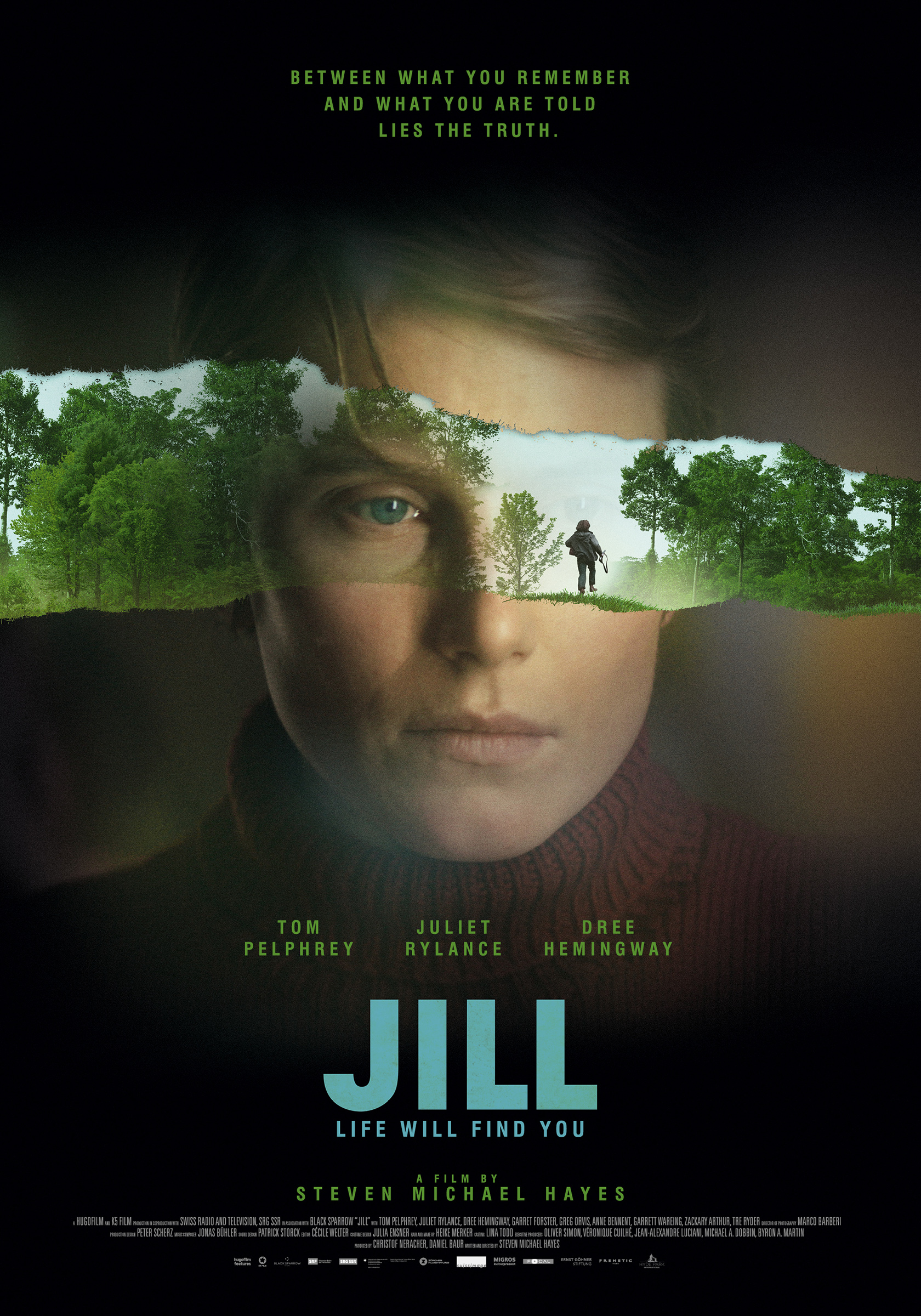
«Jill»: for radical nuance

Frenetic Films
Zurich-born Steven Michael Hayes' first feature film plunges us into the drama of an American family on the bangs of society. The film could have been a success in itself, but it goes beyond that.
When Jill (Dree Hemingway) receives a letter from her imprisoned brother, she sets out to understand how the idealistic paradise of her childhood could have turned into a nightmare. Tracking down her mother, she reconstructs the memories of a late 70s past, deep in a US forest. Surrounded by a demanding father, a supportive mother and four brothers, of whom she is the youngest, the child witnesses the gradual erosion of a home that gradually takes on the appearance of a prison.
In the footsteps of Terrence Malick
First and foremost, we must salute Steven Michael Hayes' work on this first film, which perfectly seizes the opportunity offered by this setting to deploy his style: a Terrence Malick heir style, with its floating camera, its wide angles to embrace its characters and, around them, nature. We also find a multiplication of points of view embodied by slow, introspective voice-overs. While this influence can sometimes be a little too pronounced, it never reaches the point of parody or disgust, thanks to a welcome restraint. We are bowled over by the filmmaker's ability to detach himself from his master, avoiding losing himself in an aesthetic that sometimes has no other purpose than to be admired. Here, every scene serves a plot and a purpose.
It's the same restraint that accompanies our characters. The mother, played by Juliet Rylance, She needs no dialogue to show her support for her children in the face of a sometimes tyrannical and violent father. As for the father, played by an excellent Tom Pelphrey, He always contrasts the terror of his anger with the pathos of his remorse. A violent father figure, yet unable to lay a hand on his children. Jill is an intelligent film, a film that pushes for nuance - a nuance that is paradoxically radical.
A compartmentalized utopia
If the film achieves these subtleties, it's also because it couldn't be any other way. The story takes the form of a conflict between a tyrannical father who rejects modern society as a whole in favor of a utopian return to nature, and his children who are increasingly attracted to the civilized world. A conflict in which the viewer is immediately invited to take sides. For while this natural space may be charming, the film quickly reveals its darker underpinnings: this utopian world is based solely on the detestation of civilization.
Read also | Midsommar, a horror festival
The father illustrates this throughout the film: adhering to conspiracy theories of all kinds (without being uneducated), convinced that «living together» is a permanent lie, unable to listen to the slightest politician without accusing him of corruption, he seeks only to enclose his family in the paranoia that gnaws at him. Utopia is a stronghold whose barricades sometimes serve less to cut oneself off from the world than to prevent family members from accessing it. Jill is a veritable open-air huis clos where the trees act as bars.
The critic's prism
Every film carries within it a discourse on cinema and Jill is no exception. Here, the stakes are built around the father, radically refusing to seek nuance in the world around him. This is how the film's discourse develops. That's why it multiplies points of view and gives a voice to each character. Like Rashōmon in the middle of the woods, he represents different perspectives on the situation and different ways of experiencing it. Above all, he captures a complexity that eludes his character's desire to simplify everything.
Jill gives a lesson in intelligent openness to his audience that critics in particular should not ignore. Let's face it: the modern critic, heir to the young Turks of the Cahiers, still far too often indulges in the easy pleasures of polemics. His radicalism is a comfort that only serves him, to the detriment of the film and his task. On the contrary, isn't being a critic about being sensitive to the many lights a film can shed? Shouldn't he distinguish the ones that shed the most light, and underline them? What's the point of choosing the prism of politics in Tarantino or the narrative scheme in Hong Sang-soo? It would be tempting to reduce Jill to the codes of drama, which the filmmaker reuses without question, sometimes falling into the most hackneyed clichés. But that would be to be blind to what this debut feature has to offer.
Of course, it is regrettable that Jill doesn't revolutionize the genre. It's also a little too rigid and dirigiste, anxious to tell us what to think of what it presents. And yet, above all, it's a rich film, inviting introspection and questioning, without ever trying to take the viewer for a ride. Through its theme, its narrative and its aesthetics, Jill has a rightful place among the works that seek to break down our barricades. So let him do it, because he does it well.
Write to the author: jordi.gabioud@leregardlibre.com
You've just read an open-access article. Debates, analysis, cultural news: subscribe to support us and get access to all our content!

You'll also like

 French
  German
  English
Leave a comment