




Gender and ethnicity: the danger of simplistic voter analysis
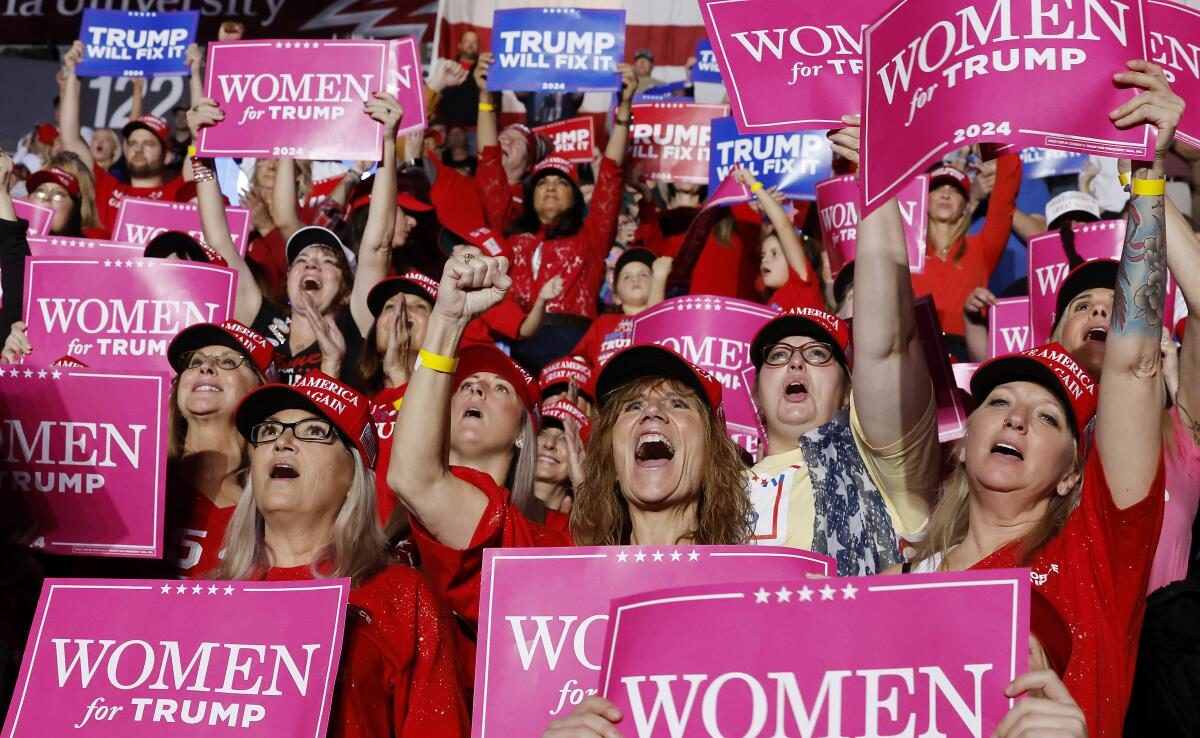
Donald Trump's female electorate. Photo: Chip Somodevilla (via Getty Images)
The electoral conclusions of 2024, marked by the election of Donald Trump in the USA, are still largely based on «identity» categories. This approach, far from being trivial, influences the perception of society and reduces the diversity of opinions.
«White people voted Trump. Women voted against him.» In the wake of Donald Trump's election last week, after a first term from 2017 to 2021, political commentators were once again plentiful in dividing voters along gender and ethnic lines.
And yet, when it comes to understanding a voter's motivations, there are many other possible categories: income level, profession, region, interests, consumer habits, marital status, and above all, political convictions. So why do we focus so much on ethnic origin and gender? Dissect the three most advanced hypotheses.
1. These data would be the easiest to collect
Perhaps gender and ethnicity are simply widely available data. Historically, censuses have favored these categories because of their accessibility and statistical clarity. They are easy to measure, which makes them simple benchmarks in social research and analysis. But are they easy to interpret? If this categorization exists out of habit or convenience, it could well give us a biased view of electoral choices.
Indeed, this vision often boils down to misleading shortcuts: when we say «white people voted Trump», this assumes that skin color is a determining factor in voting. In reality, these choices are influenced by complex factors that cannot be reduced to ethnicity or gender. We therefore end up projecting onto groups behaviors that could result from anything other than their skin color or gender.
2. These categories would have high predictive power
It would seem that gender and ethnicity are indicators with strong predictive power. In other words, by observing these categories, we could guess electoral trends with a certain degree of accuracy. For pollsters, using these criteria means taking advantage of data which, from one election to the next, has shown statistical regularity.
But correlation doesn't mean causation. If a majority of whites vote for Trump, it doesn't necessarily mean they do because’they are white. Again, this correlation may be the result of many other common factors within the same group. For example, in the 2020 presidential election, 65% of rural white voters voted for Trump, while 52% of urban whites supported Biden. Similarly, in 2020, 60% of white women aged 18-29 voted for Biden, compared with 55% of white women aged 50-64 who supported Trump.
The way we decide to categorize voters seems to reveal more about the way society thinks about politics and social groups, than about voters' actual motivations. By choosing to segment voters according to these categories, we neglect the singularity and complexity of each individual. Above all, we project a reading of the electorate that could in turn influence the perceptions and behaviors of these groups.
3. These categories reflect social inequalities
Another argument is that gender and ethnicity would best reflect unfair discrimination based on these criteria. This approach could, in theory, explain tensions in electoral choices, for example by showing whether certain groups are more supportive of a candidate perceived as racist or sexist. However, this idea has its limits.
Firstly, being white or Latino, male or female, does not define political positioning: you can be white and racist or non-racist, female and sexist or non-sexist. Categorizing voters in this way does not therefore directly indicate their values. What's more, even assuming that Trump is racist and sexist - an assumption partly disputed by his non-white and female voters - voting differences between ethnic and sexual groups are often small, and we can't rule out the possibility that other factors, common to these groups, account for these discrepancies.
Reducing electoral choices to these identities creates dangerous shortcuts. If we assume that Trump is racist and sexist, and that white people support him, we could conclude that white people are racist and sexist. This simplistic schema locks individuals into boxes and could reinforce the very divisions we seek to combat.
The self-fulfilling effect of identity politics
Emphasizing gender and ethnicity in electoral analysis helps to reinforce the idea of a society divided into distinct groups, who identify more with their ethnicity or gender than with their personal convictions. This self-fulfilling effect of «identity politics» has consequences: by dividing voters in this way, they are encouraged to identify with these categories, and political candidates in turn gear their discourse to these segments.
This reduction of voters to a series of identity groups is detrimental to public debate. If each group is reduced to visible characteristics such as ethnicity or gender, the diversity of individual backgrounds disappears, and democratic dialogue tends to be transformed into a confrontation between identity groups. This dynamic reinforces divisions within society, and prevents a more nuanced and universal reading of political choices.
By focusing on identity-based criteria, political analyses move away from a universalist vision in which everyone, regardless of origin or gender, participates in society as a free individual. Instead of seeking to understand voters as citizens, we reduce them to predefined categories. Obsessed with the fight against racism and sexism, we paradoxically end up reinforcing them.
Write to the author: [email protected]
You have just read an open-access article. Debates, analyses, cultural news: subscribe to support us and get access to all our content!
You'll also like





 French
  German
  English
Leave a comment