



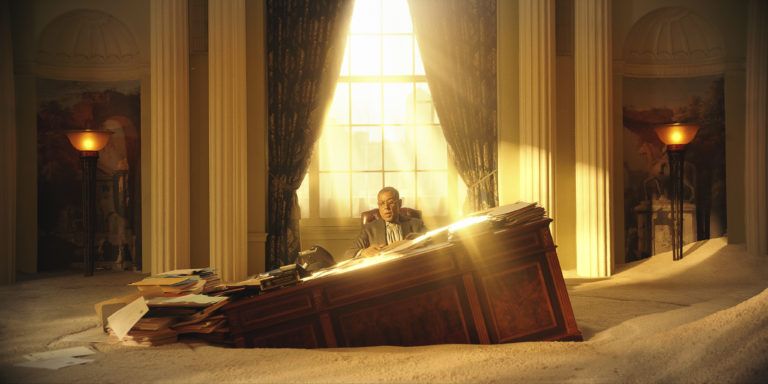
«BigBug: Jeunet short-circuits our brains

Bigbug © Bruno Calvo / Netflix
Cinema Wednesdays - Jordi Gabioud
On many occasions, Jean-Pierre Jeunet has been able to generate enthusiasm thanks to his expertise and radical choices. Thus, with the freedom granted by Netflix, many expected BigBug like a long-awaited plunge back into the director's strange and bewitching universe. Perhaps we were hoping for a great work, but the result is barely even a film.
In 2045, robots and artificial intelligence control every aspect of human life in a world ravaged by climate change. Following a glitch, a handful of humans find themselves trapped in a house in a peaceful residential neighborhood. They are aided by their domestic robots, who are also striving to become human. Here, technology serves not as a vehicle for reflection but for farce. Unfortunately, this futuristic visual trip is about a decade behind the times.
What is a movie?
It's impossible to talk about BigBug without mentioning the sense of dismay the film instills in its audience. Its radical choices plunge us into a daze bordering on conscious hallucination or a waking nightmare. What else could one be trying to achieve with these close-ups of actors just twenty centimeters from the camera, flashing their widest, predatory smiles? The unease works, but it’s stretched out over 1 hour and 50 minutes of film, nonstop, without a moment’s respite, without a shred of remorse for our mental well-being. Until we find ourselves wondering whether this film is actually a film at all.
First of all, the vast majority of the plot takes place in this living room, where we see the actors delivering their lines in a vaudeville-style tone, at times even more mechanical than the robots. The sterile sets with their garish colors are certainly meant to satirize the bad taste of our bourgeoisie, but they are forced upon us throughout the entire film. Above all, they serve no purpose other than as scenery. Sometimes someone sits on a chair, sometimes someone opens a book… We have to wait until the last third of the film to finally see a brief interaction between these set elements and our actors. Even the editing manages to make us question the nature of this film’s BigBug. The feature film regularly punctuates its sketches with a fade to black—a technique that would suggest it’s a typical Sunday evening TV movie, were it not for the fact that it was funded by Netflix.
And then there’s the writing! The challenge of getting out of this house quickly takes a back seat once you realize it’s just a pretext for a series of outdated skits. The tone of the sketches is set from the very first minutes with a robot that detects the sincerity level of a compliment or the percentage… of an erection. The characters, tirelessly embodying their caricatures, manage to pull off the fascinating feat of showing no psychological development whatsoever while occasionally undergoing sudden personality shifts. Thus, the divorced couple who never stop hating each other end up, without any transition, back together and ready to rebuild their family! Absurd!
It’s fascinating to note that in its structure, in the sequence of its sketches, in the sporadic appearance of a few uninteresting cameos, in its appalling pacing, and in its feel of a Sunday special, BigBug is very similar to the legendary Star Wars: The Holiday Special. Much more linear.
The Artist's Complete Freedom
Netflix’s strategy for attracting filmmakers in recent years has been to grant them full creative control over their works. It’s strange to see that a long-cherished fantasy of fans of their favorite filmmakers is so often called into question by critics: the mixed reviews of the latest films by Spike Lee, the Coen brothers, and David Fincher are said to demonstrate the importance of having a producer to steer the project. This argument reaches its peak with BigBug.
With complete creative control over his work, Jean-Pierre Jeunet has directed a film that, quite frankly, cannot possibly appeal to audiences. Its humor is too dated, its art direction too garish, and its poster and trailer too unsettling. And yet, Jeunet himself seems pleased with the result. This project, which has been in the works for several years and pitched to numerous production companies that systematically rejected the proposal, now exists and comes across as a true oddity that’s off the rails on every level. The result is just as hard to watch, and yet it does nothing to restore the producer’s reputation. Quite the opposite!
With BigBug, Jeunet treats us to a truly extraordinary oddity that explodes right from the opening minutes. It’s teeming with ideas that just don’t mesh. He fails without ever realizing it—so blinded is he by his own enthusiasm! No producer could have saved the film from such a magnificent derailment. In an effort to conform to the expectations of a few market studies, the film would have become nothing but more insipid. This dazzling failure would simply have been tarnished—and to what end? No! We can still celebrate the artist’s freedom in the same uncompromising spirit that Jeunet displays with his film, for it is so rare to still see films free to be wrong in their perception of the audience—or free to simply forget about it altogether… BigBug is one of the worst movies of recent years, but it has the merit of being sincere in its failure.
Write to the author: [email protected]
Photo credit: © Bruno Calvo / Netflix


You'll also like


 French
 German
 English
Leave a comment