



«Calabria», a return to oneself
Cinema Wednesdays - Hélène Lavoyer
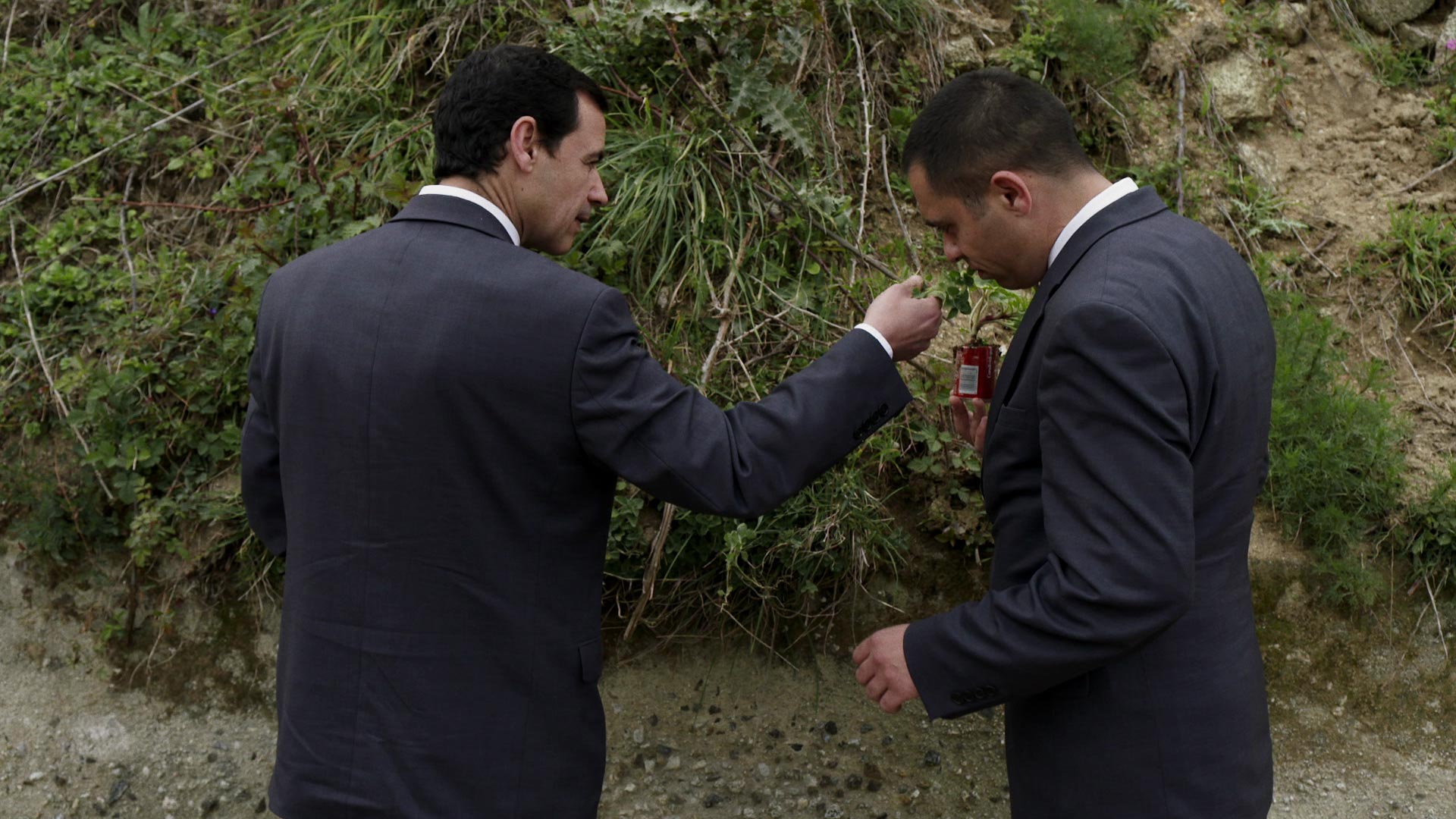
The repatriation of an Italian national from Switzerland, where he worked, to his native village in Calabria, provides the pretext for a story about an Italian man who was born in Calabria. road movie in which a dialogue develops between the two morticians responsible for bringing back the deceased. Jovan and José have emigrated to Switzerland, as has the Italian man they're bringing back to his origins.
One a gypsy and former singer in Belgrade, the other from Portugal, interested in culture but stingy with words, meet and exchange as the kilometers separating them from the cemetery dwindle. From service station to hotel, from freeway to country lane, the hearse creates a space of intimacy and trust, allowing a tolerant complicity to emerge, almost behind closed doors.
A journey through time
The director of Calabria, Pierre-François Sauter arrived in Europe at the age of eleven, and has first-hand experience of emigration. «The question of returning to the country where one spent one's childhood is something that interests me,» he declares in an interview for the festival Vision of reality. He adds, referring to the retired Italian immigrants he met: «[...] they said they would have liked to return to the country of their childhood, but they couldn't, so for them, it was after death. This component interested me because it's more a journey through time than a geographical one [...]».
As José and Jovan begin their journey, a surreptitious figure emerges: time. It imposes its existence on mankind, while demanding an end to theirs. In Calabria, temporality is dual: that of life, moving ineluctably towards death (or, for the deceased, towards childhood), and that of the journey, which must also come to an end. The coffin at the back of the hearse is a constant reminder of the passage of time, allowing us to savor each of the film's 117 minutes.
Sound comes before editing
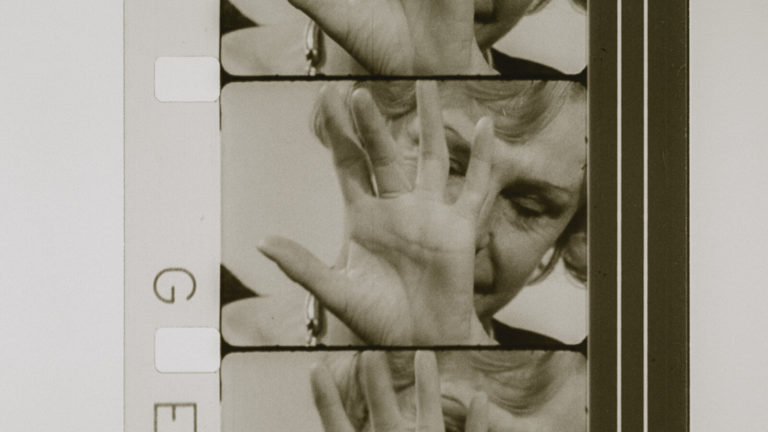
Equivocal, the beginning of Calabria is made up of archive videos of immigrants in Switzerland. These first minutes, a priori with no connection to the next two scenes, don't offer the viewer the security of an obvious hero in the opening seconds. He is subtly revealed, a silent, inert actor in the back of the hearse, omnipresent thanks to the impact of his situation.
The shots, most often wide and fixed, focus attention on what matters: the text, the characters and, in the case of a landscape, the rare movements that shatter its inertia. A way, perhaps, of representing life: strong, like the waves of the Italian sea, or fragile, like the ladybug moving gently across a bed of green grass... but always present, infinitely active.
The undeniably crafted sound establishes a space that is sometimes serene, sometimes heavy. In the hearse, the film's main - and moving - location, there are no radio broadcasts or music, just a muffled, round noise. Conversely, while the coffin is in the hands of the cemetery officials in Italy, the clattering and rusting of the coffin becomes increasingly important as it approaches its final destination.
Ethnographic value
The theme of travel, which is very present, is broken down into two main experiences: emigration and business travel. Although all three passengers have experienced emigration, it fades into the background and is not the subject of exchange between Jovan and José, who nevertheless discuss their biographies as well as philosophy and light-hearted topics.
Every journey, however unique we may believe it to be, is made up of stages common to all journeys; they have a beginning, an end, a reason for being, and they require a displacement (if not geographical, then spiritual). The stages of the journey are described in Calabria, of course, but there's an added quality: a change of scenery. Even more so for the viewer than for the characters.
Through the expression of their memories in French marked by their origins, or through the songs that Jovan sings in Serbian, Calabria conveys the normality and beauty of an intercultural encounter. Thanks to the care taken with the text and the time given to the actors to embody their characters, we notice a host of ethnographic details. It is in this respect that the film has impressed us the most.
Write to the author: [email protected]
Photo credit: © Le Laboratoire Central
You'll also like

 French
  German
  English
Leave a comment