




«Dunkirk» and the faces of war

Cinema Wednesdays - Loris S. Musumeci
A partner section of Cinérevue, NeuchVox's film program. Next live broadcast: Monday August 7, 2017, 8:30 pm - 9:00 pm
«This film is dedicated to all those whose lives were shaken at Dunkirk.»
The street is deserted. Only a few gunshots ring out in the deathly silence. Paper corpses flutter here and there. A young English soldier runs, alone. He makes his way to the beach to escape this bastion of defeat: Dunkirk. The Germans have taken the Allies hostage. Trapped like rats by the sea, 400,000 men await rescue, ’waiting for a miracle.«.
At the same time, British pleasure boats set out to free their soldiers; destroyers were not enough. Forty tiny kilometers divide the two coasts, but Axis aircraft bombs complicate the mission. It is in the air, therefore, that the third story of Dunkerque. A brave Royal Air Force aviator, almost out of fuel, flies around in a merciless battle to protect the boats and the beach from the enemy.
Games of Time and History
Director Christopher Nolan is known for his love of playing with time. Dimensional shifts in’Inception to the flashbacks in the saga The Dark Knight, this time he moves toward a «simultaneity of different durations.» Three parts, three chapters. I. Le Môle, II. The Sea, III. Air. Each of these segments covers a section of Operation Dynamo, which aimed to evacuate the encircled troops from May 26 to June 4, 1940. The viewer thus follows the young soldier and his comrades as they try to flee as quickly as possible over the course of a week; Mr. Dawson’s civilian boat for a single day; and the fighter pilot for one hour. Everyone recognizes the filmmaker’s mastery in this revolutionary technique of manipulating time. Time becomes relative—whether measured by the personal rhythm of a pilot on an urgent mission or that of soldiers slowly succumbing to despair on the sand.
Another issue, however, is far from unanimous: the historical focus. The French press is up in arms over the fact that its Resistance forces are virtually absent from the feature film. Les Inrocks, in particular, draws on specialized texts about Operation Dynamo. «To allow British troops to embark, 40,000 French soldiers held their ground against 120,000 Germans. ’They sacrificed themselves,’ insists Dominique Lormier, a historian specializing in that period and author of The Battle of Dunkirk (Tallandier, 2011).» And he complains: «The few references to the role of the French army consist of just two quotes. When Captain Winnant reports that ‘the rearguard is holding its ground; the French are protecting it,’ and when Major Bolton—who, like the captain of the Titanic refusing to abandon ship, decides to stay in Dunkirk to ‘help the French.’»
On Patriotism
In response to the legitimate tone of this criticism, there is the patriotism that fuels the film. Nolan does not so much seem to ignore the French as to depict, precisely, the selfless and courageous mobilization of a people for their own. And their love for their homeland. Commander Bolton, responsible for the fate of all 400,000 patient soldiers stationed along the shore, sings nostalgically of the homeland—so close, yet so far away.
Mr. Dawson himself never fails to remind his young crew that «it is our duty to save our own.» Such national fervor is bound to shock the leftists at Télérama – although it remains a benchmark in film criticism. «More troubling: the overly emphatic patriotic fervor when the valiant civilian flotilla appears. It’s almost as if the British national anthem were about to start playing at the end. A bit too much. »
The Anxiety of Sounds
From an artistic standpoint, the music plays a fundamental role in the unfolding of the plot. Almost constant, it does not display any compositional virtuosity. Its effect, however, evokes an inconsolable sense of dread in the audience. The violins are plucked at an ever-increasing pace; the double basses, in the background, give the repetitive melody an alarm-like resonance. The very sound of a bomb timer can be heard, deep and ominous, inside the plane as it fires its machine guns and abruptly dodges enemy bullets.
Furthermore, all of the film’s sound effects come across brilliantly alongside the music. One need only think of the roar of airplanes tearing through the sky. Or consider the simple, hesitant footsteps that add to the anxious rhythm of the hiding places in small, seemingly abandoned boats washed up on the beach. The most heart-wrenching sounds, however, are the soldiers’ final cries and breaths—at once powerful and fragile. Moreover, their wails bear witness to their innocent youth. To drown at the age of twenty. These sounds linger. They cling to your gut.
Meaningful images
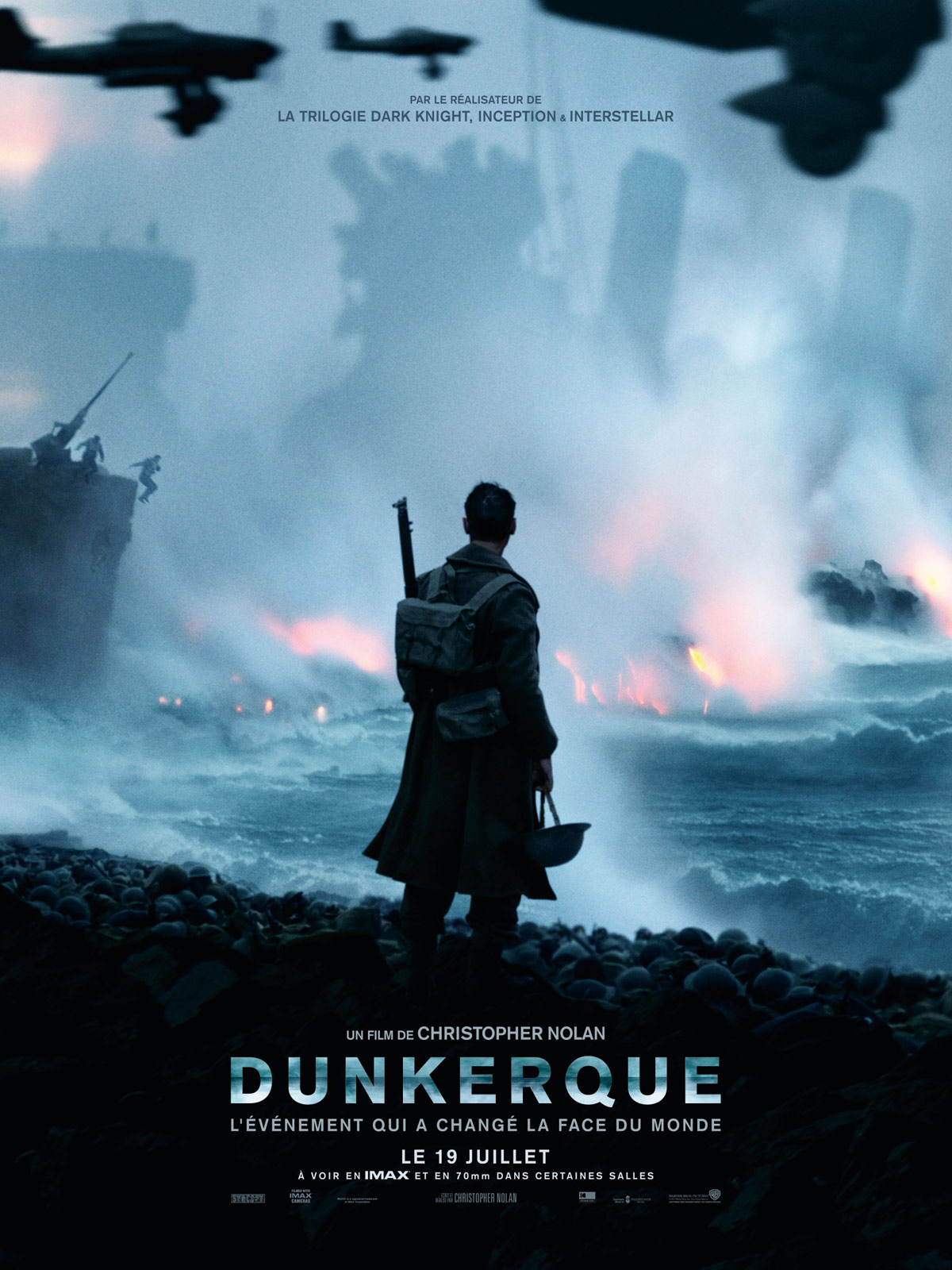
As for the cinematography, while there is no shortage of impeccable technical mastery, three techniques stand out as the most carefully crafted. The most common of the three is the extensive use of aerial shots, which offer sequences that are simply spectacular. More subtle is the very present connection between the camera and the face. On several occasions, when focusing on the main characters—who embody the emotional state of all their peers—the camera moves along an axis symmetrical to the character. The falls, grimaces, gasps, and desperate outbursts are all laid bare before the viewer’s eyes.
Finally, there is the alternation between the individual and the crowd. From the image of a single gaze, a panoramic view of thousands of helmets on the beach emerges. This approach speaks volumes about the reality of this war, where, despite strong patriotic solidarity, everyone is trying to save their own skin. Surviving—for oneself.
As for the cinematography, it employs two monochromatic filters that, first and foremost, make the film a pleasure to watch because of its beauty—even if it were a silent film—and that, secondly, carry a subtle meaning that imposes itself on the audience’s eyes, even subconsciously. Bluish tones dominate, blurring the line between sky and sea to highlight the similarity of the tragedy unfolding there. Furthermore, their omnipresence—lasting until just a few minutes before the end—emphasizes this sense of confinement. Liberation breaks the blue to make way for orange, accompanied by reddish hues—warmer, calmer, and healthier.
Dunkerque is set to be remembered as a great work. Admittedly, the reservations expressed about it are well-founded. Furthermore, the actors should not expect to make their mark in cinema with this film, as their individuality is so thoroughly subsumed in the service of the whole. Only the faces will remain, and the silences—which tell the story of war better than any words ever could.
«We'll fight to the very end.»
Write to the author: [email protected]
Photo credit: © lvdnena.rosselcdn.net
You'll also like


 French
  German
  English
Leave a comment