



«Pain», when the blur says it all

Cinema Wednesdays - Loris S. Musumeci
«What's certain, what's obvious, is that I can't imagine writing this text while I was waiting for Robert.»
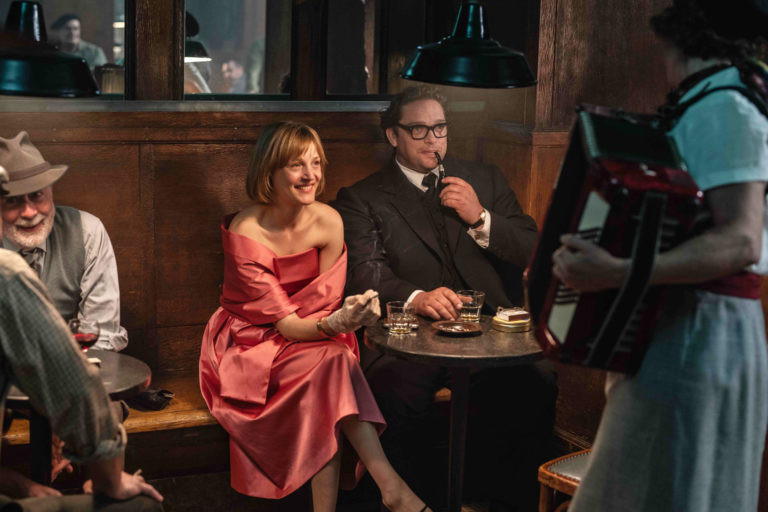
June 1944. Marguerite is a writer. She is waiting for her husband, Robert Antelme. A Resistance fighter, he has been arrested by the collaborators. In a Paris still occupied, the young woman maintains her commitment to the Resistance network. There, she works alongside Dyonis, her husband's best friend, with whom she seems to have a distant, ambiguous but sensual love affair.
To obtain information about Robert, Marguerite meets a French Gestapo agent, Pierre Rabier, whom she despises. He, on the other hand, seems seduced by her eyes, her handwriting and her mysterious air. Despite everything, he tries to get information from her about the Resistance network. She remains discreet and cautious, to the point of being sick with anxiety. «I'm his cop», she says to herself inwardly, when the fear leaves her and she thinks she's gaining power over the cop in question. Feeling threatened by each other, they stop seeing each other. What remains, however, is the agonizing, painful wait for a husband who may be dead, or alive; who may be loved, or hated.
The blur, a character in itself
Director Emmanuel Finkiel has adapted Marguerite Duras's autobiographical novel, Pain, without prioritizing historical fidelity over cinematic art. His work is rightly praised for the film. The choice of actors is a first success. Mélanie Thierry, playing Marguerite, carries in her very physiognomy the strength of a woman worthy of a Duras. Her jaw is wide and hard, her eyes sometimes absent, sometimes piercing. Her acting is impeccable. To a lesser extent, the other actors are also of a high standard. This is particularly true of the group scenes, where the dialogue falls flat.
The use of blur alone, however, recovers any possible shortcomings. The blur is, in fact, a character in itself, relentlessly guiding the viewer throughout the film, even when Marguerite goes astray. It makes Paris elegant, just as it marks the distance between people, the receiver being blurred by the speaker. It also creates an overwhelming nausea that leads to Marguerite's distraction and the agony of the spectator, who can thus touch, from afar, the experience of real pain, of Pain. The director masters this technical process with excellence.
The complexity of beings
The same applies to the duplication of characters through mirrors. For Marguerite, he doesn't hesitate to film two silhouettes in one, with different clothes and opposite attitudes. In this way, he exposes the subtlety of the human species, capable of living two lives, two thoughts, two states of mind, but in a battered body that is gradually being torn apart. With Marguerite, it's particularly the woman as an entity that is revealed in infinite complexity. Emmanuel Finkiel gives her pride of place. The pain the film deals with is placed in the hands of women. It is through their eyes that we sense the indifference of the gays, the solitude of the mothers, the hope that crumbles as they refuse to accept death while mourning it before their very eyes.
Pain, is not so much about war as about the human passions underneath it. What's more, the film shows how these passions are exported to times of peace, like a zoom-out ending in an aerial shot. Is human life tragic because there is war? It's because life is tragic that war comes," say Duras and Finkiel. With this observation, no one leaves the theater or the book unscathed. Anguish and pain stick to the skin.
«No more pain; I no longer exist.»
Write to the author : [email protected]
Photo credit: © Pathé Films
You'll also like

 French
  German
  English
Leave a comment