

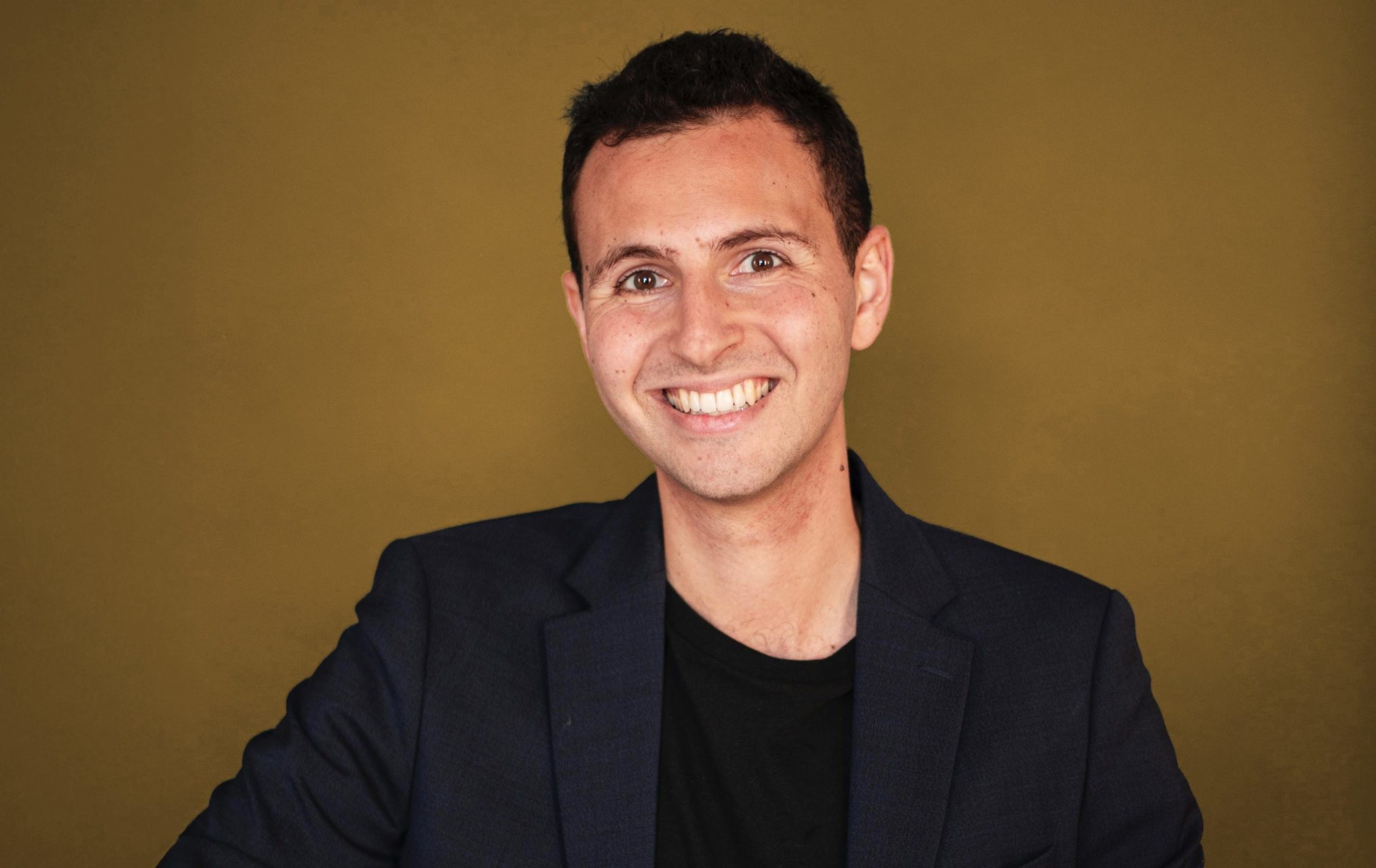
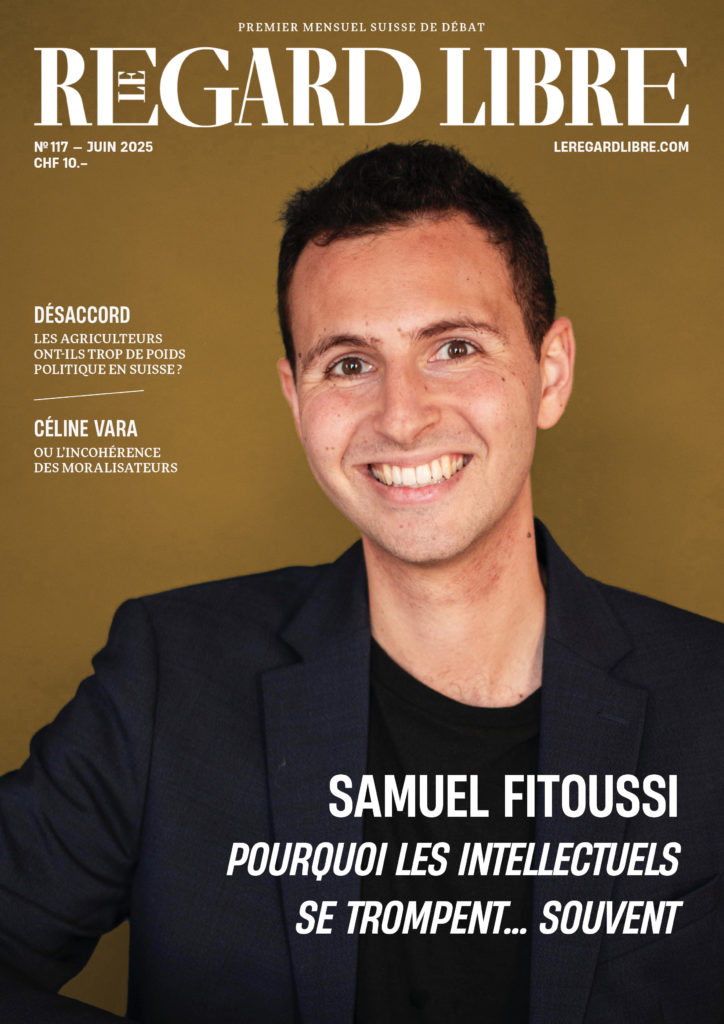
French essayist Samuel Fitoussi publishes Pourquoi les intellectuels se trompent («Why intellectuals get it wrong»), This is an incisive essay on the mechanisms that drive some brilliant minds to defend absurd ideas, with sometimes disastrous consequences.
Barely 28, Samuel Fitoussi has written a remarkable second book, drawing on cognitive psychology, sociology and the history of ideas. With a tone as rigorous as it is irreverent, he explores a contemporary enigma: why did so many intellectuals get it so wrong - particularly during the last century? And why do they continue, even today, to spread questionable ideas without ever paying the price for their mistakes? The columnist for Figaro spoke with Le Regard Libre.
Le Regard LibreThe author of the dystopian novel 1984, George Orwell, whom you quote several times in your book, argued that «some ideas are so absurd that only intellectuals can believe in them». What was he referring to?
Samuel Fitoussi: Orwell was right to observe that, under certain conditions, intelligence predisposes us to error. He himself paid the price. The British author couldn't find a publisher for his novel Animal Farm because it was an anti-Stalinist satire. The Western intelligentsia, he commented, had developed a «nationalistic loyalty» to the USSR. Even in the United States, major New York publishers refused to publish stories critical of post-revolutionary Russia, notably those by Ayn Rand. The same blindness applied to Nazism: Heidegger, Carl Schmitt and many academics actively supported Hitler. At the Wannsee conference, half the participants held doctorates. Later, the same elites became infatuated with Mao, including Simone de Beauvoir, who wrote an entire book in his honor. Fortunately, the intelligentsia didn't have the last word.
You explain that these errors are linked to a conflict between two types of rationality: epistemic and social. How do you define them?
Epistemic rationality is that which leads us to seek out what is true. Social rationality, on the other hand, makes us adopt the ideas that make us look good socially, i.e. those that are considered true by others. These two types of rationality are in perpetual competition within each of us.
You suggest that among intellectuals, social rationality often takes over. Why is this?
Firstly, their cognitive abilities enable them to rationalize any belief, even the most false ones: where others would come up against inconsistencies, intellectuals manage to construct sophisticated reasoning to defend absurdities. Secondly, their ideas form the core of their professional and social identity - to question them is to risk their reputation, their network, even their income. And, unlike other professions, they generally don't suffer the negative consequences of their mistakes.
What do you mean by that?
A baker knows immediately if his bread fails: he loses his customers. A pilot who accumulates errors ends up crashing and dying with his plane. An intellectual, on the other hand, can sustain absurdities for decades without ever paying the price. There are two reasons for this. Firstly, because his predictions are often long-term and based on complex chains of cause and effect, they are difficult - if not impossible - to invalidate empirically. Secondly, the criteria for evaluating these ideas are deeply subjective: even when the failure of Maoism was obvious (famines, repression, tens of millions of deaths), figures like Simone de Beauvoir continued to praise it, in the name of a higher ideal that was supposed to justify the sacrifices.
And I imagine that the more secure the environment in which we evolve - typically in the developed countries in which intellectuals evolve - the more social rationality tends to prevail over epistemic rationality.
Exactly. In a hostile environment, epistemic rationality is vital: your errors of judgment can cost you dearly, sometimes even your life. So, the more prosperous a society becomes thanks to rigorous ideas acquired with epistemic rationality, the more it begins to privilege social rationality... and to undermine the very foundations that made this prosperity possible in the first place.
What characterizes intellectuals, then, is not their ability to reach the best conclusions, but to rationalize any idea, including the worst ones. Why do the latter become popular, even though they run counter to epistemic rationality?
Because an idea can be socially successful without being true. For example, certain ideas, often collectivist, appeal to intellectuals because they give them a valued role: that of social engineers, charged with transforming society. They see themselves as the architects of a utopia. In a liberal vision, where society is the spontaneous result of voluntary exchanges between individuals, their role is more modest, often descriptive, which is less gratifying.
Is it just a question of power?
I wouldn't be so cynical. It's only human. When you have a job, you want to believe it's useful. The idea that progress comes from discovering the recipe for the good society gives meaning to the work of intellectuals. And, by definition, utopias offer this promise.
But there are also liberal intellectuals.
Of course. But liberal intellectuals, like Raymond Aron, are at a disadvantage in the «marketplace of ideas»: theirs are less seductive, less romantic. They are based on constant arbitration and necessarily unsatisfactory compromises. They call for caution and humility. It's less sexy than a great revolutionary promise. Why was it better to be wrong with Sartre than right with Aron? Aron's own answer: «The intelligentsia is not about to forgive me for not opening the way to the good society and for not trying to teach the method to get there.»
In your book, you evoke the concept of oikophobia - the opposite of xenophobia - which would explain the fascination of certain intellectuals with tyrannical regimes.
In the 1940s, Orwell was already denouncing the «Anglophobia» of the British intelligentsia. The left-wing intellectual, he observed humorously, would rather be seen stealing from a donation box for the poor than singing the national anthem with his hand on his heart. Roger Scruton, after him, spoke of the «oikophobia» of Western intellectuals, and regretted that British history was taught in schools as a series of crimes to be repented of. Yet it is the rejection of one's own culture that leads to the idealization of foreign regimes, including the most violent.
This critical stance towards one's own nation is a way of gaining prestige, particularly among left-wing intellectuals.
Yes, Steven Pinker proposes to imagine the intelligentsia engaged in a competition against other categories of the population in a struggle for moral prestige. In denouncing the society they inhabit, intellectuals describe politicians as incompetent, entrepreneurs as driven by selfish interests, journalists as irresponsible, the people as blind, victims of false consciousness, artists as carriers of pernicious messages, and past generations as failures. By devaluing others, by contrast, intellectuals enhance themselves.
Doesn't the right run the opposite risk of erring on the side of patriotism?
Absolutely, there are irrational reflexes on the right too - as we've seen with a certain fascination for Putin since the 2010s. Above all, I'm wary of the tendency to apply the same reading grids to all subjects, including economic ones, which can lead to serious mistakes. For example, being critical of immigration (hostile to the movement of people) does not automatically mean being against free trade (hostile to the exchange of goods). Today, however, some people, like the Trumpists, seem to be drawing a logical equivalence between the two positions. We must be careful to reason subject by subject, without adhering to a «package» of ideas that would correspond to those of one camp and that we would automatically approve of.
What emerges from your book is that intellectuals are more often wrong than «ordinary» people, even though this is precisely the opposite of what is expected of them. But is this really serious?
Yes, because these people have influence. Take the university: certain disciplines, particularly in the social sciences, come up with far-fetched theories - for example, that there are countless gender identities. In itself, anyone can believe absurd things. The problem is that the theses that come out of the university emerge with a «scientific» legitimacy that grants them a superior authority. Marginal delusions don't change the world, but the errors of the elites do.
If Donald Trump's recent election and the general anti-elite sentiment are anything to go by, it would seem that you're overestimating the influence of intellectuals.
This is not measured by electoral results. The intelligentsia disproportionately influence the direction their country takes, not least because they speak to those who have the power to redistribute public money, set educational priorities or shape public debate. Their influence therefore comes through channels other than the ballot box: the administration, public subsidies, cultural norms. Even when the majority doesn't vote for the elite's ideas, they can still prevail.
To alleviate this problem, you call for greater pluralism in universities. If so, should we be looking to recruit platists in geography departments? Shouldn't the rigor of ideas, rather than their diversity, take precedence at university?
I understand your objection. My idea is not to impose pluralism everywhere, at all costs. But in certain contexts, pluralism is a condition of rationality. Indeed, when a single idea dominates, the social cost of deviation is so high that everyone is psychologically encouraged not to seek the truth, but to rationalize the prevailing consensus. On the other hand, when all opinions are represented, everyone can choose their beliefs for their epistemic rather than their social value.
You also mention a common bias: that of confusing what is compatible with a theory with what confirms that theory. This error would explain why the information age is, contrary to what we might expect, fertile ground for reinforcing our adherence to profoundly erroneous ideas.
Yes, for example, some people believe that the existence of a hundred feminicides (understood as murders of women by their spouses) a year in France proves that we live in a patriarchal society. In reality, this sad statistical reality is compatible with the theory of patriarchy, but it is not a confirmation of it, because even in a non-patriarchal society, feminicides could still occur, simply because there is a minority of violent men. Similarly, the observation of instances of economic precariousness in the West is compatible with the hypothesis of a failure of capitalism, but is not a confirmation of it, since it can coexist with another observation (the significant reduction in poverty over several decades) which would refute the theory. Unfortunately, all we need to do is find an element compatible with a theory we like, and we believe it to be proven. This is one of the reasons why it's so difficult to change our minds.
Do you think the very structure of today's hyper-specialized university reinforces this phenomenon?
Yes, precisely. What we call «confirmation bias» isn't really a bias at all; it's well explained from an evolutionary point of view. Researchers Hugo Mercier and Dan Sperber show that, in pre-industrial societies, it was efficient for one individual to accumulate arguments in favor of his own position, while another individual did the same for the opposing thesis. Confrontation through debate then enabled the tribe to decide. Today, contradictory debate no longer takes place; everyone is stuck in a loop of eternal self-confirmation. At Harvard, for example, only 3% of professors describe themselves as conservative. This creates a breeding ground for irrationality.
Earlier you echoed the absence of «skin in the game», a concept popularized by Nassim Taleb, according to which intellectuals don't «play for their skin», and therefore don't pay the consequences of their mistakes. Should intellectuals be held more accountable for their mistakes?
I don't think we should punish them for their mistakes. That would be a slippery slope. But we should bear in mind that, as Thomas Sowell shows, those who don't pay the price for their mistakes are more likely to be wrong. Consequently, we must avoid entrusting them with decision-making power. Centralization, for example, takes power away from citizens or local communities, and concentrates it in the hands of distant, unaccountable bodies. Similarly, an elected politician can regularly be punished by the vote, while an anonymous civil servant can impose sometimes absurd or costly regulations, without ever having to face the consequences of his or her mistakes. Bureaucrats never play for keeps.
Another approach would be to organize ourselves in such a way that epistemic rationality is socially rewarded. Is this possible?
This is the objective behind the scientific method: to align social recognition with the search for truth. The mathematician who proves a theorem is valued. But in the social sciences, where there are no clear verification criteria, this alignment is more difficult. All the more so as we are often blind to the evolutionary objectives pursued by our brains: we are convinced that we are driven by the quest for truth (epistemic rationality), even when our reason directs us towards the rationalization of false and consensual beliefs.
You yourself belong to the class of intellectuals you criticize. What do you do to avoid falling into the traps you describe?
I undoubtedly fall into some of the traps I criticize! Irrationality threatens everyone. It's true, for example, that as a right-liberal, I mostly analyze the reasoning errors of the left and illiberal intellectuals. But my aim is to reason subject by subject, to adopt the ideas I deem right - and only then to see which camp this puts me in, not the other way round.
Do you think that politics necessarily pushes us towards irrationality?
To a certain extent, yes, because politics activates our tribal instincts. It institutionalizes the clan reflex. Jonathan Haidt shows that in politics, we become press agents: we don't reason to find out what's true, but to defend our team's beliefs. Politics pushes us towards post hoc reasoning and the automatic rejection of opposing arguments, even at the cost of a good dose of bad faith.
You end your book with a plea for freedom of expression, in which you are particularly critical of the fight against «fake news». How is this compatible with the search for truth?
The distinction between fact and opinion is often blurrier than we think. Those who claim to «defend the facts» sometimes have an ideological reading of their own. For a long time, saying that Covid-19 came from a laboratory was considered «fake news», or even a conspiracy theory - today, it's a credible hypothesis. What this demonstrates is that to decide that something is «a fact», and to legitimize the banning of discourse challenging this fact, is to grant exorbitant power to those who define what «facts» are - often a cultural, political or technocratic elite. But what I show in my book is that this elite is not only fallible - it is very often wrong, and sometimes very wrong!
Hannah Arendt said that «freedom of opinion is a farce if information about the facts is not guaranteed and if it is not the facts themselves that are the subject of debate».
Yes, and it's not just theoretical: if Galileo were alive today, he might be called a conspiracy theorist. Even the Gayssot law in France, which forbids denial of the Shoah, seems problematic to me. Not because I deny the Shoah - of course not - but because giving the state the power to decide once and for all what can and cannot be debated, even when it's an established historical fact, sets a dangerous precedent. One day, this power could be used to prohibit the questioning of other so-called «facts» - such as the idea that the West is «systemically» racist - since there will always be a social science study to justify it.
President of the Association Café-philo, Yann Costa is an editor at Regard Libre. Write to the author: yann.costa@leregardlibre.com
You have just read an open-access article published in our paper edition (Le Regard Libre N°117). Debates, analyses, cultural news: subscribe to support us and get access to all our content!
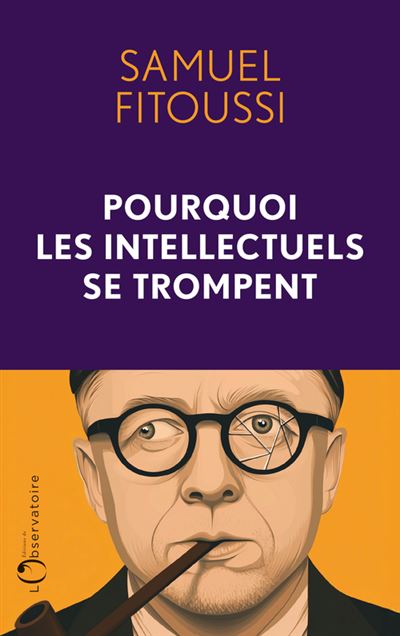
Samuel Fitoussi
Pourquoi les intellectuels se trompent («Why intellectuals get it wrong»)
The Observatory
April 2025
270 pages
 French
  German
  English