



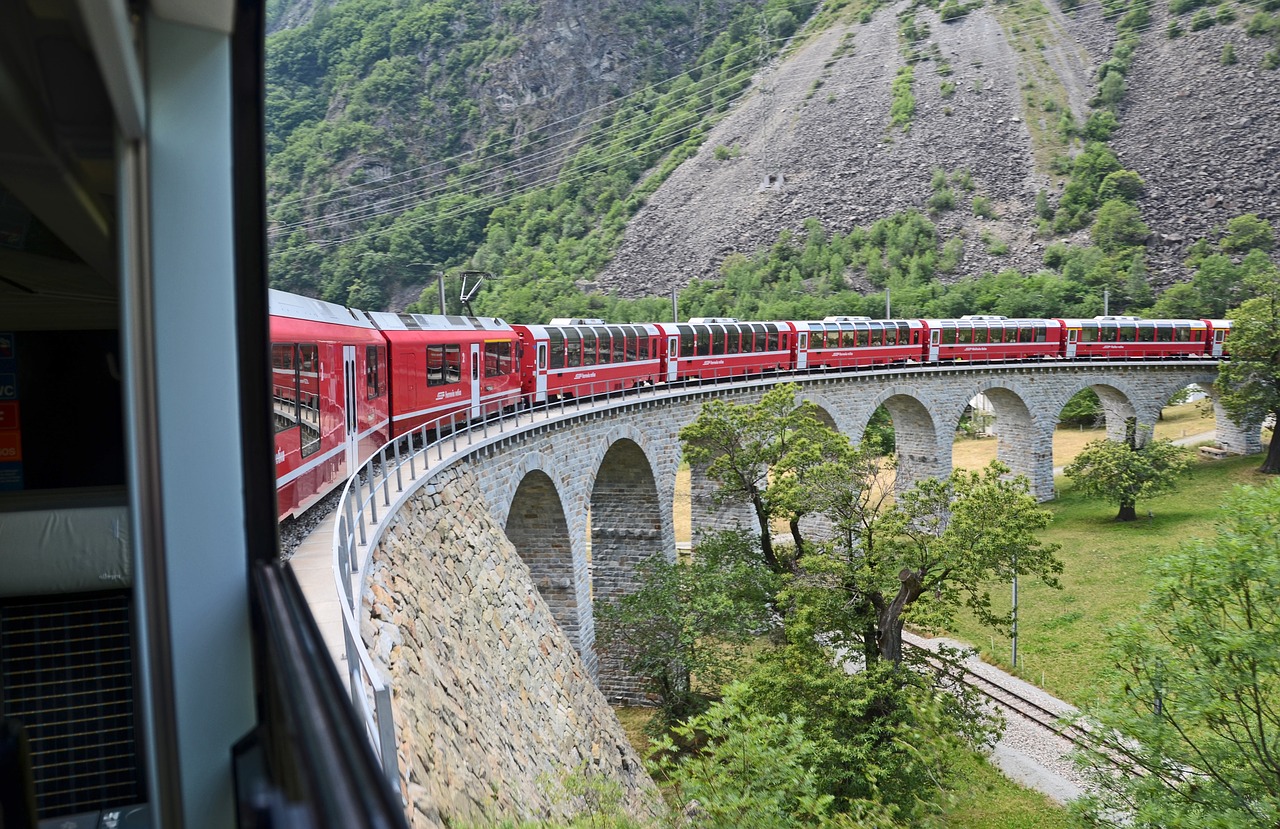
The train, a gateway to dreams
Le Regard Libre N° 48 - Hélène Lavoyer
A choice had to be made, and given the state of the world and current prospects, it was a no-brainer. Twenty-seven hours, a few minutes and twelve seconds. That's what the man in front of me announced, smiling down at me from his comfortable office chair. His expression was one of delighted and sincere astonishment, apparently pleased that I had chosen to travel by train from Neuchâtel to Oslo. While this decision may at first appear to be a waste of time or money, if it seems less convenient, it's nothing of the sort.
Nearly thirty hours would pass before we arrived. Why take the train? Because we had to. For me, at least. It is essential that our actions align with our words and thoughts. When our ideas and values do not support behavior that is consistent with them, it’s a free fall—a surrender to the world. Consequently, I had to choose the train. Indeed, the issue of transportation is more pressing today than ever before. More and more people, more and more often, are traveling across the globe and crisscrossing the skies, which are now constantly crisscrossed by the contrails formed by the jet engines of some of the eighty thousand or so airplanes they keep in the air.
Read also: Why deny reality?
In Switzerland, however, the trend toward air travel for private trips is one of the most deeply entrenched in the world, partly due to the continuing decline in airfare prices and the wealth of a segment of the Swiss population. Particularly among those aged eighteen to thirty-five, the desire to enjoy newfound independence and financial freedom—which is still largely unencumbered by expenses related to a family or a home of one’s own—appears to be a natural response. This is the time when «you have to live life to the fullest» because «time flies.».
The «EasyJet Generation»
The first trips we dreamed of taking are formative—whether with friends, alone, or as a couple. Yet the «EasyJet generation» may be wary of the aviation industry (and not just the airlines low-cost): In Switzerland, the aviation sector accounts for nearly 15% of total greenhouse gas emissions. Nearly one-sixth of emissions from a single sector is undoubtedly enormous. However, the message behind these figures is not that we must «stop all air travel.» As Florian Egli pointed out in an interview with swissinfo, «There are important occasions that fully justify taking a flight.»
There’s no denying that there are important opportunities, and we’re not questioning here that travel is a joy and an enriching experience—quite the contrary. What we’re arguing against here is the sometimes irresistible urge to breathe a different air; setting out to work, study, or immerse ourselves in a different culture; reconnecting with—or even meeting—people in a part of the world that is unfamiliar to us—these are just a few of the reasons that drive us to leave our hometowns to experience other lands, and see other streets and landscapes.
But when it comes to spending a few days in Europe—and trips that «only take» three or four days are very popular with young people—the environmental cost isn’t listed on the bill; it remains a subjective consideration, a little voice in our heads that isn’t quantified. Ultimately, the fares offered by airlines like EasyJet carry much more weight—and take a smaller toll on the wallet – than the Interrail pass costing two hundred seventy francs and change offered by the SBB for five days of travel across Europe. While trains in Switzerland remain an expensive mode of transportation, a host of other benefits—which we’re all too quick to forget—are directly associated with them.
The Joys of Traveling by Train
Although most of us today are convinced of the genuine urgency of the climate crisis and are concerned about the demographic, social, and economic consequences it portends, it is crucial to ask ourselves what other beauty—besides that of the eco-friendly gesture—train travel offers. We must recognize that many wonderful activities can be more eco-friendly without becoming a burden, and above all, that making the effort to change our habits does not mean restricting our comfort, freedom, or the opportunities available to us.
«Happy is he who, like Odysseus, has made a wonderful journey.» So wrote Joachim du Bellay in his collection of poems Regrets. When reflecting on this sentence, the concept of travel takes on a very interesting meaning. Indeed, it’s hard to imagine that what Joachim du Bellay is referring to when he thinks of Odysseus’s journey is simply his stay in Troy—his point of departure—and his arrival in Ithaca—his destination. No, the journey that Odysseus undertakes—one that was eventful and beautiful, and whose story gave rise to an entire ancient imagination—begins with his departure from Troy and ends with his arrival in Ithaca. Thus, it is indeed the crossing, the journey itself, that gives the journey its full meaning.
In an age when Phoenician round ships, galleys, and horses are a thing of the past, the options available to us have completely transformed the very essence of travel—the journey itself, which takes us from our starting point to our destination. The train still offers us that luxury—the feeling of setting out, of watching the kilometers pass by as the landscape gradually shifts before our eyes. There’s no need to arrive at the station an hour early—unless we feel like reading a newspaper while enjoying a cup of coffee—nor do we need to worry about the contents of our bag or any prohibited items it might still inadvertently contain.
It’s impossible not to think about the symbolism the train has come to embody as it has become increasingly intertwined with our daily lives. While it was a revolution in its own right in our physical world, it is no less significant in our collective unconscious; the train evokes new beginnings and—given the large number of passengers it can carry—shared journeys. Not to mention that the ability to eat, reply to emails, use a cell phone, or even read and walk around inside its carriages makes the train a space in its own right. A place on the move. Unlike an airplane, where freedom of movement is reduced to a minimum, and unlike a car, which forces the driver to be behind the wheel—and unlike “soft mobility” options that don’t allow for such long journeys—the train offers the opportunity to rest.
His passenger isn't bothered by the wait. He's on his train. He'll get there, to his destination. The real fear that haunts this traveler isn't that of possible accidents or his CO2 but to miss the right track. Even if the train pollutes, even if a trip between Neuchâtel and Oslo takes nearly thirty hours, it leaves room for daydreams and offers a chance to stretch one’s legs. It may be less of a source of fantasy than the airplane, high up in the sky, which has allowed humans to fly. But its safe rails and down-to-earth nature ultimately offer a chance to dream—something our fast-paced modern lives sometimes sorely lack.
Write to the author: [email protected]
-
 Le Regard Libre - N° 48CHF10.00
 -
 Standard subscription (Switzerland)CHF100.00 / year
 -
Support subscriptionCHF200.00 / year
You'll also like





 French
  German
  English
Leave a comment