




«I am capable of creating a very beautiful work», April 1950 - October 1957
Le Regard Libre No. 25 – Loris S. Musumeci
Auspicious Days (4/6)
The family is growing with the arrival of Marie-Noëlle, the youngest child. And that’s not all. «I’m capable of creating a very beautiful work,» the third chapter of Happy days, which covers correspondence from 1950 to 1957, opens the door to new literary gems. Corinna Bille and Maurice Chappaz increasingly exchanged thoughts on their readings. They also began a sublime correspondence from their travels. To be savored without restraint, letting the writers’ own words speak for themselves.
Family: From Worries to Joys
«Achille is such a lovely companion. He never bothers me for a moment. He sleeps, he eats, he plays—it’s a dream. He’s always happy with everything. Today, I took him for a walk along the bisse all the way to Plan-Praz. What a joy it was for him to splash in the water with a stick, throw little pebbles, and touch the reservoirs—I sat on the grass and looked at the blue tufts of gentians. »But don’t worry, I keep a close eye on Achille, even when I’m working nearby. Don’t worry.”
After Blaise, the eldest, the family grew with the birth of Achille in 1948. Achille’s arrival was met with less anxiety than Blaise’s. Corinna was now well-practiced. She managed, with varying degrees of ease, to balance motherhood and writing.
Still, an artist needs freedom and time off to devote herself to her work. Leaving the two boys with their father, she heads south to the seaside to recharge. Le Pradet doesn’t really welcome her alone; Corinna is already carrying her first and only daughter.
«I'm going to listen to and watch the sea; I never get tired of it.".
Our third child was rocked by the waves.
»I send you all my love, my dear Maurice."
Despite his mother's absence, baby Achille is doing just fine. Maurice, for his part, is discovering—without any fanfare—just how infinitely precious his children have become to him.
«He wants to see the cars and the animals, but he’s a little more hesitant to touch them. I haven’t noticed anything particularly striking about his life: he drinks, he eats well, he laughs. I still think his emotions will be very intense and that he’ll likely have a tough time later on. I don’t know why, but I still think these children will be a blessing to me.»
The whole family is here. Just as she did with her eldest son, Corinna includes all three children in her correspondence with her husband. Each one gets their own message for Dad.
«Achilles: Ha, Dad, Dad, Ha!"
Blaise: His final wish: to have a lighthouse on his nose. His final question: How are scepers made?
Marie-Noëlle: »papapapapapapapapa" »
The children’s inclusion in the letters is not merely innocent and gratuitous sympathy. Maurice is rarely present. Corinna suffers because of this—for herself and for her little ones. Her beloved, though a bit rough around the edges, is not indifferent. His conscience reminds him of his role as a father, but also of the genuine gratitude he owes to the woman who cares for Blaise, Achille, and Marie-Noëlle every day.
«I’m writing you a quick note: not only am I trembling, but you seem so regal and gentle to me when, far from you, I turn inward. I curse my own naturally rough and anxious disposition, even as I feel more and more that I really should take all of you on a cruise around the world.”.
I really need to get more involved in my sons’ education: they should learn music, play an instrument, and play sports.
»I think that you're giving them a very noble dream, and that it will show in their thoughts or their demeanor."
Literary Exchanges
Nevertheless, parents still have interactions that are just for them and between them—namely, their romantic intimacy and the books they share.
Maurice is more into the classics.
«I read about ten of Voltaire’s letters every night before going to sleep. They’re clear and lively—he’s a fanatic, but a fanatic for tolerance. I think of your father and I laugh when he talks about the Jesuits and the little black tyrants of the Pays de Gex.»
Corinna, for her part, indulges languidly in more alternative literature.
«I also became fascinated by a man named Joseph Day, a student in Virginia at Moïra »A remarkable novel by Green. And now I'm rereading Edgar Poe's short stories in the La Pléiade collection."
«Here, since there's practically no life (except for the children's), I lose myself in dreams and books. Did I tell you that I got really excited about The Bewitched Wanderer by Leskov? It's a really beautiful book. I've also reread What I've Learned »by Colette, because it interests me."
Travel, travel
The most rich and captivating part of this collection of letters is the section that recounts their respective travels.
«Then, I boarded the train to Marseille with a sweet young woman from Basel who was terrified of traveling alone and of being mistaken for a victim of white slavery!… What intense joy that night brought me. I couldn’t sleep. I gazed at the moonlit landscapes, listened to that strange voice coming from the loudspeaker at the train stations, those chimes… In Valence, the delicious iced chocolate, then the red dawn over the Arles plain, finally the tall maritime pines, the day breaking over the garrigue, the beautiful Étang de Berre, then the sea, the boats, and Marseille.»
Corinna discovers the south of France: its sea, its tranquility, its people…
«The people I love are ordinary folk—fishermen, small farmers, and laborers—all at the same time. They’re fervent communists, by the way. In the fall, they go hunting for partridges, hares, and rabbits in the great forest of Pierrefeu in the Massif des Maures. They go to every festival (every festival in every village here lasts five days) and dance just as well as our dancers at the Rhône festivals; among other things, the »valse du Midi” with its small steps; my head spins when I watch them!… It’s terrifying. They think that in Switzerland everyone has blue eyes. I tell them that where I live it’s warmer than here, that there are cicadas, prickly pear cacti, lots of vineyards, but mountains so high they stop all the clouds. I don’t tell them that the people of Anniviers are a bit like them; which is perhaps why I understand them so well.”
… her vibrant life.
«Last night, I listened to a wonderful jazz concert by a young group from Toulon performing on Radio Monte-Carlo. Some of the pieces were really excellent. And the child dancers were remarkable. They played an old tune:
I'm looking for Titine
Titine, oh Titine!
I'm looking for Titine
»And can't find it."
Maurice is invited to Sicily. He travels there with his friend Eric Genevay to translate ancient texts for publication.
«It's nice here, too. We're staying in two small rooms on a rooftop terrace, and as soon as the weather clears up, we translate Virgil while basking in the sun and looking out at the sea.»
«I walk around Syracuse along the sea. I never tire of watching the waves. On a windy day, we were surrounded by white foam. I watch the stray cats, families sitting all alone in a square on straw chairs, children playing with coins. I’ve seen fishermen dipping their nets into barrels where crushed pine bark was simmering in boiling water.»
Sicily, a cradle at the crossroads of cultures:
«Everything blends together strangely—the past and the future: the rocks thrown into the sea to protect the island are Spanish; the castle belongs to a Greek condottiere from the year 1000; the songs sung by a young boy and the manuscripts in the library are Arabic; the houses on the square at the edge of town bear the name of a marvelous German prince, Frederick II of Swabia; the beautiful statue of a woman is Athenian, and the faces of some of the men at the harbor are Carthaginian and African, while the coats of arms featuring elephants are Roman—the very walls where I’m smoking my cigarette, and I haven’t even mentioned the monuments yet.»
A truly beautiful work
Both Corinna and Maurice are struggling to write and publish their works. In pain, she must bring the final part of her novel to fruition. Venus's Clog. He inspires her with sincere encouragement.
«Weariness, melancholy, hope"
Keep up the good work, Fifon (Editor's note: Corinna's nickname for Maurice) »to the few pages left in your book. Succeeding in this will be a great benefit to your life."
«I want you to be able to write and have a good time, and for real books and real children to come from the two of us.»
But family life takes precedence over a good mother's work.
«Anyway, I take care of people, I cook—I’m constantly on the go, except for the few moments when I write pieces that will earn me a little money. I always write with joy, as if it were my greatest pleasure, my way of existing, of fighting against the world.”.
»Big hugs to you, and the kids send you big hugs, too."
Despite the very particular difficulties faced by Maurice, a perfectionist, in completing his works, confidence and hope prevail. It took him ten years to write his collection of poetry Testament du Haut-Rhône. When it was published in 1953, the writer set out on a new journey into the depths of Valais. He shared these few words with his sweetheart:
«But I’ve already told you this, and I still feel it deeply: I’m capable of creating something truly beautiful—something greater than I sometimes realize when I limit my ambitions to Valais or French-speaking Switzerland.»
Putting the very meaning of his entire existence into it.
«I feel weary, and the struggle to write a new book seems to me to be nothing less than the struggle for truth and the right to make a meager living.»
The third chapter of Happy days ends with this «struggle» as its central theme, in Corinna’s story.
«So I’ve decided, to save myself, to go back to my writing and my books, and to worry less about everything else—which only brings me sadness, since I’m still being scolded on top of it all.”.
That's what gives me hope.
Marie-Noëlle will stay in Le Châble for a few more days.
Come back as soon as you can, because I love you, dear Maurice,
»Your Fifon"
Write to the author : [email protected]
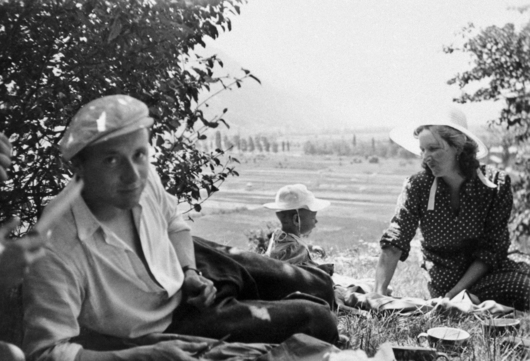
Image : Maurice Chappaz et Corinna Bille, avec l’un de leurs enfants (© www.cavesa.ch)
You'll also like



 French
  German
  English
Leave a comment