





The «Nouvelles bucoliques» of writer-peasant Jean-Pierre Rochat

In seventeen short stories, a country narrator describes the world around him. Horses, goats, village schoolmasters, disappointed loves, peasant life: the author takes us into a world that is gradually disappearing. A funny and touching collection that reads at top speed.
In 2019, the Prix du Roman des Romands was awarded to a singular personality in the literary life of French-speaking Switzerland. A writer-peasant or farmer-writer: Jean-Pierre Rochat. His prize-winning book Little Mist and published in 2017, described the last day of a farmer who, having gone bankrupt, is forced to attend the auction of all his goods and animals. A tragic novel about a fact of life experienced by some farmers...
Horses and men
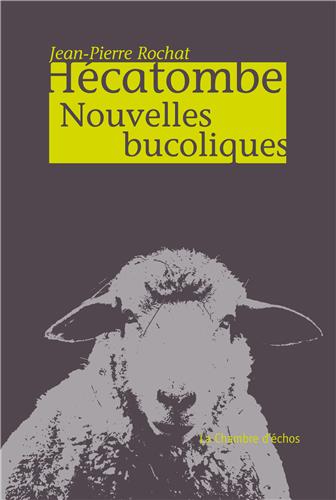
At the same time, the writer who lives and works at the Bergerie de Vauffelin is rather a fan of the short story. And that suits him just fine. I'm not a big fan of this genre myself, but I got into the swing of things when I read Hecatombe. Bucolic news, a collection published in 1999 by La Chambre d'Echos. It's a bit Les Bucoliques of Virgil, but with Ramuz handling the writing and narration. And less haughty, too.
«The son came out of agricultural school, came to his old man with new, modern ideas, profitability-productivity, he said: - Listen Dad, if you want me to stay, if you want me to take over the farm, you've got to modernize-rationalize-rendering it profitable, otherwise, I'm out of here, I've got other proposals, forty-hour week, vacations, and so on. So, the first thing to do is to get rid of those horses that take up three times as much time as the tractor, eat as much as cows and take up a lot more space.»
It is with these lines that Draft horses, The story of one of the collection's short stories, in which a son «fresh out of agricultural school» wants to modernize the family farm and force his father to get rid of his beautiful horses. The father, bruised by this request, will reluctantly part with his precious companions of life, work and even family. For Jean-Pierre Rochat, the love of horses - and animals - is a religion. The author himself is a horse breeder and occasionally takes part in carriage races. They are to be found almost everywhere in his work. As if to symbolize the beauty of nature and freedom. And perhaps even love. Who's to say?
A concern for orality
«Another jolt, I find her again twenty years later, ten or fifteen years older, the same, brighter than ever, all real in my dream. I discover Tristessa of Kerouac and even though he's far above me, he stole my squaw, it's really her, her hair has grown back, her arms are tattooed all along the veins.»
In «writer-peasant», there is «peasant», worker of the land, but also «writer». And not only does the author write, he also reads a lot. His mentor? It had to be Charles-Ferdinand Ramuz! The first to claim the right to write in his own language (to «write badly», as he put it). If I wanted to draw comparisons, I'd say that Jean-Pierre Rochat is a bit like our French-speaking Arno Camenisch. The peasant-writer does a hell of a job on orality, trying to capture this language of French-speaking Switzerland which, full of twists and turns, remains difficult to transcribe into writing. In Café de la Poste, The famous café-bistro we've all been to once, with its barroom reflections on Swiss men marrying «Môriciennes».
Hecatombe. Bucolic news, is a collection that focuses on small moments in life: a child’s attachment to his little goat, a child’s romantic fascination with an Indian girl in the circus, the life of an Italian immigrant as an outcast, Firmin’s trip to the dentist, a farmer experimenting with acid, and so on. And these are small-scale tragedies. The stories do not all necessarily end with a physical death, but rather with the disappearance of something or someone. In my view, Jean-Pierre Rochat captures, with humor and authenticity, the disappearance of a world—the world of the past, where people took their time and cherished nature, people, and simplicity.
«Trains are good partners for life, faithful, regular, even if they stop more, keeping their contents in their bellies, ladies en gentlemen, They stay in their dining cars and don't even see the sign, the kiosk or the station buffet.»
Photo credit: © Ivan Garcia for Le Regard Libre
Write to the author: [email protected]
Jean-Pierre Rochat
Hecatombe, Bucolic news
The Echo Chamber
1999
96 pages

You'll also like





 French
  German
  English
Leave a comment