



The insignificance of forgotten little people

In several surveys conducted on Facebook, here and there within literary groups, obscure or luminous, elitist or popular, deserted or teeming, anarchic or measured like a Swiss clock, Pierre Michon's name systematically gallops back into the top ten most adored writers. And considered with, as an example, his work Tiny lives, This is the famous aroma of forgotten existences that move us to the point of tenderness. But why does the name Pierre Michon keep cropping up, the daily bread that we're all so desperate to get our hands on?
Before answering, it's important to know that these Tiny lives are a series of eight ignored, forgotten existences, names that have fallen into disuse, no longer ringing in any ears, no longer evoking any memories. These unsuspected lives, swept away by death or disappearance, are linked to Pierre Michon (the supposed narrator) only by blood or by encounter. And using one of the powers of writing - that of bringing the past back to life, breathing life back into it - Pierre Michon infuses these lives with words, so that they breathe again, blood circulates, and dead skin is warmed. And to commemorate memories, making abundant use of fiction when memory isn't enough, imagining what might have been of such and such, of his ancestor Antoine Peluchet, for example, banished by his father and disappeared, whose only tangible proof of his passage here on earth remains a relic preserved in an old cookie tin. Pierre Michon remembers this relic, as he remembers other primers that readers will discover as they read the book:
«The relic is a small cookie Madonna and Child, sovereignly inexpressive beneath a glass and silk case that conceals, in a sealed double bottom, the minute remains of a saint. This object followed to me the path I have described, and married all these names; and all the names I have described are attested here and there by the steles of the cemeteries of Chatelus, Saint-Goussaud, Mourioux, invariable under the great sun and in the frost of nights; and all the variable flesh that inhabited these names called upon the relic when they had to grapple with the essential, when in its living nest the being collides with itself and from this collision appears or disappears, when it is necessary to be born and to die.»
Made-to-order souvenirs
Perhaps if these Tiny lives have had - and continue to have - such an impact on French-speaking readers, it's because each of us, in these eight successions of lives recounted, explored in depth and re-appropriated through words, finds ourselves in them, selfishly and intimately, fantasizing (through a mirror effect) once the book is closed, about a relic of his own family, on which to set the living scene of a family tragedy or sparkling happiness, consolidating the past through intuition, repainting walls as he goes, filling memory gaps with magnesian cement. As we know one day and forget the next, we create memories on command to remind ourselves and the truth about what was.
From the little people and villages of France
And if Pierre Michon's bread is so sought-after, isn't it because it's a country loaf, crusty and golden as is the French custom? These Tiny lives are those of rural people in the Limousin region, at the beginning of the twentieth century.th century, in the Creuse department. In other words, these are the hard lives of little-known people, living in little-known villages, at a time when women, like Elise for example, looked after and tended households, from the cooking pot to housework, sweating under their aprons while the men sweated under their hats in the fields, baling hay or herding cattle. So Pierre Michon's ancestors are not so different from our own, because country life is still country life. Some dream of making their fortune in faraway lands. Others stay, tear each other apart, do violence to each other, appease each other and love each other madly. But everyone lives, and in the evening, when sleep commandeers our bodies and lowers our eyelids, everyone dreams.
«The wind blows over Saint-Goussaud; the world is certainly violent. But what violence has it not endured? The merciful ferns hide the sick earth; bad wheat, silly stories, cracked families grow there; from the wind the sun rises, like a giant, like a madman. Then it fades away, as did the Peluchet family: so it is said, when the name ceases to be associated with the living. Only tongueless mouths can still utter it. Who lies obstinately in the wind?»
Style
Finally, what we like about Pierre Michon's work is surely the same as the others - we could say a Proust, an Aragon, a Bobin, a Duras, an Ernaux or a Despentes (dare we use a catch-all term) - it's the singularity of his writing and the boldness of his style. In these Tiny lives, The sentences are strung like pearls on a bride's necklace. The writing is the work of a goldsmith, imperious, precious, pigmented and fragrant. The semicolon serves as a point of attachment, giving rhythm and vivacity to the descriptions, and the occasional parenthesis serves to contain the narrator's doubts. Of course, there's also a polished vocabulary and a powerful, natural poetry capable of anything. Poetry capable of embracing the poor, the rural and the viper under the bramble. Poetry capable of weighing down, on the scale of human lives, the insignificant heaviness of forgotten little people. And isn't this insignificant heaviness, this human weight, this featherweight, ultimately as heavy as a sacred anchor, clear proof that all life is important?
«He stroked little snakes very softly; he was still talking. The cigarette butt burned his finger; he took his last puff. The first sun hit him, he staggered, held on to tawny dresses, handfuls of mint; he remembered women's flesh, children's looks, the delirium of the innocent: all this spoke in birdsong; he fell to his knees in the overwhelming signifiance of the universal Word. He raised his head, thanked someone, everything made sense, he fell dead again.»
Write to the author: arthur.billerey@leregardlibre.com
Photo credit: © Babsy/Wikipedia
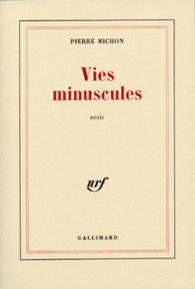
Pierre Michon
Tiny lives
Editions Gallimard
1984
224 pages
You'll also like




 French
  German
  English
Leave a comment