



«C'est la lutte finale», between text and images
Tuesday's books - Ivan Garcia
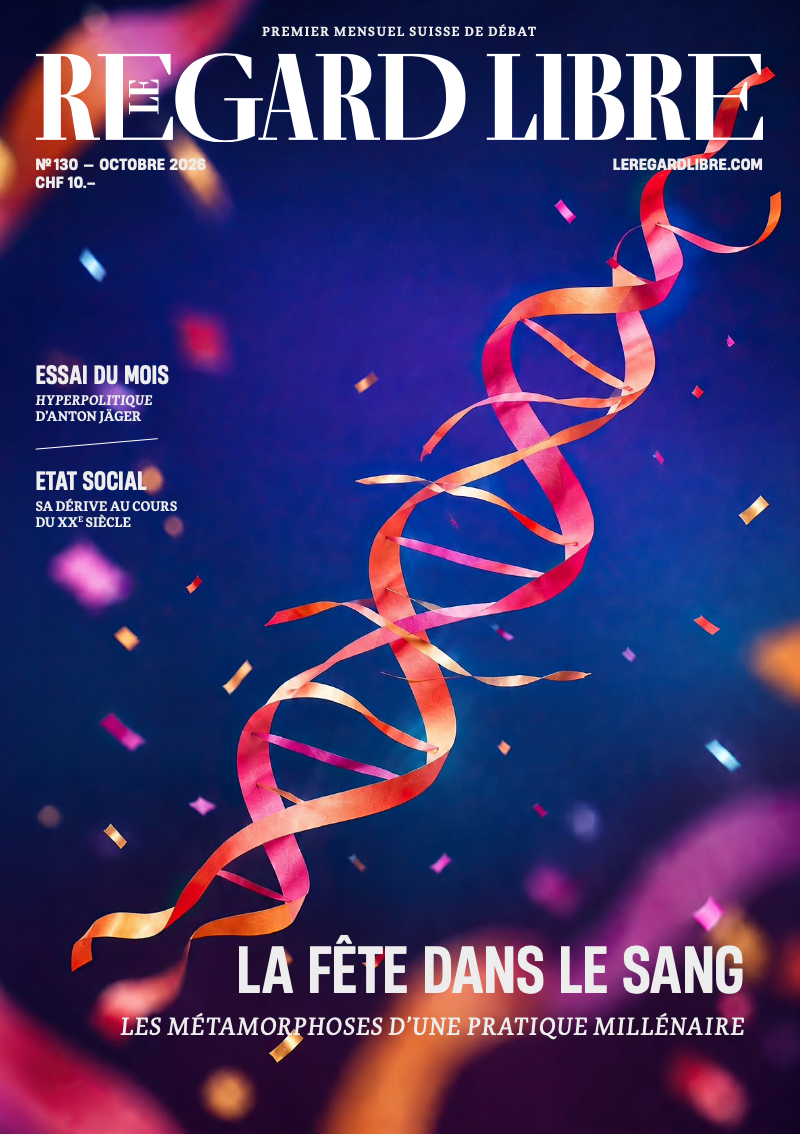
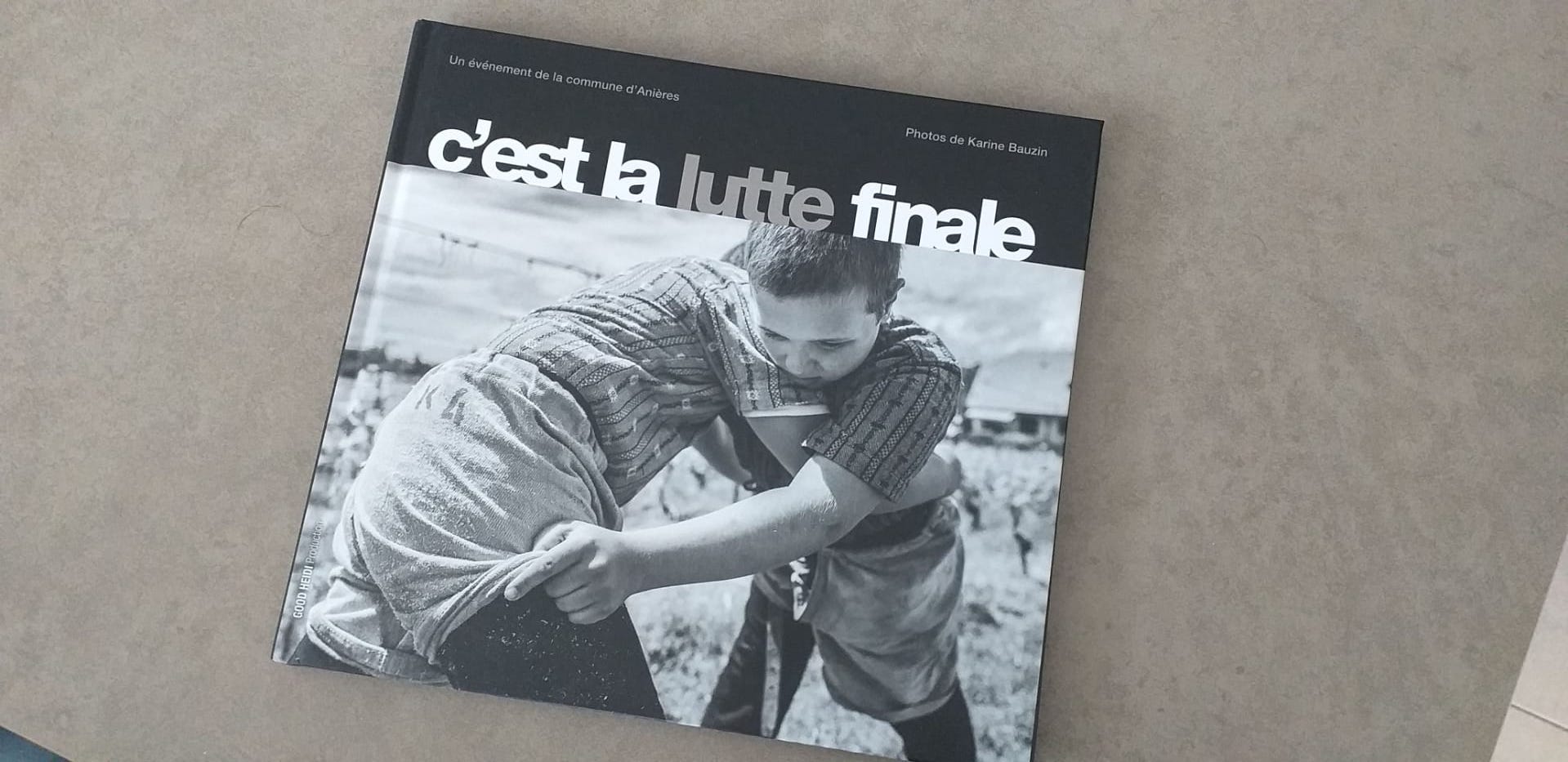
Literature and photography have often joined forces to create hybrid works. From the famous Bruges-la-Morte of Belgian writer Georges Rodenbach in The Clear Room by Roland Barthes, photographs have often accompanied texts to illustrate them or provide alternative readings. Today, Le Regard Libre offers you a dive into It's the final battle, A photo book about the nineteenth Fête cantonale genevoise de lutte (Geneva Wrestling Festival) to introduce you to the sport through words and pictures.
In the Geneva municipality of Anières, from May 12 to 13, 2018, a major event took place: the Geneva Cantonal Wrestling Festival. Not only did the event receive media coverage from journalists and photographers, but it also inspired a book published by Good Heidi. Its author, Geneva-based photographer Karine Bauzin—a former assistant to photographer Raymond Depardon—is no stranger to this kind of project. After suffering a ruptured aneurysm, this former literature student turned to photojournalism and has published two books: the first, One day, everything changes…, is about his accident; the second, titled PORTRAITS-GE.CH published by Slatkine, is based on portraits of prominent figures from Geneva. In this, her third book, Karine Bauzin combines photographs, interviews, and narrative to create a vivid account of this sporting event.
A memoir
In recent years, Swiss wrestling has been on the rise: the 2016 Swiss National Festival in Estavayer-Le-Lac in French-speaking Switzerland, major Swiss events, sports associations, and extensive media coverage have helped spread this sport—which was long confined to German-speaking Switzerland—to French-speaking regions, where it is now gaining a following. Moreover, the originality of this book lies in providing readers with multiple entry points. The casual reader can simply admire the photographs—all in black and white—while the avid reader will scrutinize every word in search of information. The most dedicated reader, meanwhile, will combine the text and photographs to gain a comprehensive overview of the subject.
It's the final battle is presented as a memoir that recounts for readers the two main days of the 2018 Geneva Cantonal Wrestling Festival in Anières. In doing so, the book offers a curious blend of journalism, photography, and literary experimentation. No sooner do you open the book than you are greeted by half a page of text on the history of wrestling and, on the other spread, an engraving. We thus encounter a blend of sources and formats designed to draw the reader into this exploration of the sport.
Beginning with historical reflections on this sport, the author provides readers with some context for his book and his work before launching into his report. In the same vein, readers will find two brief interviews with the event’s organizers, who explain the reasons behind the festival.
Photos and text: a traveling duo
As we read, we can follow the narrative by choosing to focus on either the text or the photographs. But it is only when the two mediums are brought into harmony that the book reaches its peak. The photographs are like fragments, as if the photographer had wanted to capture the highlights of this sport in just a few shots. For example, we see children wrestling against one another or, in more festive moments, wrestlers drinking beer.

To reflect this goal of highlighting special moments, the author skillfully uses the layout to create visual effects. Among other things, we see interweaving effects between the various photographs, with some evoking others or serving as more finely framed details within broader shots. From a certain perspective, the book, with its black-and-white tones, is reminiscent of flip books that tell a story as the pages are turned.
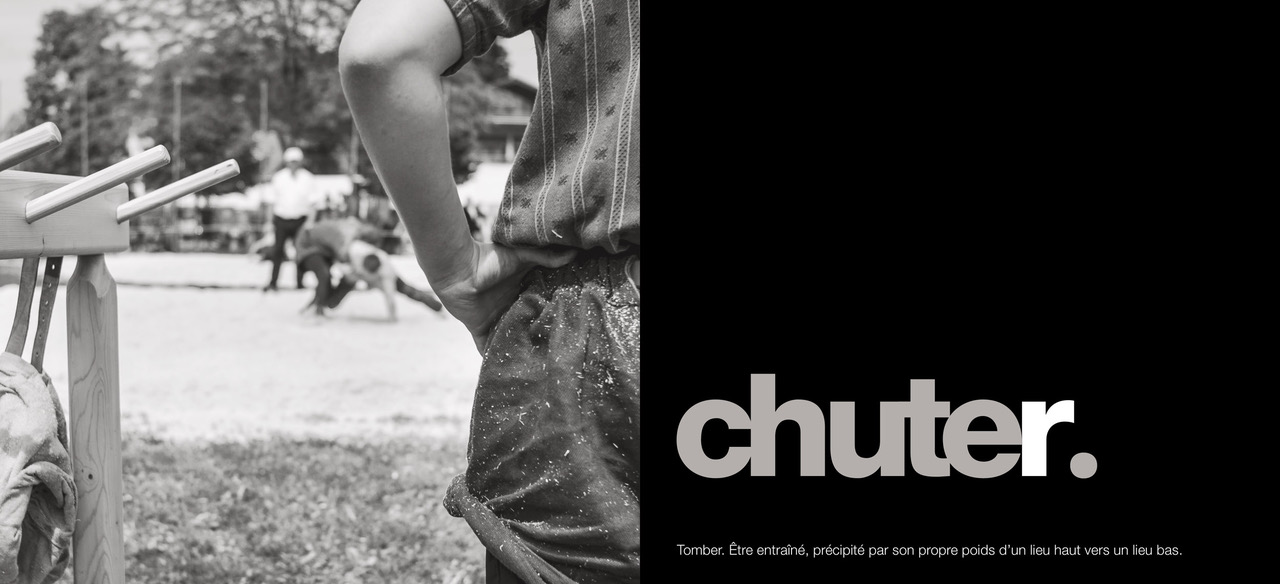
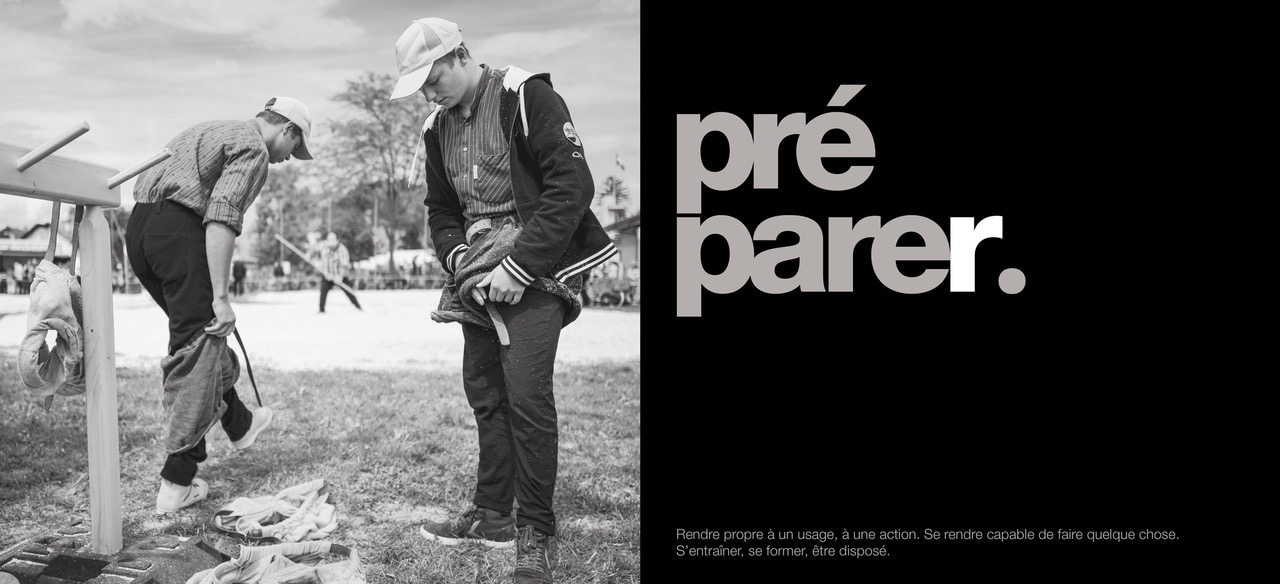
Far from limiting himself to simply playing with photographs, the author also gives prominent space to text, which appears, in particular, in the form of verbs such as «confront,» «hydrate,» «respect,» … also in black and white, and which often take up half a page. Since the other half-page is occupied by a photograph, readers quickly make the connection between the two. Moreover, since each verb is defined, it takes on a very specific meaning unique to the context of the Geneva cantonal wrestling festival. Through this approach, Karine Bauzin offers us a sort of brief, visual parody of the Dictionary of Common Misconceptions by Flaubert.
Aesthetically, the book is a true success and succeeds in taking us on a journey to discover a sport that, a priori, seems uninteresting or, at any rate, would have a hard time taking the form of a novel. As for the narrative level, of course, Karine Bauzin’s work is not a text we could describe as purely literary, but, thanks to its ingenious techniques, we could liken it to a kind of graphic novel. Through its layout and photographs, this work draws the reader into a narrative—that of those days of struggle—weaved between text and images.
Write to the author: [email protected]
Photo credit: © Ivan Garcia for Le Regard Libre

You'll also like

 French
  German
  English
Leave a comment