




Wanderings and thoughts of a solitary walker in times of health crisis

Tuesday books - Arthur Billerey
Jon Ferguson, the Morgian writer of many hats (basketball player, philosopher, golfer, etc.), publishes a new essay on the year 2020.
A Cluster of Thoughts
The story of the coronavirus is still unfolding, and it’s far from over. Shortly after its Corona diary Originally published in Switzerland, author Jon Ferguson has published «2020» Reflections. As an active philosopher, he poses several questions to his readers in this essay—questions he himself had been asking himself both in the lead-up to and throughout the year 2020. While the book necessarily begins with the current health crisis linked to COVID-19, the author manages to move beyond it and detach himself from it freely through a profusion of daily reflections that expand a little more each day. He successfully addresses several nuanced themes, such as friendship in the passage «What Are Friends For?», death in the passage «The Feeling of Death,» and blame in society in the passage «We Love to Blame.».
Read also | Jon Ferguson in his Corona diary
While the author’s approach seemed to necessarily take the coronavirus as its starting point for reflection, one could say that, much like an apple or pear tree, the bud of each passage in this book contains a lateral inflorescence, resembling a cluster of flowers where each flower is a thought that has its own reason for being as well as its own rhythm of growth. In this passage, for example, Jon Ferguson strives to describe the current health crisis as simply as possible—that is, with striking and accusatory simplicity—to highlight its unprecedented nature and the exceptional place it has taken in his life as a man:
«I’ve been alive since 1949. Like many of us, I’ve never experienced a year like 2020. For nearly ten months, we’ve been at the mercy of this vile virus. We don’t touch each other. We don’t get close to each other. We cover our faces. We stay home. Theaters, stores, movie theaters, gyms, churches, schools, brothels, bars, and restaurants have all been closed for long periods of time. Airlines and the travel industry have been brought to their knees. Governments tell us how far we can go and how many people can be in the same room.»
Witness to the Constant and the Accidental
At times, a line of thought is developed based on the headlines of newspaper articles about the health crisis that appeared in the press on the same day this passage was written. For example, there is the headline from La Tribune de Genève: «United States: 1,015 deaths in 24 hours.» And while Jon Ferguson’s repetition of these headlines makes him a witness to the routine, the constant, and the daily evolution of the crisis, that does not prevent him from also bearing witness to the accidental and describing an accident that happened to him, such as the agitated pedestrian who nearly knocked him over during a walk. This incident, in turn, becomes a subject for reflection on whether or not one is a good person in society, or it prompts the author to question the relationships and connections of the principle of causality. At times, one could almost say that the book transforms—to paraphrase Rousseau—not into “reveries,” but into the “strolls” of a solitary walker during a health crisis:
«As I wrapped up my stroll, I found myself thinking that the best definition of a »good» person might not be someone who wants to change the world, but simply someone who strives to be civil, pleasant, respectful of others, and who doesn’t make life any worse than it already is. Perhaps a good person and a good dog are pretty much one and the same. When they’re out walking, they’re courteous and don’t cause any trouble. They won’t discover the meaning of life or the secrets of the universe, but they don’t bite anyone or poop on the sidewalk either. There are probably more bad people than bad dogs in the world.»
Openness to the World
While the book is a kind of essay-diary in which Jon Ferguson, in his own unique way, approaches the world through the thick prism of the great upheaval caused by the health crisis, one might think that in each of these passages the reader is confronted with intimate and perhaps isolated thoughts. Nothing could be further from the truth. The skill in structuring the text lies in starting with the particular and moving toward the collective. Geographically, this encompasses Switzerland, the United States, and the rest of the world. Temporally, it takes the reader on a journey, starting from the present to look back a few years, or projecting into the future beyond the current health crisis, as in the passage «Life After Corona,» which includes a list of things that will unfold after the health crisis—in politics, the economy, and even waste management right in the heart of Paris.
Although Jon Ferguson deliberately chooses to summarize certain philosophical concepts in a very concise manner—condensing Heidegger’s philosophy into three lines, for example— he also does not hesitate to develop original ideas about his everyday life, as is the case with his rabbits, which he observes daily. These rabbits lead him, a few passages later, to discuss his encounter with Kierkegaard’s philosophy, definitively making this book—which deals with the health crisis and its collateral damage—a sort of oddity or standout work in the genres of the essay and the journal thatcan be read without fear of getting bored, enduring dreary repetitions, or—for the most hypochondriacal readers—suddenly feeling as though they’ve contracted the coronavirus.
«When I look at the rabbits, lockdown takes on a whole new meaning. They live in a cage on the patio. One of them, Mini-Wally, is alone upstairs because she was new and couldn’t get along with Little-Wally, who is also a female. They would violently attack each other every time we tried to put them together. […] When I look at the rabbits in their cage, I tend to think they must be unhappy. Then I remember that passage by Kierkegaard, and I realize full well that they can be perfectly happy rabbits.»
Three Questions for David Poirson, Publisher of Dashbook:
Le Regard Libre: Why did you publish this particular book, rather than another, among the many manuscripts dealing with the current health crisis and its effects?
David Poirson: We immediately liked Jon Ferguson’s book because of its intelligent and refreshing skepticism. The author truly thinks outside the box and invites us to set aside the framework of preconceived ideas that guide our lives and are nothing more than clichés. He advocates for a salutary intellectual (rather than social) distance in our anxiety-ridden times.
Is it a political book from that perspective?
More than political, it is above all philosophical. John Ferguson invites us to reflect on what defines our condition as thinking beings and to appreciate every moment of life. The book is not without humor either—a mindset that always involves taking a step back and questioning the prevailing way of thinking.
At the beginning of this book, there is a note introducing your publishing house: «Dashbook is a collaborative publishing house. As specialists in publi-tech, we use the power of the web to connect authors and readers. By facilitating this connection, we enable our authors to find their audience and make a living from their passion.» How do you facilitate the connection between readers and authors?
Like any publishing house, we select manuscripts from promising authors but then immediately make them available to the public online. We also promote them on social media. The role of a publisher is to bring authors and their readers together. Traditionally, this all takes place in bookstores (physical or online), a mass distribution model that has remained virtually unchanged for two centuries. We believe that the Internet allows us to identify, with much greater precision, the readers who will be passionate about our authors—even if those readers are on the other side of the world.
Write to the author: [email protected]
Photo credit: © Futura Sciences
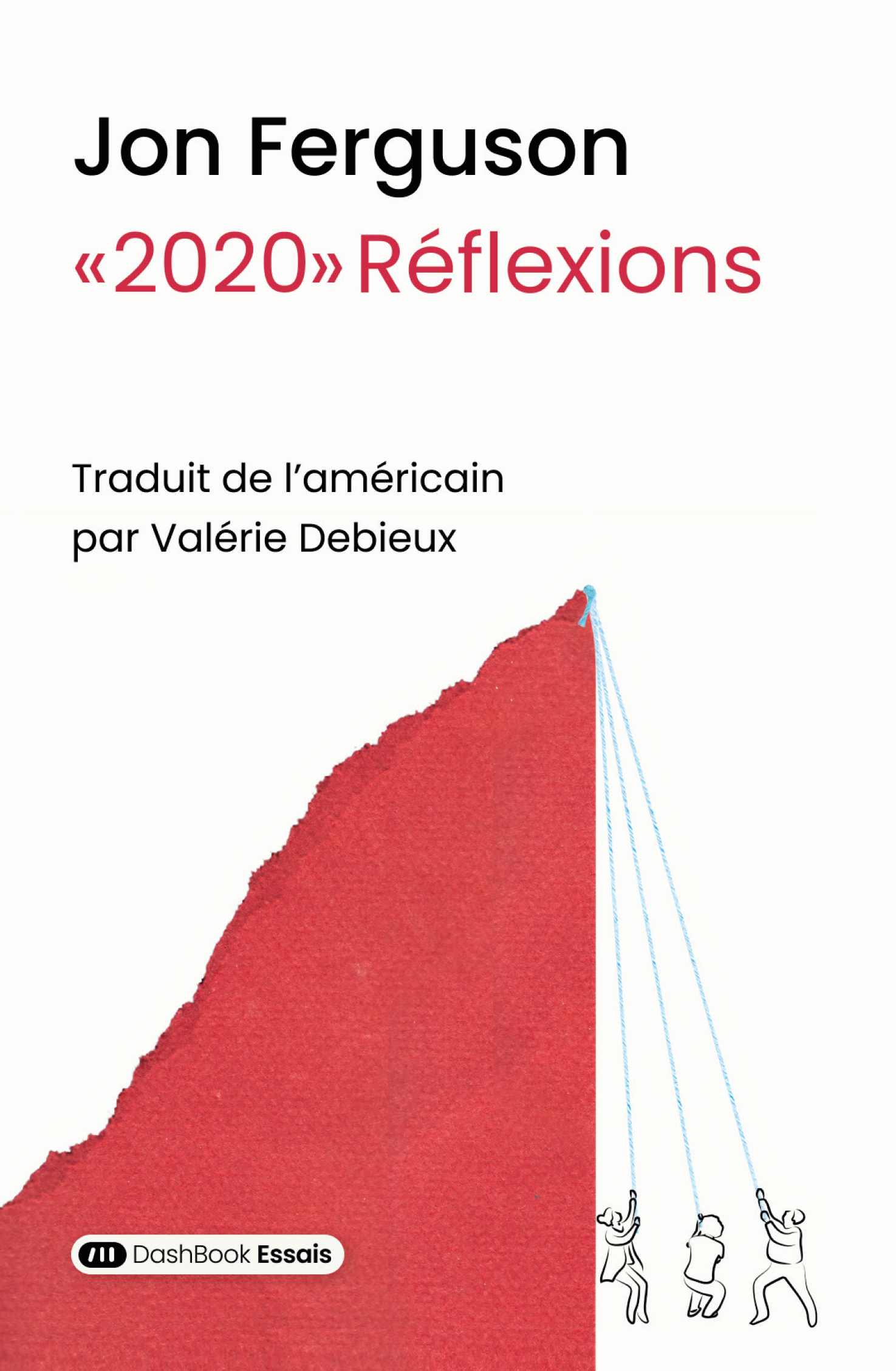
Jon Ferguson
«2020» Reflections
Translated from American English by Valérie Debieux
Dashbook Publishing
2021
112 pages
You'll also like






 French
  German
  English
Leave a comment