



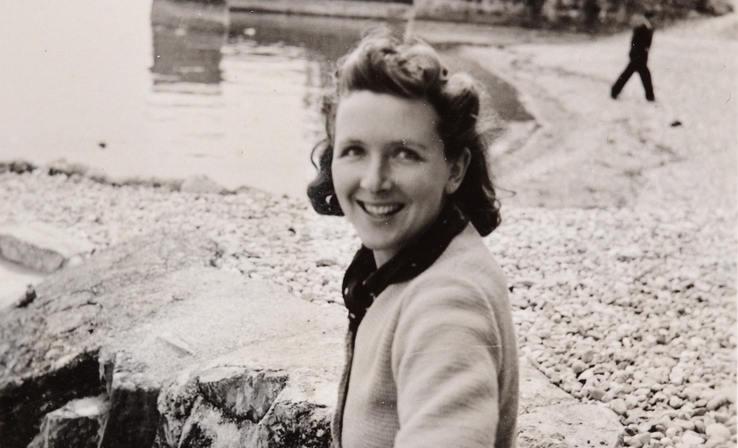
«We already feel the beating of our impatient heart», February 1942 - December 1943
An article by Loris S. Musumeci published in Le Regard Libre N° 23
Happy days (2/6)
Following the November 2016 interview with Pierre-François Mettan to open the present series, Jours fastes is presented here under its first chapter: «We already feel the beating of our impatient heart». This section runs from February 8, 1942, thirteen days after the two writers met, to December 30, 1943. Corinna Bille and Maurice Chappaz began to write to each other for life, continually recounting daily banalities, the miseries of the world, the bitterness of their sweet loves and the joys of their families, until 1979, the year of her wife's death. This correspondence has the rare prestige of being complete, as it covers, in a delightful style, the couple's issues of friendship, love, literature and travel. So it's less appropriate to recount the biographical facts than to dwell on the variety of the type of remarks and appreciate the meticulous writing. It is to the discovery of the most beautiful and interesting passages scattered throughout the letters of the two lovers that this article is dedicated.
Fatigue and peace for a special love
«Soon when absurd events in a world we don't want to know will have come to an end... we can already feel the beating of our impatient heart.»
Corinna Bille and Maurice Chappaz, although protected by Swiss borders, knew each other in the context of war. This is not the main content of their first two years of correspondence, yet it is discreetly felt, especially by Maurice who is more concerned by the affair, mobilized as a lieutenant in the mountain infantry. «We already feel the beating of our impatient hearts» was chosen as the title of this first part: war is denounced, love finely suggested. At the start of this epistolary exchange, the two young people have not yet revealed their love for each other. There's a word that marks all male seduction: «notre cœur» («our heart»). In the eyes of the lover, they are one. That their common chest beats to the rhythm of the bombs is one of those "absurd events" that it would be better not to know about. What matters, however, is the very uniqueness of this heart, promised here by Maurice. Difficulties will knock, sometimes violently, on the door of eternal old lovers. Against all odds, however, they walk on, confessing their respective weaknesses and mutual hopes.
They'll try to understand each other, and the goal will often be missed. Fortunately, love is not incompatible with misunderstanding:
«At times, and this is when you love me, your face is that of a being who has never lived here, who knows neither civilization nor evil and who doesn't speak our language.»
Corinna paints her beloved as a savage who wouldn't even speak her language, yet it's in these moments that he loves her. Maurice, with his love of the great outdoors and his love of walking, is often seen as a person far removed from the norms of society. As a result, he is often absent from the couple's and then the family's lives. He realizes this, as his partner writes to him, ever so delicately, right from the start of their relationship:
«Maurice darling, I miss you. You seem so far away now! I love your presence too much to appreciate absence. To think that I used to live mostly in absence, with those I loved. I savored them from afar, I made my loves with the same angry patience I used to sew my puppets, and like them I adorned them with velvet, feathers, trimmings and painted them strange green eyes.»
Long absences give rise to a more intense, fuller presence. Both protagonists are concerned by the remark. If Maurice is known for his desire for solitude, so is Corinna. Each has been able to write generously and abundantly precisely because of this space left to work, to create. These writers give their lives, or at least part of them, to art, in a way that is never excessive, although it does border on it. Such power is also to be found in their relationship, seemingly born of a sober, true lyricism:
«Yes Maurice, I know that my life I could give it to you, I would like to give it to you; death is sweet to me now that you have loved me, I sometimes even unconsciously desire it because it is now the most beautiful [moment] of my life and it is difficult to maintain happiness to such a degree.»
In pain or in joy, Corinna needs peace; from love, which couldn't be greater, as the sentence above testifies, from the world too, and from all this exhausting life. Even so, she writes in September 1942, and the war is in full swing. Misanthropic outbursts are frequent in her letters, especially hers, because she is so sensitive to what she can do nothing about:
«I'm dead tired. I don't even have the strength to love you anymore. I'd like to leave and live alone. I hate men, I hate tyrants. I ask only one thing: peace.»
Maurice doesn't express his feelings so much as what he sees. He describes more, in a simpler style. His way of telling another war-related story - invaluable for the history of the Valais during the Second World War - is aimed at the fact itself, obviously allowing himself a little «unimaginable» to express the horror in the following passage:
«Heaps of people are fleeing France, the police, imprisonment, relief in Germany, the unimaginable tortures that await some of them: Jews, Poles and anyone who commits a fault of any kind. There's a man in our company from the Valais who enlisted in Germany believing he would earn 15,000 marks a year, and returned after three months in a concentration camp.»
Practicalities
At a time when the telephone did not have a monopoly on communication, letters fulfilled the function of the practical word: brief and to the point. That's what Corinna Bille and Maurice Chappaz's correspondence is all about: messaging. On a professional level, the two writers exchanged letters about their works:
«My darling Maurice,
I love you.
You gave me happiness, you encouraged me for Théoda.»
«I think very highly of you for writing Théoda, and I sometimes think with emotion of the ups and downs of your heart as you took up the task again. It takes a lot of courage.»
The novel Théoda was almost finished, and would be published in 1944, but before that Corinna had to cross long deserts for her inspiration. Maurice's support enabled her to achieve a demanding and successful result.
But writing isn't the only problem. Other worries are growing here and there on the minefield of correspondence:
«Let me know as soon as you can be absolutely certain.»
[Note: Corinna Bille is pregnant with her first child].
«And this morning, an idea came to me. I'll tell you and you can tell me what you think. For us, it seems interesting and likely to simplify a lot of things, and especially to avoid the terrible expenses (of a child raised outside our families, of pied-à-terre, of pensions and comings and goings, of distress due to loneliness, lack of support, etc.). It would be to get married and not live together.»
Corinna has a different vision of a couple than Maurice. While he wants to rush her divorce so he can marry her, live with her and have a child - even though he'll be anxious about her pregnancy once it's known - she prefers a life of illicit lovers, to avoid «terrible expenses», she says. In reality, freedom is important to both of them, and remains the core of their love.
Freedom, sour and sweet
«I love you and I love the love with which I love you. He dances madly. It now owns all space. I can only love the being I leave free and who leaves me free. You can do what you like, I love you, I take you with me and you are part of my solitude. Perhaps I won't even suffer, although it's impossible to say anything in advance.»
Freedom is written here in Corinna's cheerful pen: «You are part of my solitude». She seems completely at ease within the relationship. Also, the strength of this passage testifies to a real depth of respect for the other, because this love is anything but possessive, unlike a relationship we might have imagined to be more passionate. «I can only love the being I leave free and who leaves me free»: that says it all.
Such a conception of married life sometimes turns sour:
«More and more, I need to live independent of my family, of you too. In spite of your pessimism on the subject, I believe I can do it. I can't be happy without it. I want to make my own life, not ask others to. I want to earn money, live on my own, wander. Roaming the roads, with no ties to anyone, has become a passion for me. It intoxicates me. I'm a lot more like René than I thought. Like you too. Maybe too much: that's why we can't live together.»
Corinna's breathless words raise doubts about the possibility of an existence for two. It's up to Maurice, the peacemaker, to moderate the fragile situation:
«We'll have to be very brave and get along very well. I'll help you with all my might. I know that with the life I lead, the part I'll always devote to poetry, which is great, there will be many difficulties. Will we be able to keep each other free, for example, which is best for everyone? I think so.»
The solution to a life between union and separation is already in sight. Such will be the couple's days, forever. Between travels and various occupations, both will be able to breathe at a distance, without ever ceasing to write to each other. They will leave room for the imagination of the mind, during the absence of the body.
«I imagine every day the wonder of your presence, your friendship and your naked freshness close to me.»
Write to the author : [email protected]
Photo credit: Agenda - Kultur Wallis
You'll also like



 French
  German
  English
Leave a comment