




From instrumentalized Simone de Beauvoir to queer drift
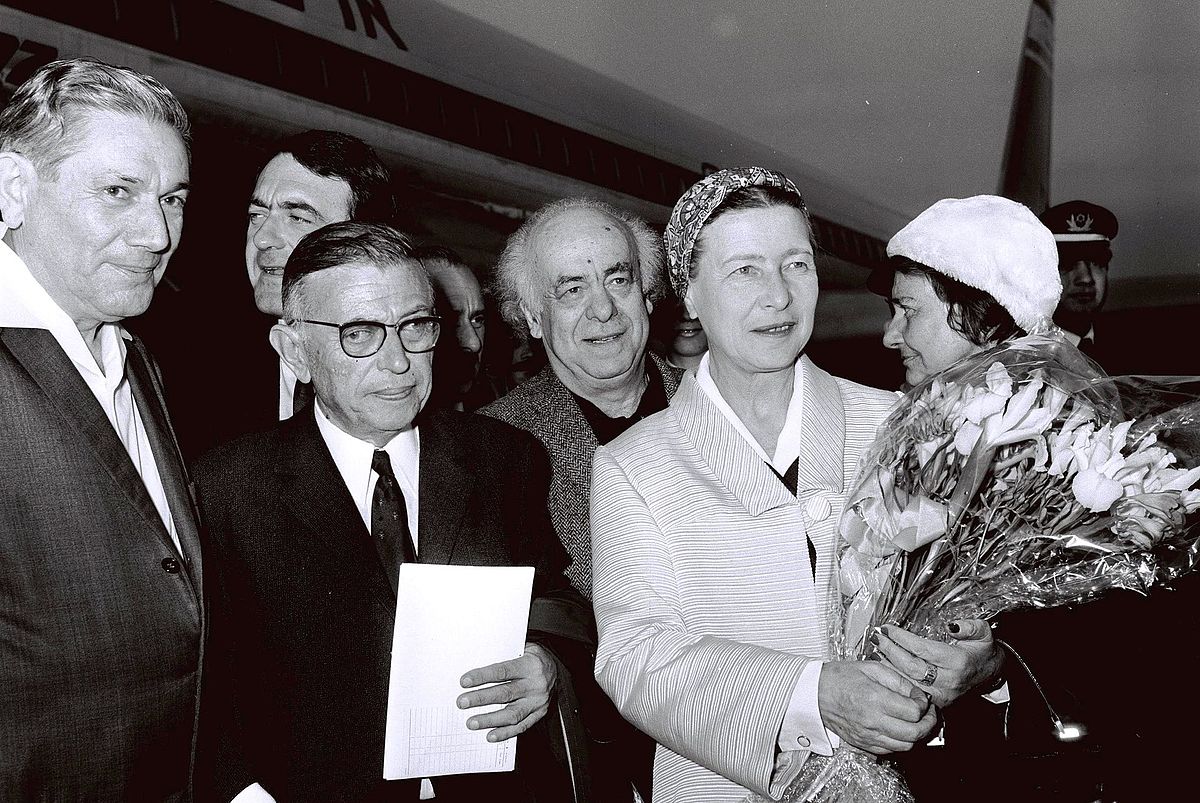
Government press office
«We're not born women, we become them»: Simone de Beauvoir's famous phrase is often quoted today to justify the idea that we can decide our own sex. But Beauvoir was not thinking of putting biological reality into perspective.
To understand Simone de Beauvoir's famous phrase, we must first find its context. «One is not born a woman, one becomes one» must be interpreted in the light of another famous phrase by the French essayist's companion, Jean-Paul Sartre: «Existence precedes essence». This means that we construct ourselves through our successive choices in life, and thus become what we are - in other words, we acquire our essence.
However, as freelance journalist Sarah Pines pointed out in the NZZ on November 14th, Simone de Beauvoir simply applies Sartre's existentialist thesis to women. For her, there is no question of becoming anything other than a woman: she accepts that the separation of the sexes is an inescapable biological fact. It's just a matter of freeing herself from the stereotypes associated with her sex, such as mother, virgin or married woman, in order to be socially like men and thus choose the type of woman she wants to be.
A distorted sentence
In the 1960s, the philosophers associated with the French Theory radicalized the existentialism of Sartre and Beauvoir - and ended up nullifying it, as the journalist argues. According to the latter, it can no longer be said that «existence precedes essence», because there is no longer any real essence or nature. Things never have their own identity; everything is fluid. According to authors such as Gilles Deleuze and Jacques Derrida, truth does not exist in the world, but only in the text. This emphasis on words helps us to understand why the fight for equality is currently focused on language: female emancipation requires the adoption of a neutral language (inclusive writing, neutral pronouns...), free from the domination of the masculine.
As there is no longer any truth in the world, our bodies are now freed from the burden of all normativity, not only in terms of clothing, but in their very identity. We can change gender from one week to the next. «Gender identities are as arbitrary as the color of socks,» Sarah Pines sums up.
For our part, let's point out that it doesn't even make much sense to say that you're not born a woman, but that you become one, if you can't explain what a woman is. Indeed, some people now claim that a woman doesn't necessarily have a vagina, that a person who menstruates can be a man, that a woman is simply a person who feels like a woman, and so on. So what does it mean to «become a woman»? The circularity of the definition is obvious. We are born without knowing what we are, because the sex «assigned at birth» is provisional, and we become what we want to be... without being able to define it.
Write to the author: [email protected]
You have just read a reprint from the paper edition (Le Regard Libre N°92).
Cover illustration: © Government press office
You'll also like



 French
  German
  English
Leave a comment