




Withdrawal from Iran nuclear deal: toxic fallout for Trump
Les lundis de l’actualité – Baptiste Michellod
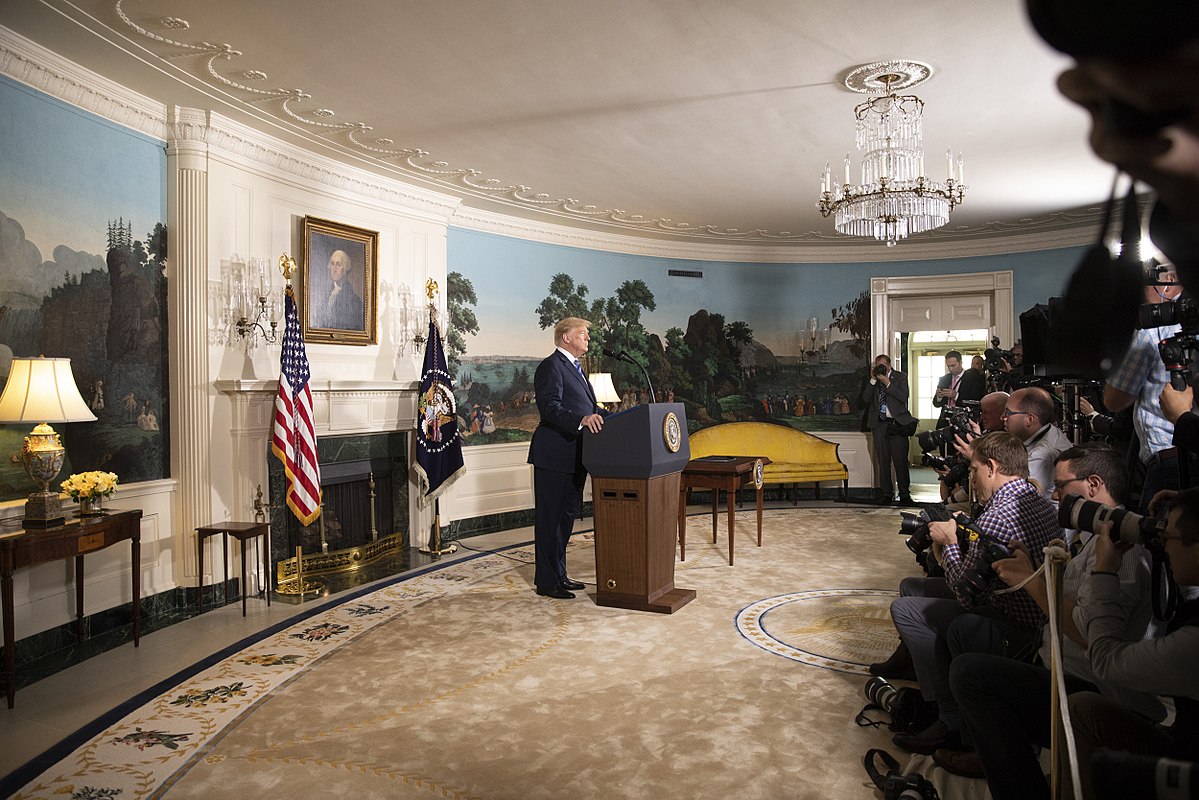
France, the UK, Germany, the European Union, Russia, China and Iran watched in dismay as Donald Trump withdrew from the historic Iran nuclear deal struck under Obama in 2015. Despite eleven inspections by the International Atomic Energy Agency concluding that Iran is complying with its commitments in terms of uranium enrichment and centrifuge capacity, despite the advice of his Secretary of Defense James Mattis as well as the opinion of Emmanuel Macron, Angela Merkel and Boris Johnson, all of whom maintain that the agreement effectively prevented Iran from acquiring the bomb, President Trump nevertheless decided to withdraw from the JCPOA (Joint Comprehensive Plan of Action).
The Iranian government has proved extremely resilient since its inception. For Iran, sanctions are more the norm than the exception. Trump's belief that reinstating sanctions will lead to regime change is strongly contradicted by the country's history and the analysis of many experts. Therefore, rather than attempting to justify or explain the insane causes of the US withdrawal from the JCPOA, we will instead examine its consequences.
The main beneficiary of this withdrawal, beyond the Saudis and Israelis, is none other than the Revolutionary Guard Corps. This institution, originally created by Ayatollah Khomeini to guarantee the gains of the 1979 Islamic Revolution, has become the armed wing of Iran's ultraconservative factions. The Revolutionary Guards, or Pasdaran, acquired a growing role during the presidency of Mahmoud Ahmadinejad (2005-2013), which accelerated their political and economic rise. Taking advantage of a large-scale privatization operation launched in 2005, the Pasdaran bought up thousands of state-owned companies. It is estimated that this group now controls at least a third of the Iranian economy. These are the same Revolutionary Guards who brutally repressed the Green Movement's peaceful demonstration in 2009, challenging the vote to reappoint Ahmadinejad as president. They are also in charge of Iran's nuclear and ballistic missile programs, supplying weapons to Hezbollah and intervening in Iraq and Syria.
The victory of the moderate Rouhani in the 2013 presidential elections was a real slap in the face for the Pasdaran. Its political representatives sharply criticized the 2015 nuclear deal, interpreting it as an act of betrayal of revolutionary ideals. Since then, they have constantly questioned Rouhani's policy of openness. Thanks to Donald Trump's withdrawal, a boulevard is now open for them to delegitimize the moderates' record.
By reactivating his sanctions regime, Trump will not only worsen Iran's faltering economy, but also fuel the anti-American rhetoric of conservative factions. In his speech on May 8, Trump expressed his support for the Iranian people. Yet it is the Iranian people who will pay the highest price when sanctions are reinstated, and whose aspirations for change will be suppressed by the now omnipotent Revolutionary Guards.
In conclusion, let's recall George Bush's 2002 State of the Union address, which classified Iran as part of the Axis of Evil, even though the then President of the Islamic Republic was the most progressive in the country's history. Three years later, the populist and Holocaust-denier Ahmadinejad emerged. We can only hope that history doesn't repeat itself, because who knows what extremism Trump's insolent rhetoric might awaken in Iran in the next elections?
Write to the author : [email protected]

You'll also like
 French
  German
  English
Leave a comment