




Geoffroy Lejeune's arrival at the head of the JDD: a senseless hoopla
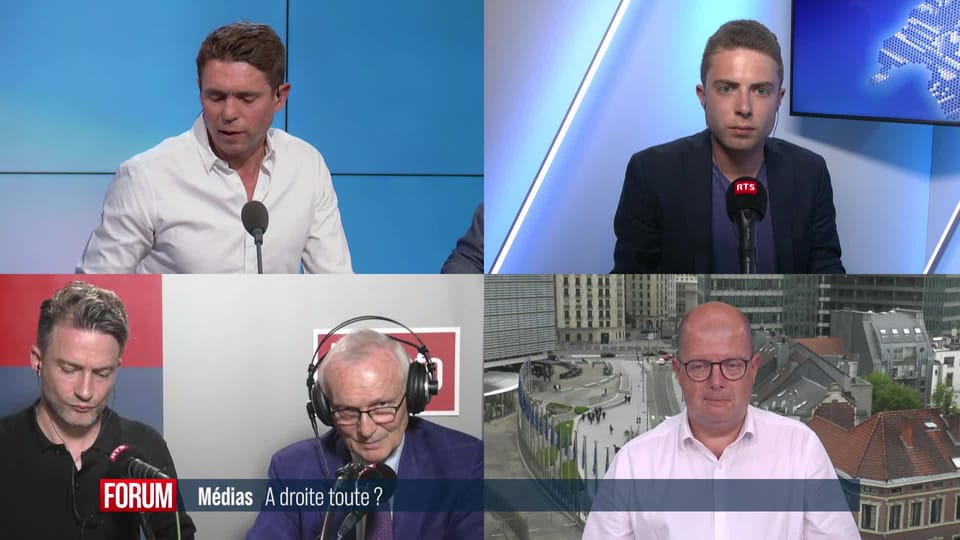
Big debate on the «Forum» program on Radio Télévision Suisse (RTS) on July 4, 2023
The turmoil caused at the highest levels by the appointment of the ex-boss of Valeurs actuelles to the Sunday newspaper is selective, misplaced indignation. Small development of point of view I expressed on RTS on July 4.
One month ago today. On June 23, Geoffroy Lejeune, former editorial director of the conservative weekly Valeurs actuelles, was officially appointed head of the Sunday newspaper (JDD). Since the rumour of his appointment relayed by Le Monde the day before, journalists at this leading French magazine, which tends to be center-right, announced that they were going on strike. This was due to a «refusal to be managed by a man whose ideas are in total contradiction with the values of the newspaper», according to a press release issued by the Society of Journalists on June 22.
The strike continues even today, taking it past the one-month mark that had been the duration of the strike by journalists at the iTélé channel, now CNEWS, when it was bought by billionaire Vincent Bolloré in 2016. The same fear has been voiced for the past month: that the businessman would have far-right ideas, which he would spread by taking over more and more French media. His Vivendi group is on the verge of swallowing Lagardère, owner of the JDD, of Paris Match and Europe 1, following a successful takeover bid. Many observers see Geoffroy Lejeune's arrival at the helm of France's only major Sunday newspaper as a «Bolloré takeover».
If the validation of a media outlet's management by its editorial staff is a real debate, it only concerns the media outlet in question. However, the entire country's elites, who claim to be on the side of good, have made it a political issue. No fewer than 400 players from the political, economic, social, cultural, associative and sporting worlds have signed an article in Le Monde to declare that «the JDD cannot become a newspaper serving extreme right-wing ideas». The French Minister of Culture herself issued a tweet where she expressed alarm about «republican values». In addition, a cross-party bill to protect the «editorial freedom of the media» was presented to the National Assembly on Wednesday.
Qui sont-ils pour dire ce qu’un média privé doit faire?
The point here is not to ask what these Sunday outraged mean by «extreme right» or «republican values», words almost never defined in contemporary political debate, which too often consists of labeling instead of argumentation. Rather, the point is this: even if Geoffroy Lejeune embodies the extreme right, whatever that means, it's up to the boss of a company - in this case, a media outlet - to decide on its direction. In the same way, it's up to readers to decide what they read.
According to all the polls, moreover, the French are far more conservative than the British. JDD current market. This operation certainly meets a demand. And if it turns out to be a fiasco, so much the better for the competition. In fact, before the JDD, Geoffroy Lejeune has been dismissed from Valeurs actuelles... because he defended a line too far to the right. Why, then, should people be so taken aback by the forthcoming - and still presumed! - of JDD are they not moved by the fact that Valeurs actuelles is also likely to be gutted? Doubtless, because this would mean admitting that some media - contrary to what Patrick Baudouin, President of the Ligue des droits de l'homme, for example, claims - are moving to the left, while others are moving to the right. Life, in short.
L’affaire est encore plus basique, hélas: «il suffit à la gauche de se voir contestée pour se croire assiégée», comme le disait très justement in an interview le sociologue québécois Mathieu Bock-Côté en 2020. Déjà minoritaires dans les idées de la population, les représentants d’une certaine gauche morale ne peuvent supporter de devenir également minoritaires dans les médias.
Cela étant, n’éludons pas la discussion de fond: ce ne serait pas bon pour le pluralisme que Bolloré rachète tous les médias privés de France. Mais il est réjouissant que des hommes d’affaires investissent dans la presse. L’idéal étant qu’il y ait une diversité de ces acteurs, de la même manière qu’une variété de points de vue est nécessaire au débat public. Or justement, si une telle volonté existe au plus haut niveau de «sauver» un dominical aux idées qu’on dit proches de la Macronie, n’y aurait-il pas moyen de financer d’une manière ou d’une autre un nouvel hebdomadaire pour faire concurrence au nouveau JDD? Par exemple, par l’entremise d’un riche mécène proche du président? Ou d’un financement participatif? Bref, ceux qui n’aiment pas Geoffroy Lejeune ne sont pas obligés de continuer à lire le JDD ou à y travailler. Qu’ils créent un autre titre. La presse ne s’en portera que mieux.
The real issue is public media
L’autre volet hautement critiquable de cette indignation politico-médiatique, c’est l’énième «deux poids deux mesures» qu’elle révèle. Quand un ancien co-directeur du grand quotidien de gauche Release accède (à nouveau) à l’animation de la matinale de France Inter, radio de service public, les mêmes qui militent aujourd’hui contre la nomination de Geoffroy Lejeune ne s’offusquent pas. Logique, répondra-t-on: ces bonnes âmes penchent plutôt à bâbord! C’est là oublier qu’ils devraient justement en faire abstraction. Et que l’impartialité des médias publics – ou au moins l’équilibre dans leurs rédactions et les directions qui s’y succèdent – est pour le coup un vrai sujet politique, contrairement à ce qui se trame dans les médias privés.
In France, public radio and television are always biased in the same direction, and citizens who feel on the same side don't find this shocking: it shows the profound ineptitude of their worldview. And it's not just a French affair: the same phenomenon can be observed in French-speaking Switzerland.
Write to the author: [email protected]
You have just read an open-access article. Debates, analyses, cultural news: subscribe to support us and get access to all our content!
-
 Youth passFrom: CHF2.50 / month
 -
Digital subscription
From: CHF5.00 / month with a 30-day free trial and a CHF2.50 sign-up fee -
 Standard subscription
From: CHF10.00 / month with a 30-day free trial and a CHF2.50 sign-up fee

You'll also like



 French
  German
  English



Leave a comment