



«Format, sun and canvas

Le Regard Libre N° 65 - Indra Crittin
Deconfining photography and putting it in the public space, in large format, on the heights of Saint-Imier: this is the project of the «Format» exhibition, a free outdoor biennial dedicated to contemporary Swiss photography. That's all it took for your dedicated photographer to set off and discover the work of the eleven exhibitors in this second edition. Here's a look back at the opening day on June 13.
While access to the Mont-Soleil site is just a few minutes by funicular, it was also on the idea of the funicular company's director that Swann Thommen, a multidisciplinary artist from Imérien, created the Impulsion association in 2017 to give visibility to the region and is responsible for its artistic direction. More concretely, the first contacts were made in September 2019 with the photographers, who were able to visit the premises in January, and adapt according to them.
No theme is imposed on them; the work lies precisely in placing their works in context. It's rare for tarpaulins to be used as a support for photographs, especially perforated ones - windy as they are! - of twenty square meters mounted on scaffolding. Usually, prints are made on paper fine art. Exhibitors should therefore select images with good contrast, as some colors are too dull.
One, two, three... sunshine
The installation, inspired by Asian advertising, not only focuses attention on the audience's role, but also plays with perspective and natural light. In this way, the back the black and white portrait by Prune Simon-Vermot (System limits) gives a different reading, thanks to the transparency of the canvas. Her subject is a seventeen-year-old boy she has been following for six months, who is affected by Asperger's syndrome. The three-dimensional layout resonates with his hypersensitivity and takes on its full meaning.

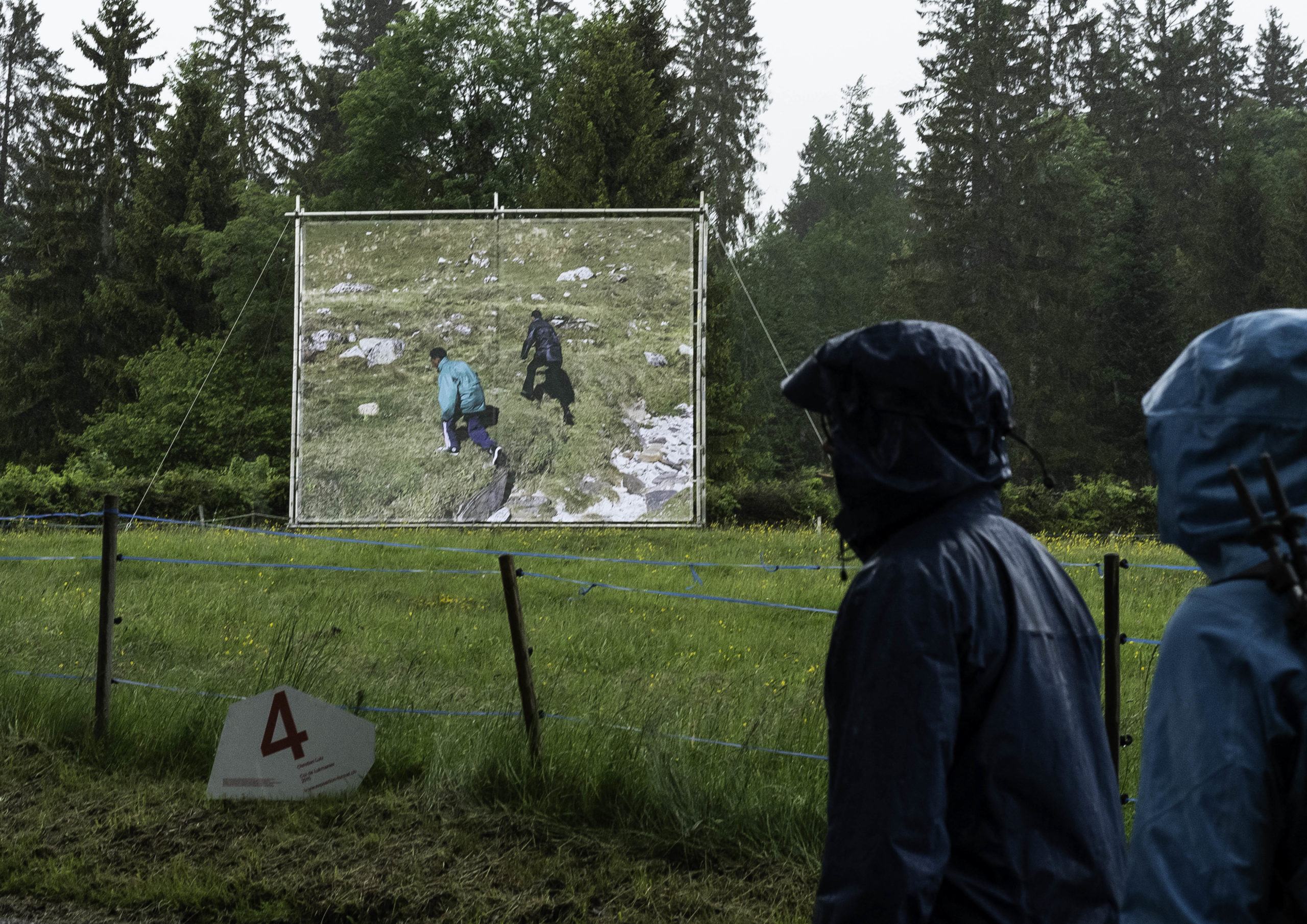
Each artist proposes either an original creation, or a work or series already produced, presented this time in a new way. Sophie Brasey (Social Distancing), for example, produced images in Switzerland during confinement, questioning social distance and our relationship to solitude. The only image by Swiss Photographer of the Year Christian Lutz, entitled Lukmanier Pass, was taken in 2015 on the pass linking Ticino and Graubünden for a commission during the migration crisis. The slope of the terrain continues, creating a continuity of image. The mise en abyme process is repeated ad infinitum, and I too am caught up in the game.
A show within a show, once again with Cyril Porchet's photo-sculpture (Meeting), at the heart of a shareholders' meeting. The photograph is taken high up, centered and deliberately overexposed; the absence of human presence makes the device more imposing and powerful.

One, two, three... cheese
As the guided tour continues in the pouring rain, we come to the diptych from the series The Call, started in 2010, the result of numerous expeditions to the wilds of Russia. And its author, Yann Laubscher from Vevey, says: «I'm delighted that the weather is like this, because it's in these conditions that I take my pictures. We've been warned! These shots, taken with a view camera, required a few minutes» exposure - hence the presence of mosquitoes on the face of one of the two men (a Russian and, unexpectedly, a man from Lausanne), centered and looking straight at the viewer.
The confrontation raises a question: what does it mean to live in a wilderness? Swiss-Italian artist Graziella Antonini is also interested in the complex relationship between man and nature. By collecting stones, seeds and other small plants, then representing them in an artificial setting - a sky-blue background for White fir and Tulip tree -This creates the illusion that nature, fragile as it may seem, is literally in our hands.
This idea of fragility and even preciousness is echoed on an even smaller scale in Catherine Leutenegger's project, featuring a fragment of bird feather, Feather, for which she symbolically chose the color gold. Invited to EPFL Lab, she used the technique of X-ray microtomography, which enables the object to be precisely reconstructed in three dimensions, without altering it. A way of challenging the traditional practice of photography by raising new reflections on the materialization of the virtual and digital omnipresence.
«The work lies precisely in setting their works in context.»
A few steps further on, we come across two photographs, this time taken at the smartphone by Guadalupe Ruiz. A space-saving solution for travelling to her native Colombia to visit her family and immortalize her surroundings, such as flowers (Anturios). But there was one woman who didn't get a break, in the 17th centuryth century: The Woman with the Erased Name. Condemned for acts of witchcraft, this woman mentioned in a collection of trials actually owes her anonymity to the tear that occurred in the edge of the page. flash by Virginie Rebetez on a black background. In the flyer accompanying the exhibition, the director of Mémoires d'ici, Sylviane Messerli, points out that «today, paradoxically, the trials that express [the] condemnation [of women and men] are precisely those that preserve their memory.» Now it's your turn to remember to discover the «Format» exhibition until August 16 at Mont-Soleil!
More information on www.exposition-format.ch
Write to the author: [email protected]
Header image: Vitali enjoys a bath after a Banja (Russian sauna) made from a gigantic tire from a Caterpillar truck used in the mines. Beat Schweizer Indra Crittin for Le Regard Libre

You'll also like
 French
  German
  English
Leave a comment