




Versatility in the Service of People (An Interview with François-Xavier Amherdt)
Le Regard Libre N° 15 - Loris S. Musumeci
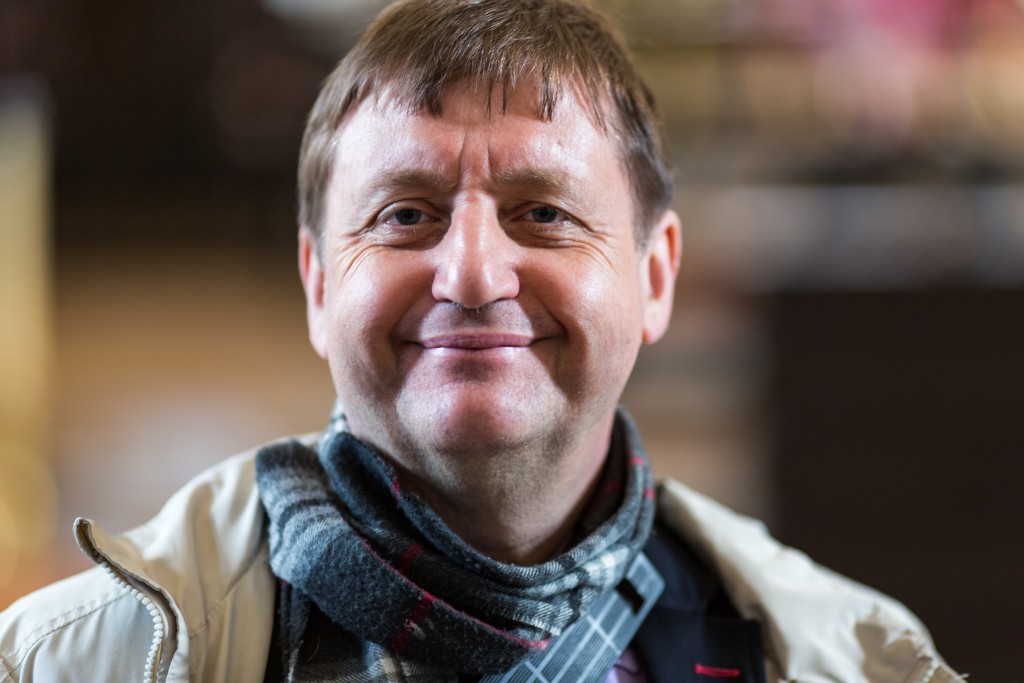
For this edition, Le Regard Libre invites you to take part in a long interview with a well-known figure from the Valais, Abbé François-Xavier Amherdt. Where to start introducing him? Just let yourself be guided by this long interview, conducted at the beginning of this month.
Loris S. Musumeci: You are one of those men who can truly be described as versatile. Your activities are indeed as numerous as they are diverse, but you remain above all a priest, and have been since June 17 1984, the day of your ordination by Pope John Paul II in Sion. From your earliest youth, what reasons and circumstances led you to become one?
François-Xavier Amherdt: I've always nurtured a quest for the absolute, and very soon I became convinced that only God could fulfill it. From my earliest childhood - my vocation was born at the age of five - I felt called to give everything for the One who alone could fill my heart and soul. For me, becoming a priest meant being able to «give God» to the men and women of our time.
At no time was I disappointed in this choice, for the Lord of the Scriptures, under whose gaze I grew up and in whose message of love I bathed, has never ceased to watch over me and give me the strength to minister to my brothers and sisters. What's more, the Roman Catholic Church, which gave me the gift of baptism and to which I owe everything, is the only ecclesial and religious institution in the world to offer a unified and universal network, «Catholic» meaning «universal». All other Churches and religious traditions are in reality fragmented into a multitude of autonomous groups or identities, whereas the Pope, the Bishop of Rome, is the servant of the communion of all local Catholic Churches, which thus form a single Church.
Finally, it is rooted in an unbroken two-thousand-year tradition which, despite the mistakes of the past, inscribes me in a lineage capable of giving meaning to the present and maintaining confidence for the future. It also benefits from the riches of Jewish tradition, since the Canon of Catholic Scripture shares with our Jewish brothers and sisters what we call the First or Old Testament.
My vocation - or rather, my various vocations articulated around the desire to become a priest - was thus engendered within the framework of my family, thanks to parents who gave me the witness of a faith professed and put into practice in the tenderness and justice of everyday life. It developed mainly in the context of the choir «La Schola des petits chanteurs de Notre-Dame de Valère de Sion», where singing, community life with other children, young people and adults of all ages (from 5 to 80), liturgical rhythm, and even a taste for soccer and refereeing, all came together harmoniously: for me, studies (we also sang in Latin), music and play converged in the same quest for sharing and the infinite, which found its full flowering in the God-family, Father, Son and Holy Spirit.
Basically, all my vocations were already present from the age of five around Sacré-Coeur in Sion: I lived opposite the church, went to school at the center scolaire, learned classical guitar at the Conservatoire located in the former nursery, rehearsed with the Schola under the church, played soccer (and refereed already) on the Place du Sacré-Coeur, and all this came together as a brew in the animation of celebrations at the parish.
You have a great passion for soccer and referee in your spare time. What link would you forge between this hobby and the priesthood?
The referee is at the service of the teams« »encounter« and enables the game to run smoothly. He's in the game without being in the game. He takes part in the match but does not win. He is the guarantor of the evangelical values present in sport: fair play, respect for the opponent and the rules, channelling violence and chauvinism-nationalism, team spirit, forgetting oneself for the benefit of the group, the ability to give one's all and to surpass oneself, to »transcend" oneself in crucial moments, the balance thus found between body, mind and soul according to the adage mens sana in corpore sano («a healthy mind in a healthy body»), the evacuation of excess aggression through physical effort, and so on.
The best referee is the one who knows how to make himself forgotten, while remaining very close to the action and knowing when to impose himself. I see many parallels with the priesthood:
1. The priest aims to reconcile people in couples, families, society and the Church; he encourages encounters in peace, serenity and respect.
2. He is not the main character, but refers to God, whose spokesman he is. He seeks to step aside to facilitate each person's intimate encounter with his Lord.
3. The less he is noticed, the more transparently he serves the Father in heaven. Priests have to make decisions and take positions that are not always well understood. He is criticized, challenged, even booed or scorned. Following the example of the suffering servant of the prophet Isaiah, a figure of Christ who, humiliated, does not open his mouth, the arbitrator, like the priest, cannot (always) explain or justify himself. He serves the cause of justice or faith, at the risk of being rejected, or even «martyred».
4. When necessary, the priest is invited to intervene prophetically, to denounce injustice and violence, to whistle a foul, to issue a yellow or red card. But he always does his utmost to bring the players back to their senses on the field of life.
In many ways, moreover, God appears to be «the arbiter of the nations». As the prophet Isaiah (2:4) and Psalm 7:9 tell us: in eternal life, all peoples will converge on the mountain of God, Mount Zion (!), the hill of heavenly Jerusalem - on which the Temple was built, the seat of the Lord's presence here on earth, for Israel. He will reconcile men of all origins, who will transform their spears and weapons into sickles for the harvest. God will invite them all together for a feast of fatty meats and heady wine that will never end. There will be no more war: shalom, the fullness of peace, will be finally and definitively established, the Kingdom that the Messiah Jesus Christ has already come to realize among us. That's why I entitled one of my books God is the arbitrator. I comment on the biblical Word and current events through sports parables.
On the other hand, I remain very lucid on the stakes and excesses of competitive sport (in a little book...), Sport, the religion of the 21st centuryth century?) in which I show that, at heart, sporting disciplines are threatened by the same excesses as the world at large, of which they are merely a reflection: violence, doping, nationalism, racism, cheating, corruption, etc. But also solidarity, the beautiful gesture of scoring a goal, the ability to surpass oneself, esteem for other athletes and even for the referee, etc.
The big difference in the «game of faith» is that everyone can win, especially the weak and the small, and that the aim is not to beat or annihilate others, but to encourage and support them. Not in confrontation, but in communion.
Photo credit: octuor.ch
Music is also a great love of yours. You teach guitar and sing in the Octuor Vocal de Sion, which you founded forty years ago. What role does the art of music play in your life, and what does it bring you?
I still teach classical guitar, no longer at the Conservatoire cantonal de musique de Sion where I happily exercised this profession for thirty-one years, but within the framework of the Société suisse de pédagogie musicale (private lessons). Choral art at the Schola and guitar have been with me since I was a child. I started both at the age of five. I find them a prodigious source of inner joy, fulfillment and balance for every part of my being.
I'm one with the instrument, which is feminine in form. With the harmony of the six strings, I express the fine point of my soul, I turn to God, I abandon myself to him, the unspeakable, beyond all words. The melody of the guitar expresses better than any words the beauty and grandeur of the transcendent God (cf. my CD The guitar for prayer, meditation and celebration). I'm always impressed by the guitar's unique ability to speak to all ages and all categories of people, to children as well as the elderly, to teenagers as well as adults, by the warmth and sweetness of its tones. It's like an orchestra in miniature, playing solo, in accompaniment, in ensemble. For fifteen years, I formed a duo with geriatrician Jean-Pierre Pfammatter from Sion. We shared an exceptional complicity, one deploying the melody and the other the harmonic support. We got on so well that we didn't even have to look at each other to be together.
As for the Octuor vocal de Sion, this double quartet of men's voices with the use of low (basses) and high (countertenors) voices, its wonderful adventure has indeed been going on for forty years. We've just celebrated our emerald wedding anniversary with four concerts in St-Maurice, Chippis and Sion. As I lead in song, we try to establish the most direct and familiar contact with all audiences and assemblies. Whether we're leading a celebration, singing liturgical works or secular pieces, it's always the idea of being one with the people that inhabits us: being one with the eight of us, like a little Church in miniature, where each timbre has its own importance and where each member is at the service of the whole; being one with the people to lift them above material contingencies, to recharge their batteries and fill them with joy. «Exalt» (turn upwards, altus in Latin) is truly exhilarating. And I'm constantly invaded by the motto of the Pueri cantores (little singers): «What you sing in your mouth, believe in your heart. And what you believe in your heart, prove it with your actions», followed by the prayer «To sing is to pray twice: brothers, let us sing so that we may pray, so that we may look up to heaven a little».
Liturgy would be poor and bare without song and music. They form an integral part of it, either accompanying a ritual gesture (a procession, the offertory, communion), or forming an action in themselves (the entrance hymn to gather the scattered faithful, the Sanctus to proclaim the wonders of the thrice-holy God, etc.). I've also devoted another book to musical metaphors, in an attempt to express the Word for today (ed: God is music).
From 1986 to 1992, you were vice-director of the seminary of the Diocese of Sion in Givisiez. What do you remember about this experience, and what do you think about the current lack of religious vocations?
I was passionate about it, as I was about my four other ministries (vicar episcopal, pastoral collaborator of Cardinal Henri Schwery for the French-speaking part of the Diocese of Sion, parish priest-dean of Sainte-Croix in Sion and Noës, director of the Institut romand de formation aux ministères laïcs en Église (IFM in Fribourg) and professor of theology).
I really enjoyed trying to communicate to future priests the flame of the priesthood, the joy of passing on the Word and Bread of God, in fidelity to the world and to the Lord (cf. my two volumes of meditations...). God is a party). It's by being passionate that you can be passionate. A taste for God is transmitted by contagion, like a perfume that perfumes and spreads. I also aimed to introduce them to theological disciplines, as a prefect of studies, taking into account the pace of each one. Some came from a professional background, others from a training course. The Faculty of Theology at the University of Fribourg offers a wide range of training courses, which have to be adapted to each candidate.
As in my other ministries, I have of course come to realize my own limits in this personalized accompaniment, and have come to appreciate the freedom of each individual's journey. Some seminarians became diocesan priests, others religious, others lay pastoral workers. Some have gone in a different direction. Some of those I presented for ordination went on to leave the priesthood. No trainer is ever «master» of anything in the evolution of his «disciples»...
Of course, I'm concerned about the decline in the number of vocations to the priesthood, both religious and lay. Since in other parts of the Catholic Church, and all over the world, the number of seminarians and priests continues to grow, I am firmly convinced that it is living families, groups and communities that generate vocations. Wherever the Church shines, future pastoral workers, lay people, deacons and priests flourish. In Western Europe, then, we're going through a crisis of faith and meaning, of which the lack of vocations is just one symptom; nevertheless, I remain confident in the future of the Catholic Church, in «the joy of the Gospel» following Pope Francis. Christ watches over his people and remains at our side «until the end of time». (Mt 28:20).
In addition to all your other activities, you were a military chaplain for the Swiss army from 1984 to 2007. What did your job entail? Why would you defend the idea of the army having a chaplaincy and even, simply, how do you justify the compulsory military service still in force in Switzerland?
For me, military chaplaincy is part of the same logic as my presence in the world of sport and music: to be in the world without being of the world, to be with recruits and soldiers without participating in any war mentality, to be leaven in the dough and salt of the earth: living human realities, such as military service, soccer, singing or instrumental music, sharing joys and difficulties, the same passion, so as to be able to bear witness from within to something else, to the Kingdom that is already here among us but not yet fully realized.
As a chaplain (as in the field or in the music world), I had the opportunity to rub shoulders with a multitude of men who often had time to talk, whom I would probably not have had the opportunity to meet in church and parish life. It was an opportunity for some wonderful discussions, in a prison, in the infirmary, in the refreshment room after a concert, which often led to the celebration of a wedding, a baptism, or even a funeral.
As long as the Swiss army remains purely defensive, it can be in line with the evangelical values of peace, security and protection of the population. And I find it positive and unifying that all young Swiss people give a little of their time for their country, in thanksgiving for the chance they have to live there, in spite of everything, and in the service of democracy and human rights. In line, then, with our patron saint, whose six hundredth birthday we celebrate in 2017, Bruder Klaus, Saint Nicholas de Flüe, the peace-loving mediator.
To top it all off, you are also Professor of Pastoral Theology at the University of Fribourg. What are the challenges of studying theology today?
Theology tries to find a language to make God, the Gospel and the Church intelligible and desirable in the contemporary world. For so many young people and people in search of meaning, gripped by a deep spiritual thirst, it offers the great answers of the Bible and Tradition, the history of art, the Fathers of the Church, the saints and witnesses of today. It shows how faith and reason fit together in the search for truth, for a happy existence nourished by hope and turned towards the future. It shows how to proclaim the Gospel, bring communities together, celebrate life and serve justice in the 21st century.th century (the latter being the responsibility of my chair of «practical» theology / pastoral care, religious pedagogy and homiletics - or the art of preaching).
Catholic theology establishes a close dialogue in the search for unity with other Christian confessions (ecumenism), including free evangelical churches, and with other religious traditions (Judaism, Islam, Buddhism and Hinduism, traditional religions, as well as sects and new religious movements). The stakes are therefore immense in our society, where religions have never been so much talked about, and where certain extremist excesses are jeopardizing world peace. The Faculty of Theology in Fribourg has just founded a «Centre Islam et Société», with the aim of promoting inter-religious dialogue, contributing to reflection on Islam and its place in Switzerland, and fostering mutual integration between Muslims and Christians in the Swiss context. Quite a project!
You're a theologian as well as a philosopher. How would you respond to Saint John Paul II's assertion that the current crisis is not primarily moral or economic, but metaphysical?
Saint John Paul II, from whose hands I had the great honor of receiving priestly ordination in my town, at the Sion airfield, thirty-two years ago, is profoundly right. It's enough to note that the construction of Europe has stalled, not just for political or economic reasons, but for lack of a common humanist, spiritual and therefore metaphysical project. European culture was built on art, philosophy and theology. It is only by drawing on our roots - multiple ones, moreover, where Islam and Judaism have their place alongside Christianity - that Europe and our post-modern society can rediscover reasons to live together and still hope.
On Christmas Eve last year, in a radio interview with RTS, you said: «Can we interpret the Koran taking into account the context in which it was produced for today? And therefore, not take it literally as dictated by God, but as being able to give meaning, but in a way that is differentiated in the 21st century.th century compared to the VIIth century?» On that basis, do you think Islam could be compatible with Western democracy today? Could the figure of Mary, the only woman given a voice in the Koran, contribute to this?
I am indeed very concerned about the willingness of Muslim dignitaries to integrate positively into Western democratic societies, even though I have met many brothers and sisters faithful to Islam who are peacemakers. In any case, this will not happen without intense theological work and a commitment on the part of Muslim intellectuals, who are often too reserved in this area, to a genuine hermeneutic undertaking to interpret the Koran for the context of the 21st century.th century. May Mary of the Gospel and of the Koran contribute to this!
Turning to secularism itself, do you think religion is a private or public matter?
As the exhortation so strongly states Evangelii gaudium of Pope Francis, social justice, working for the distribution of wealth, solidarity, peace and respect for the environment are an integral part of evangelization. There can be no Good News without social, economic, political and cultural repercussions! Faith is as much a public matter as a personal one. It's impossible to conceive of authentic adherence to the God of mercy without love for one's brother and service to the little one.
Secularism is therefore the necessary condition for different beliefs and cultures to be able to express themselves in the privacy of their own hearts as well as in the public arena, as long as they do not undermine the social order. This differs from French-style secularism (as practiced in Geneva and Neuchâtel), which seeks to expel all forms of religion from the public arena, and for which secularism remains the only religion. The ban on nativity scenes and Christmas trees in town halls is an example of this outrageous secularism, which shows no respect for our shared history and cultural heritage.
« I'm very concerned about the willingness of Muslim dignitaries to integrate positively into Western democratic societies.»
Finally, what would you wish for the Church and your own life, as a ’man of the Church«?
May the Church be ever more a sign of the Kingdom, and may we, as men of the Church, be authentic and true, consistent between our words and our deeds. May the fire of the Gospel ignite the hearts of many young people, as it did at World Youth Day and the Taizé International Meetings.
May we cultivate an intense interior life, nourished by meditation, silent prayer and oraison. May we turn our communities into schools of prayer, where our contemporaries can find answers to their spiritual thirst.
May the Church, in this Holy Year, be an oasis of mercy in the midst of our pitiless world, a field hospital where the wounded of existence receive the balm of listening, trust and forgiveness.
May Catholics, following the example of Pope Francis and Vatican II, continue to call on the powerful to come to an agreement on global governance in the service of peace and the planet.
May the baptized be in the world and not against it, beacons and witnesses that faithful, respectful love is possible.
Let the Church be like a soccer team, a choir or a guitar, made up of different and strong personalities, but pulling at the same rope and striving for the same harmony.
Interview by Loris S. Musumeci
You'll also like


 French
  German
  English
1 comment
Thank you François-Xavier for your testimony as a valiant priest, your journey brings back beautiful memories of the Valais, and thank you too.
for your thoughtful reflections on the future of our Church, which we love and wish to see happy with the risen Christ.
And long live life.
Leave a comment