




Beware of educational sciences!

Antoine-Frédéric Bernhard, deputy editor-in-chief of Regard Libre. Drawing by Nathanael Schmid
«The first error [against which education must guard] is forgetting or misunderstanding ends.» This phrase is found in the opening pages of a text by the French philosopher Jacques Maritain (1882-1973) entitled For a philosophy of education. At a time when the educational sciences are taking up all the space, the idea of a philosopher of education may come as a surprise. How can philosophy still have a say, at a time when all educational practices are based on the «scientifically validated»?
This type of discourse is clearly a form of positivism. A term coined in the nineteenth centuryth The term was coined in the 19th century by Auguste Comte, and is commonly used to describe any philosophical doctrine that holds that true knowledge can only be obtained through the experimental sciences. Positivism therefore rejects a priori any form of metaphysics - or philosophy, for that matter - that seeks to understand the profound nature of things or their purpose. For the positivist, only knowledge of the «how», as opposed to the «why», is possible.
Applied to the educational sciences, positivism implies «considering that pedagogical methods can be determined scientifically», as summarized by the Institut de recherche et d'éducation sur les mouvements sociaux (IRESMO) on its website, in a article entitled «La tentation positiviste en sciences de l'éducation». The idea is certainly seductive, but totally false.
As the IRESMO article shows, a positivist approach to educational science comes up against empirical limits. Its objects of study are difficult to quantify. How, for example, could critical thinking be quantified? But the major flaw in such an approach is philosophical: the positivist approach is blind to the aims of education - precisely what Jacques Maritain denounces. These cannot be discovered through experimentation. So, while the sciences of education can legitimately study educational means, they are by nature incapable of attributing their own ends to themselves.
This privilege rightfully belongs to philosophy, which positivism rejects. Forgetful of all finality, positivism necessarily makes the means of education an end in itself. Yet, as Maritain points out, «[if] the means are loved and cultivated for the sake of their own perfection [...] the vital efficiency [of education] is replaced by a process of infinite multiplication, each means developing for itself and taking on an ever wider field for its own sake». This helps to explain the numerous reforms, or incessant reworking of school methods and curricula: the means are used to compensate for the neglect of the end.
Read also | The school, a political issue through time
Today's school, under the positivist rule of the educational sciences, wanders at random. Like a headless chicken, it rushes along with fashions and intellectual currents. Teachers - especially those in training - are progressively stripped of their autonomy, summoned to conform to new standards imposed despotically by the universities of teacher education, with the passive - and sometimes active - complacency of politicians.
To save the school, we urgently need, as Maritain advocated, to answer the - properly philosophical - question of the aims of education. Otherwise, we will condemn it.
Write to the author: [email protected]
You have just read an open-access editorial opening our school dossier. Debates, analysis, cultural news: subscribe to support us and get access to all our content!
-
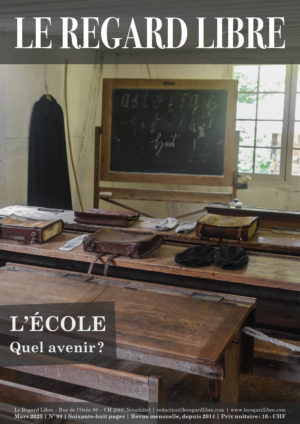 Le Regard Libre Nº94 | Dossier ECOLEPrice range: CHF5.00 through CHF10.00
You'll also like



 French
  German
  English
Leave a comment