



Guillaume Gallienne: «I’m always striving to serve the work even more.»

Cinema Wednesdays - Jonas Follonier
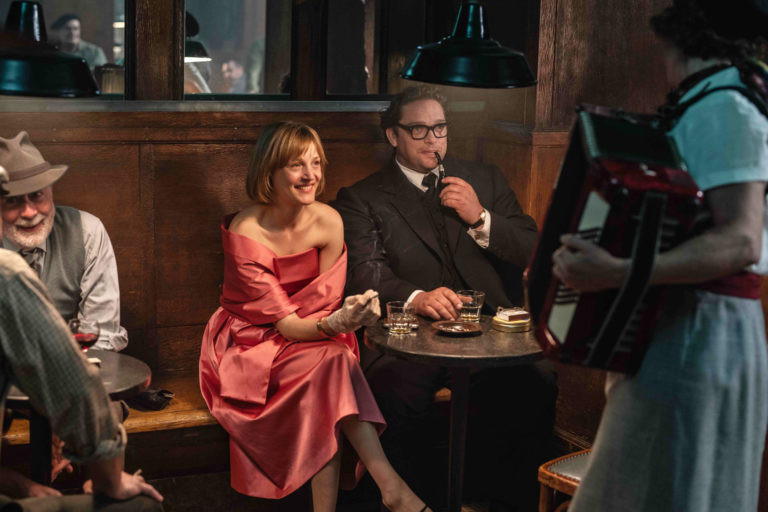
Guillaume Gallienne is an actor and filmmaker who has carved out a prominent place for himself in the French film scene. A member of the Comédie-Française, he won two Molière Awards in 2010 and 2011, as well as four César Awards in 2014 for his debut film, which is as touching as it is hilarious, Les Garçons et Guillaume, à table!. This year, Guillaume Gallienne delivers a second feature film that draws on dramatic themes, with the subject of acting still serving as a backdrop. We met with him in Lausanne a few days before the release of Maryline.
Le Regard Libre: Maryline is a film about cinema, silence, and alcoholism, among other things. Did you draw inspiration from real-life events—things you’ve seen or experienced—when creating this film?
Guillaume Gallienne: This film was inspired by a woman I met fifteen years ago. She is a person of great humility who touched me deeply. She told me her life story. Her story moved me deeply; I’ve carried it with me for fifteen years. Above all, it’s the story of a woman who lacks the words to defend herself and who, despite the humiliations she endured and thanks to the kindness of others, will find her way to freedom. I chose film and theater as a medium, which allowed me to amplify my message. It is, in fact, one of the few professions where you’re told, «We have to shoot right here, right now—action!»
What made you choose Adeline d’Hermy, who is also a member of the Comédie-Française, for the lead role?
I met Adeline when she joined the Comédie-Française six years ago. What first impressed me about her was her humility. I think that’s something you can’t fake. The film is structured like a chronicle, but I was aiming for drama. I knew Adeline would carry that drama from start to finish and see the narrative through to the end. Also, Adeline comes from a dance background; she can therefore express herself without speaking, and she has a knack for conveying emotion through the smallest details: a tensed neck, a shoulder movement, a body posture. Finally, you can sense that she’s someone who comes from the countryside.
At one point, Maryline says, «I’ve been waiting for this moment for ten years. Ten years of being trapped in my damn silence. A silence that makes you want to throw up.» Did you want to show the connection between silence and alcoholism?
No, because I think words can save, but words can also kill. In this character’s case, her addiction stems from family dynamics, as well as from the violence she endures in the first third of the film at the hands of a terrible director. The silence that makes you want to vomit is the self-hatred that people who feel left out, out of place, and defenseless can feel. This sense of powerlessness often turns against them—because of society, but also because of themselves. Ultimately, the shame they may feel at not having the words, at not knowing the unwritten rules, is deeply painful. That’s where that line comes from.
There’s a wonderful character—a benevolent fairy, you might say—named Jeanne, played by Vanessa Paradis. In a car, she says to Maryline, «The only movies worth watching are the ones that have a touch of darkness, a subconscious element.» Is that you speaking through her?
Actually, this is a tribute I wanted to pay to a sentence from a novel by Jun’ichirō Tanizaki, titled In Praise of the Shadow: «Gold is never more beautiful than in the dark.» This statement was a foundational idea for my film. When Jeanne praises films with an element of darkness, it is a tribute to Tanizaki (cinema is a pretext for depicting life in general, in Maryline), but it’s also a clever way for the character played by Vanessa Paradis to convey that, in the end, what remains unsaid is beautiful. It’s a way to reassure Maryline, to save her.
At the end of your first feature film, Les Garçons et Guillaume, à table!, you declare at the end of your play, indirectly addressing your mother in the audience: «It was her modesty that gave me the words.» So was the theme of Maryline already present in your first film?
In Les Garçons et Guillaume, à table!, This marks the actor's debut; in Maryline, ...it's his journey that's being told. It's true that my thoughts on the actor are somewhat of a continuation of my second film.
Finally, I’d like to ask you about the spoken word. You have a beautiful voice—as this interview proves. You’ve recorded audiobooks by Flaubert, Proust, and Balzac. How do you view your role as a conveyor of these works?
I focus more and more on serving a work—on truly immersing myself in it—rather than on my voice as such. I’ve been working in public service for twenty years now, and I’m deeply committed to this role as a conduit. I find culture to be freer when it allows itself the luxury of not being commercial. Its role is essential because it’s the only place where the mix of ideas is unexpected—where that mix takes you by surprise. I’m grateful for the opportunity I have to be part of the public service, and I feel a sense of responsibility toward the taxpayer.
Write to the author: [email protected]
Photo credit: Wikimedia CC 3.0

You'll also like


 French
  German
  English
Leave a comment