



«Sons of Man: dystopian exploration
Cinema Wednesdays - Special edition: The coronaretrospective of anticipation cinema - Fanny Agostino
Before becoming the source of much controversy over the detour of his film from the traditional distribution circuit Roma released on Netflix, Alfonso Cuarón took on this holy practice of the apocalypse. In The Sons of Man, He depicts a world doomed to perdition, due to the inability of the human species to reproduce.
Could our Hispanic filmmaker have read Margaret Atwood's novel? The Handmaid's Tale before the phenomenal success of its TV series adaptation? In any case, the comparison is inevitable: In a near future ravaged by war, the youngest person on Earth, «Baby Diego,» has just been murdered at the age of 18 after refusing to sign an autograph for a stranger.
England, portrayed as the last bastion of civilization, is pursuing a particularly repressive policy in response to the massive influx of immigrants. Theo Faron, an office worker leading a quiet life, finds himself entrusted with a mission of the utmost importance—at his own expense: to escort an illegal immigrant named Kee to an organization in the Azores that is determined to rebuild humanity. One significant detail: miraculously, she is the first woman in the world to become pregnant in nearly twenty years.
A Complex Political Microcosm
Although the loss of fertility is presented as the defining event that leads to the emergence of the Republic of Gilead in Atwood’s work, Cuarón did not draw inspiration from this dystopian world, since The Sons of Man is also an adaptation based on a novel. The apparent complexity of the universe and its established structures may be a manifestation of this intricate narrative tapestry.
A veritable modern-day Constantinople, the Anglo-Saxon government founded the aptly named «Ark of the Arts,» where all the world’s surviving works of art are preserved and remain inaccessible to the capital’s residents. Far from being able to exercise its near-totalitarian power without reprisals, the government faces two major opposition forces. On one side is the organization «Poisson,» considered a terrorist group and functioning as a sort of armed NGO fighting to defend immigrants. On the other is the very discreet «Planetary Renewal,» which brings together scientists searching for a way to eradicate infertility.
Dystopia: A Future Set in a Laboratory
It’s clear: all these political forces are ready to use this clandestine forum for their own interests. A symbol of the revolution for one, a new muse with a troubled past for the other. Kee is a relic that Theo must protect from a society that, through epidemics and wars, has become unstable.
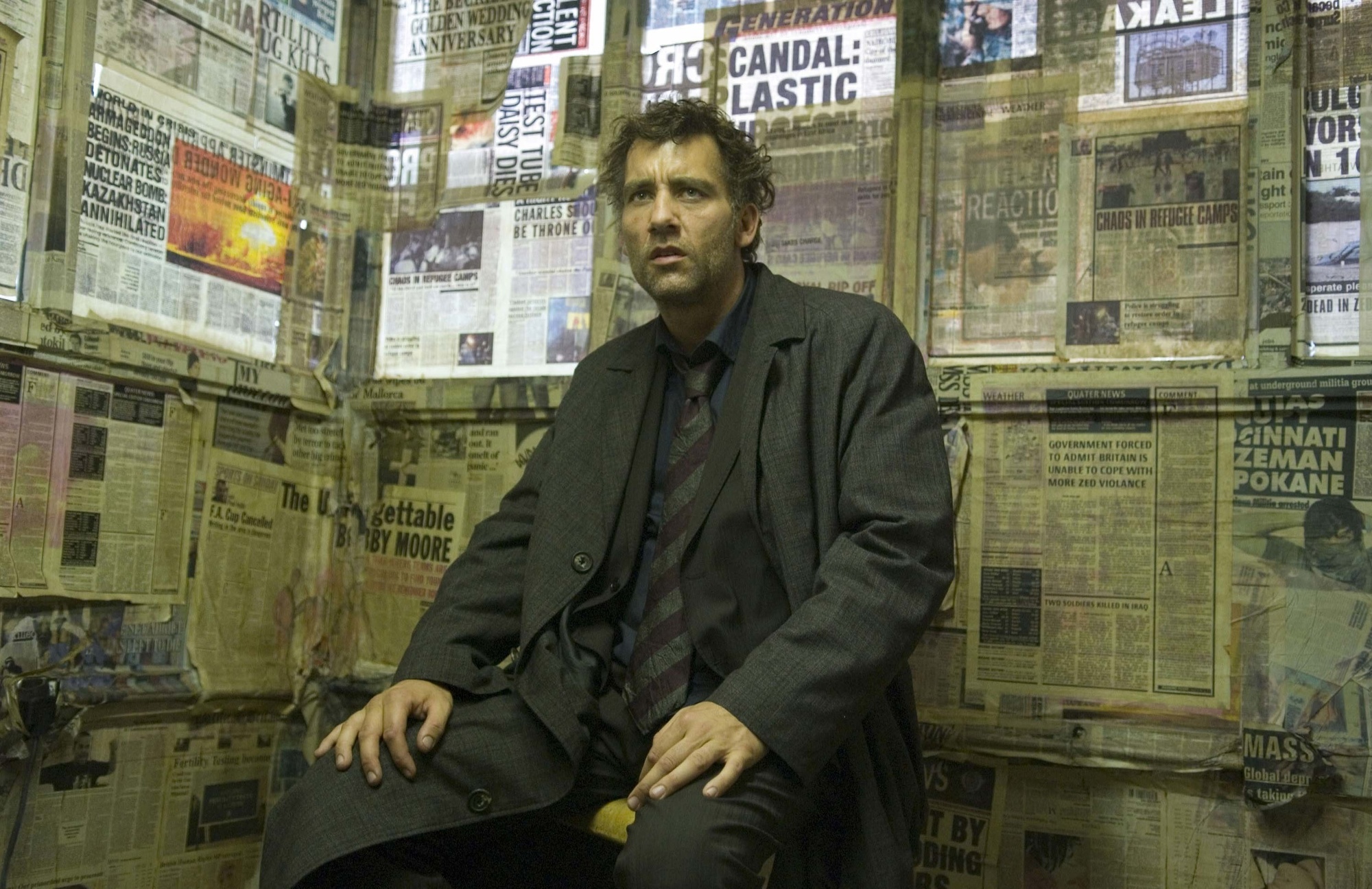
A mirror of the world, the film uses the portrayal of a dark and decadent future to present a dystopian world. It is replete with historical references that help shape its morbid universe. With the southern part of the United Kingdom being requisitioned to house refugees in camps, the refugees establish structures and an organizational system reminiscent of concentration camps.
The arrival in Bexhill is a case in point: in the middle of the night, buses with barred windows pass through a checkpoint guarded by turrets and surrounded by walls topped with barbed wire. Once inside the compound, the vehicle stops to drop off the illegal immigrants, who are then executed, before stopping again to park the latest arrivals.
Within the camp, a small town—littered with debris and makeshift stalls—has sprung up. In central London, one must also reckon with the presence of small Islamist groups opposing the closure of mosques.
Beyond the rich fictional world he creates around the political forces at play, Cuarón also offers magnificent imagery, particularly the long take in the camp under siege by British forces: an experience that is both deeply immersive and a visual treat. The Sons of Man, with its richly detailed world, offers an enjoyable science-fiction film as well as a dark—albeit liberating—glimpse into a possible future.
Write to the author: fanny.agostino@leregardlibre.com
Photo credit: © Universal Pictures


You'll also like





 French
  German
  English
Leave a comment