



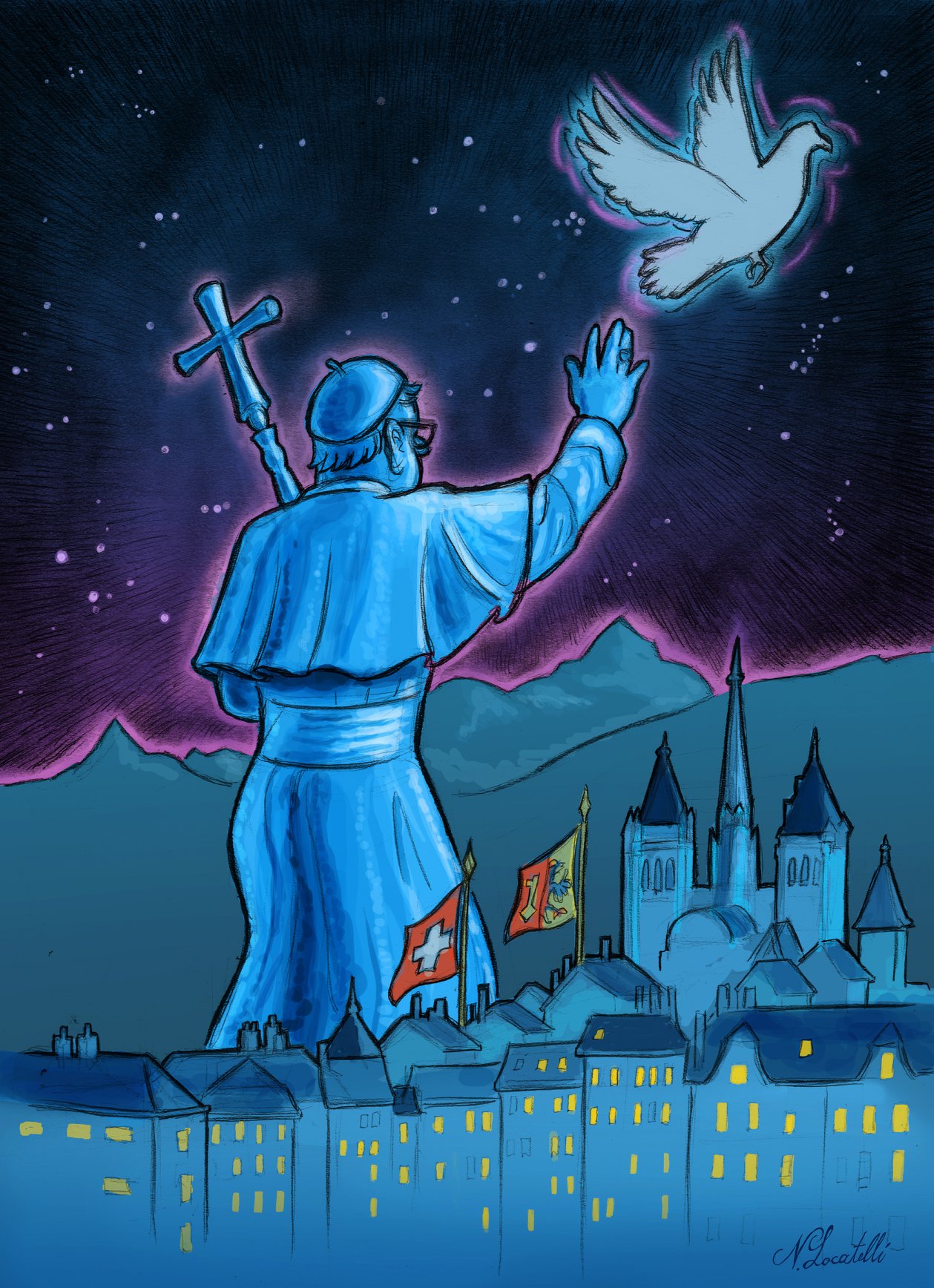
Father, bread, forgiveness: Pope Francis' visit to Geneva

Ecumenical Pilgrimage of H.H. Francis to Geneva, 21 June 2018 After visiting the World Council of Churches and the Ecumenical Institute at Bossey. The day ended with a Catholic mass at the PalExpo exhibition center bring together about 40.000 believers.
Le Regard Libre N° 41 - Loris S. Musumeci
Pope Francis was not long in coming, but he was eagerly awaited. His visit to Geneva on June 21 was marked by a strong symbolic value at the political and ecumenical level, and by a strong emotional value for the population. In addition to the keynote address at the WCC (World Council of Churches), there was the homily to look forward to. What could this good man possibly have to say to the good people of Switzerland? Once the preaching was done, the ardor passed, but the message remained.
The event was described as a visit from Catholic Rome to Protestant Rome. There was some of that, of course. When it comes to religion, Geneva is certainly not without its own special history. Ecumenical discourse is essentially consensual, in the neutral sense of the word. Everyone is more or less in agreement in advocating ecumenism, or at least small ecumenical gestures. We knew in advance that the various speeches would be strong and that they would appeal to everyone.
The homily is a different matter. For the simple fact that it belongs to the liturgy of the Mass. Its function is to comment on and explain the day's Gospel. So, on the one hand, the Pope's words were expected to fulfill their liturgical role for the Mass, but at the same time they were expected to be a continuation of the words spoken at the WCC. More simply, was the homily rich enough to speak to everyone? How can it be interpreted so that its impact extends beyond the boundaries of Catholicism and even Christianity?
Be that as it may, the words of the head of the Church are inspired by divine revelation. Francis is a man of the Church and his message is Catholic. Without distorting the homily, it's a good idea to open the doors to a deeper meaning that echoes man's natural intelligence. One that can speak to every man of good will, without causing unnecessary distance.
Father
«Father, bread, forgiveness. Three words that today's Gospel gives us. Three words that lead us to the heart of faith.» With these three words, the Pope articulates his entire message. He goes even further: he sums up the Christian faith and the commitment of Christians behind the Father, bread and forgiveness. It's well known that Christians conceive and truly experience a God who is no longer the power in the heavens, detached and disinterested in mankind, but that he is Father. Evidence that the Holy Father recalls in these terms: «We pray as Christians: not a generic God, but God who is above all Father.»
There is a Father, who is not only, according to Jesus' teaching, my Father or your Father, but well our Father. And memories come flooding back of that little prayer you used to say as children when, for some of you, you went to mass wearily: «Our Father who art in Heaven». Beyond the father figure, it's the «our» that gives the formula its social significance. «When there's a father, no one is excluded; fear and uncertainty don't have the upper hand. The memory of goodness reappears, because in the Father's heart we are not virtual children, but beloved children. He doesn't gather us into sharing groups, but regenerates us together as a family.»
God is seen here both as the parents who comfort, the friends who are always there, and a group of a true human community. All these aspects are part of the family. The «we» reminds us of a natural fraternity and, by the same token, of a responsibility towards others. In short, because the Father is ours, we are brothers. It is because we are brothers that we must work for one another. In layman's terms: people share the same conditions of human life, and are therefore called to mutual and fraternal support.
Bread
«There's no point in asking for more: just bread, that is, the essentials of life. Bread is first and foremost sufficient food for today, for health, for today's work; the food that so many of our brothers and sisters sadly lack. That's why I say: beware of those who speculate on bread! Basic food for people's daily lives must be accessible to all.»
So much for setting the tone. The essential is the quest for human happiness. This essential is the return to a simplicity that sets us free and fills our lungs with fresh air. «Give us this day's bread» is both a request to receive the material necessities of life, and a request to receive Christ, who becomes daily bread through the mystery of transubstantiation - the transformation of bread and wine into the body and blood of Jesus. Beyond this theological access, there is an ethic of contentment; not mediocre contentment, but contentment with what is necessary, which is balance.
In their own way, these words are also a political message. Great minds will consider it simplistic. The great liberals will cry communist, rightly or wrongly. In any case, following on from the responsibility engendered by the natural fraternity deriving from «our father», we can certainly accept poverty, just as we can accept that some societies are richer and more developed than others. Where there is hunger, however, dignity is trampled underfoot.
Francis' message seems to recall the human moral duty to organize policies that give everyone their due. Even if, for the sake of realism, we can tolerate precariousness, we can't let anyone lack basic foodstuffs, lack primary needs. If food is lacking, the strength of the body is lacking, the determination of the spirit is lacking. A well-nourished body and a satiated mind are capable of building a society based on work, a truly common good.
Sorry
«Forgiveness renews, it works miracles. [...] Only then do we introduce real novelties into the world, because there is no greater novelty than forgiveness, which turns evil into good. We see this in Christian history. Forgiving one another, rediscovering ourselves as brothers and sisters after centuries of controversy and heartbreak - what good it has done us, and continues to do us! The Father is happy when we love and forgive each other with a sincere heart.»
From the knowledge of the Father, of our Father, comes the social project and the desire for justice. These require a first personal step. Promoting peace in society must begin with inner peace, where the anxieties of constant stress are released. A life turned towards the essential. Towards Christ for Christians; towards bread for all - Christians included, it will not have escaped us that however enlightened they may be, Christians are beings of the flesh.
«Our Father» and «Daily Bread» require an open heart. And the key? Drum roll: forgiveness! It's the real, concrete act of forgiveness that translates true charity - applied charity. Forgiveness cleanses, and, without any geographical pun intended, sets the course for hope. Newness, entrepreneurship, change and even the revolución can only be healthy and lead to something better if they are purified by the act of forgiveness.
History clearly shows that revolutions, especially the most ambitious ones, which have not gone through a prior pardon have been harmful. At the risk of being caricatural and approximate, I would take communism as an example. It unfolded in hatred and drowned in its own blood. Had the proletariat forgiven the aristocracy and bourgeoisie for any abuses they might have committed? Not really; hatred alone was the compass. To balance the scales of political criticism, have today's conservative movements in Europe forgiven illegal migrants for acting illegally, out of opportunism, need or desperation?
These theses deserve further reflection and discussion. So let's return to the heart of the homily: Father, bread, forgiveness. Or rather, forgiveness, bread, Father. Love of neighbor requires forgiveness. Forgiveness frees us from social ills, from unnecessary and devastating burdens. Forgiveness aims at a return to the essential. Forget our differences, I forgive you; let's get back to the essentials of our relationship. What's essential is that everyone should be able to live in dignity, the bread that every human being deserves simply for being human.
A life with daily bread for everyone is a life with a deep desire for social justice. In a project of fraternity. A fraternity united under a common entity, that of the Father, of our Father.
Write to the author: loris.musumeci@leregardlibre.com
Peter Williams/WCC
You'll also like


 French
  German
  English
Leave a comment