



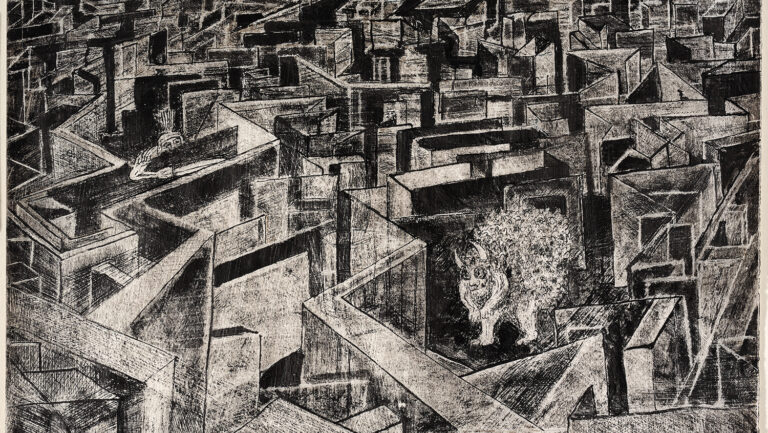
The human labyrinth

Tuesday books - Aude Robert-Tissot
Mohamed Mbougar Sarr has been awarded the Prix Goncourt 2021 for his fourth novel, Man's most secret memory, published by Philippe Rey. A mise en abyme to remind us that literary genius does exist. And so beautiful and so good that I chose not to finish reading it before writing this review. Let yourself be carried away.
Have you ever found yourself not wanting to finish a book? Savoring every page, pretending to leave it on your nightstand for a while, just for the pleasure of picking it up again each night… Well, that’s how I feel about Man's most secret memory. I admit I’m feeling a double pang of sadness: the sadness of talking about a book I haven’t finished reading yet, and the sadness I’ll feel soon when I have to put it down.
The reason Mohamed Mbougar Sarr’s fiction is so powerfully unsettling is because of its form, which is original and difficult to summarize. The novel is constructed as a series of nested narratives: the author draws us into a labyrinth of stories that take us from Senegal to Paris during World War II, and on to Buenos Aires. Literature is the key theme of this novel, which constantly reminds us of the path ahead, like a flag flying high in the sky so we do not lose sight of the only land that matters—the land of literature—which overlooks and tells the stories of our countries, the history of the world, and its people.
See also our review of the 2020 Prix Goncourt | «The Anomaly,» a fragmented novel set against a philosophical backdrop
The protagonist of this work of fiction is a young Senegalese writer, Diégane Latyr Faye, accompanied by a mysterious young woman who is passionate about literature; together, they set out on a quest to discover a masterpiece titled The Labyrinth of the Inhuman, published in 1938; its author, T.C. Elimane, has vanished without a trace. The reader is thus drawn in by the succession of stories that unfold during this search to find the writer. We are constantly kept on the edge of our seats by the many surprises inherent in the myriad secrets a life can hide when we set out on the trail of a genius—or simply a man.
But ultimately, literature is merely a pretext in this book. A pretext for Mohamed Mbougar Sarr to talk about the world he has, despite being in his early thirties, managed to understand so well. He presents us with sumptuous pages, written with incredible precision, on exile, love, sexuality, illness, God, identity, plagiarism, friendship, death, Judaism, family… All of this is conveyed in fabulous language, always fluid and varying in style depending on the character speaking, but above all with a subtlety and insight worthy of a great philosopher; a veritable labyrinth of the human condition from which it is difficult to escape—and whose twists and turns ultimately transform us.
Mohamed Mbougar Sarr has come within reach of his dream—just like the protagonist of his novel—to write «the ultimate book, the one after which there would be nothing left to write,» because he has managed to say it all. Ultimately, the best way to bring this book into existence is not to actually power to discuss it, as a kind of "mise en abyme" of the apophatic theology found in Mankind's most secret memory.
«But why keep going, why try to write after millennia of books like *The Labyrinth of the Inhuman*, which gave the impression that there was nothing left to add? [… ] We didn’t know; and perhaps that was our answer: we wrote because we knew nothing, we wrote to say that we no longer knew what to do in the world, except write—without hope but without easy resignation, with obstinacy, exhaustion, and joy—with the sole aim of finishing as best we could, that is, with our eyes open: to see everything, to miss nothing, not to blink, not to take shelter behind our eyelids, to run the risk of having our eyes gouged out from wanting to see it all—not as a witness or a prophet sees, no, but as a sentinel longs to see—the lone, trembling sentinel of a wretched and lost city, who nevertheless scans the shadows from which will spring the flash of his death and the end of his city.«
Write to the author: aude.robert-tissot@leregardlibre.com
Featured image: Master of the Cassoni Campana, Theseus and the Minotaur, 69×155 cm, 1500–1525, oil on wood panel, Musée du Petit Palais, Avignon.
Photo Credit: Maestro di Tavarnelle © Wikimedia CC BY-SA 4.0

Mohamed Mbougar Sarr
Man's most secret memory
Co-publication Philippe Rey/Jimsaan
2021
448 pages
You'll also like



 French
  German
  English
Leave a comment