




In search of the lost us
Zep
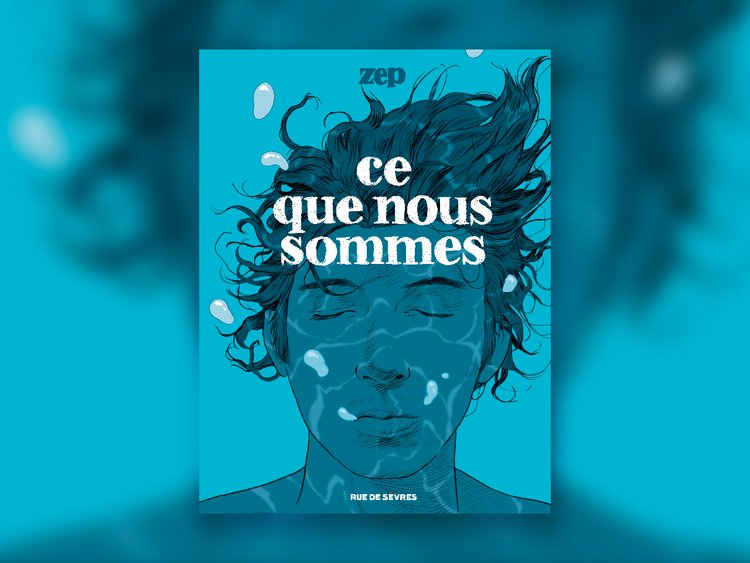
With his latest album What we are published by Editions Rue de Sèvres, Zep takes a futuristic look at transhumanism and questions human vulnerability in a world dominated by data.
What if you could speak twelve languages you’d learned in three minutes? Master Korean, Arabic, and Greek in less time than it takes to brush your teeth? Even better. What if you could store the entire contents of the Encyclopedia in your brain? Or, to take it even further, experience extrasensory phenomena with unrelenting realism without ever leaving your chair?
Let’s continue. What if you could swim with a blue whale? Or fulfill your most secret sexual fantasy? What if you could share dreams with others and communicate without speaking—through telepathy—or move objects without touching them—through telekinesis? And what if, in short, you could almost attain the status of a god? Would you do it? Would you do it, if it were within your power? Because in 2113, in Zep’s latest graphic novel, set in a futuristic society dominated by data under the dome of a DataBrainCenter, this is what a wealthy, bourgeois segment of the population—to which the main character, Constant, belongs—can afford.
Unlimited Knowledge
In this new era, humans—equipped with a second, digital brain into which they can download and store anything—buy knowledge just as one buys a baguette. There’s no longer any need to learn anything. Knowledge is no longer the result of personal discovery or empirical intuition. It’s simply uploaded. Thus, elevated almost to the status of deities, the bourgeoisie lives without a care for others or the planet. It learns what it wants, pushes the limits of humanity, and augments it to dizzying heights—which is not unlike the central line from Sapiens by Yuval Noah Harari: «History began when humans invented gods. It will end when they become gods.»
Just like our current data storage systems, the DataBrainCenter consumes a great deal of energy and, as a result, harms the environment. Zep, by amplifying our relationship with digital technology and exaggerating the harmful effects of our actions on the planet, offers a glimpse—admittedly fictional, but one the reader can grasp—of what the year 2113 might look like. This lends the comic a certain sense of realism. The society depicted is futuristic, yet tangible and imaginable. It almost feels as if we’re really there.
Constant, the main character, loses all his knowledge and abilities related to the DataBrainCenter following a cyberattack. He finds himself stripped bare, helpless. Taken in by Hazel, a young woman living outside bourgeois society, among the common people and ordinary humans, he receives help and sets out to piece together his past. She helps him regain his memory and introduces him to what it means to learn, remember, touch, and experience sensations—taste, touch, and all the other tangible experiences of a flesh-and-blood human being.
Human Vulnerability
While our society’s march toward transhumanism is heavily criticized—with Hazel’s character remarking, «We wanted to create an enhanced human; instead, we created an assisted human…»—and while the frantic race toward cutting-edge digital technology and a form of ecocide are raised as issues, Who We AreHe also questions human vulnerability. Constant’s investigation into his own hacking incident transforms—as reflected in the stark colors of the pages—into an intimate exploration of who he truly is, turning this futuristic fable into a reflection on humanity—and thus, on all of us.
Constant, in search of himself and his memories, acts as a mirror, reminding us that we are intimately connected to one another. Through his sense of disorientation, he reminds us that it is possible—if everyone could set out overnight in search of themselves—to set out in search of a “us” lost in an inadequate society.
Write to the author: [email protected]
© Zep / Editions Rue de Sèvres
You've just read an open-access article. Debates, analysis, cultural news: subscribe to support us and get access to all our content!
Zep
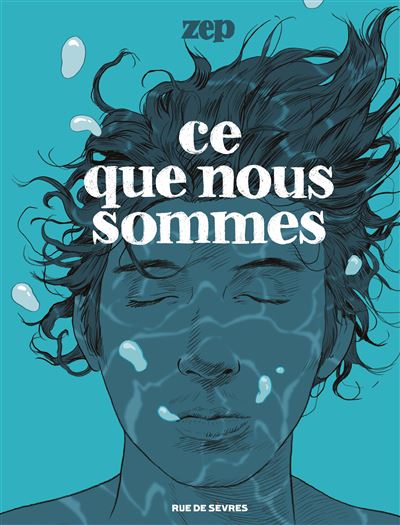
What we are
Rue de Sèvres Publishing
2022
87 pages
You'll also like





 French
  German
  English
Leave a comment