




Don't go to the heart of others: get out of them
The final volume in the Manifestes Incertains by artist-writer Frédéric Pajak is a black-and-white comet of the new literary season. He sheds light on the crosshatchings and cast shadows of our human trajectories, with the mysterious poet Fernando Pessoa as his lucky star.
Read more in our October issue (pre-order here), Arthur Billerey's interview with Frédéric Pajak.
When reading a book, it’s sometimes helpful and inspiring to take a break (much like taking a break for a “trou normand” during Sunday dinner) to open another book and find a connection, a link, or a point of comparison. Because this isn’t a scoop, nor is it a last-minute revelation that would shake the world, but it is important to know that all books are interconnected. All books, across all genres and eras, are interconnected. To put it more simply, we could say that books are like a network of veins that keeps a single, unified heart beating—and we could add that this heart is, well, the heart of each person’s imagination.
In the spirit of bringing people together, for this last one Uncertain Manifesto, we could search as much as possible, rummage through the very bottom of drawers, clear out the old books and classics from the bookshelves; we could even search beyond what’s possible, turn heaven and earth upside down—let’s go crazy—and frantically reopen the sacred texts, since the one and only connection, the only connection that works and serves as a magic lantern to guide us forward as enlightened readers through the sparse night of Frédéric Pajak’s words and drawings, dedicated to Fernando Pessoa—the one and only connection is the title of a poem by Paul Eluard from his collection Full Song: «Don’t go into the hearts of others: step out of them.» To put it even more accurately, we could say—with a slight tweak—«Don’t go into the hearts of others, but step out of them from time to time, so you can return to them with greater clarity.»
Why highlight this poem by Paul Eluard? Because it sums up the latter Uncertain Manifesto. Why not go to the very heart of others and come back out? To gain some distance so as to better retrace one’s steps. For what makes this manifesto unique is that it breaks with the narrative structure of traditional biographies. Goodbye to linear, progressive narratives. Here, these back-and-forth movements serve a fundamental purpose. You have to walk out the door. The reader enters the life of Fernando Pessoa—or rather, the multiple lives of Fernando Pessoa—only to step out and return a chapter later, with a fresh, rested, and watchful eye. And when the reader steps out of the poet’s life, it is to join, for a few paragraphs, the life of the biographer, Frédéric Pajak, who sets the rhythm for the entire work. The reader discovers episodes from his own journey as a writer and illustrator, such as his spontaneous trip in July 1975 to visit Algeria on a whim, or, more recently, how he felt and perceived the French news surrounding the «Yellow Vests» protests. The writer-illustrator thus presents himself as an artist who is part of the world, intertwined with the reality of everyday life, directly influenced by what happens on his own doorstep—or rather, at the roundabout at the end of the street.
«The uniqueness of this movement also lay in the way it mobilized. Within a few hours, its supporters gathered at roundabouts—the unappealing symbols of modern urbanization. Using only social media, these tens of thousands of ordinary citizens—who are usually isolated from one another and indifferent to political parties and unions alike—were able to come together spontaneously. Not only did they recognize one another, but all of France—and far beyond—recognized them. To silence them, in addition to a police crackdown and swift judicial sanctions, the state was able to rely on provocateurs and rioters who appeared out of nowhere.»
One might foolishly think that these narrative back-and-forths hinder the reading experience. Nothing could be further from the truth—in fact, the opposite is true. Fernando Pessoa’s life, punctuated by Frédéric Pajak’s memories and reflections, conveyed in a straightforward, well-researched, and slightly poetic style, becomes clearer and easier to grasp, to imagine, and to feel. Although, to be more precise, one should really say “the lives of Fernando Pessoa.” For one of the poet’s distinctive traits—beyond the mystery that surrounds him, beyond the fact that his entire body of work, comprising more than thirty thousand documents, almost all unpublished, was discovered in a trunk after his death, and beyond his unconventional path for the time— his youth in South Africa, his failures, his adventures, and his influences—one of his distinctive traits is that, according to the scholar Teresa Rita Lopez, he had more than seventy-two heteronyms to his credit, the main and best-known of which are the following: Ricardo Reis, Álvaro de Campos, Alberto Caeiro, and Bernardo Soares. And these heteronyms are firmly rooted in his work. Just like the art of paradox, which he developed through the lens of his humble job as an office clerk, as Frédéric Pajak points out:
«It is through the art of paradox, however, that he manages to express what is undoubtedly his deepest feeling: “We are made of death. This thing we consider to be life is the slumber of true life, the death of who we truly are. The dead are born; they do not die. For us, the two worlds are reversed. While we believe we are living, we are dead; we begin to live when we are dying.”
And what about the drawings in all of this? They’re just like everything else—they take us on a journey, they move us, they pull us out of the story only to bring us back into it. At other times, they stick closely to the text, like the portraits of Fernando Pessoa, his family, or his friend Mário de Sá-Carneiro. Other times, they’re just a tiny detail in the unfolding story, like that squirrel in a tree, perhaps located in a park near New York’s Kennedy Airport. Let’s talk about the trees. In Frédéric Pajak’s trees, there is a rather rare and strange ability to capture the natural essence of the plant kingdom. One might think the trees are so full-bodied and alive that they push against the frame surrounding them. There is something impetuous, anarchic, disorderly, and deeply primitive about them—like life in its very first moments. Which moments? Perhaps the first moments of a light whose origin we must seek. Frédéric Pajak’s eye—or eyes—organize the light.
And what's crazy is that the poem comes full circle with its last two lines Don't go to the heart of others: get out of them, by Paul Eluard, which attests to this: «Beautiful eyes, command the light / Through all new life.» The trees seem real because, just as in reality, they are perpetually in search of light. Is this not the only cause they embrace—one that is honorable and very simple? One might say that with this age-old quest, we are far removed from our human causes, far from our certainties, and far from our stubbornness—which blinds us and sometimes leads us to historic defeat. And that’s just as well, for it is the author’s view.
«Most of those who champion a cause leave me indifferent at best, and repulse me at worst. The more honorable the cause, the more they make their case worse. They share the same blind fervor as evangelists, the same self-satisfaction, the same unshakable conviction, the same proselytizing. Among them are economists, those materialistic religious people. As soon as I see a man—or a woman—full of strong convictions, I run away. I go have a drink in the vineyards at my friend Gilles’s place. We’re careful not to try to change the world.»
Write to the author: [email protected]
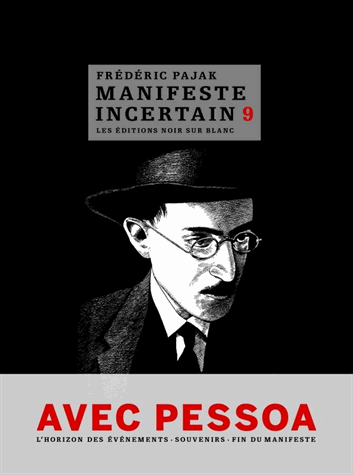
Frédéric Pajak
Uncertain Manifesto 9: With Pessoa. The Event Horizon. Memories. End of the Manifesto
Noir sur Blanc Publishing
2020
352 pages
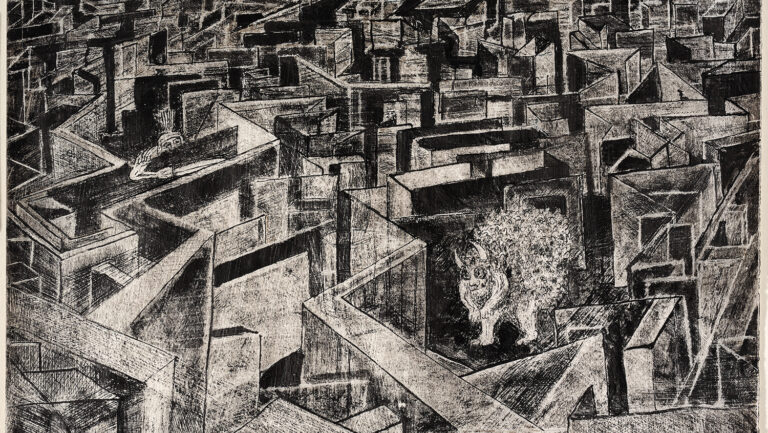
Header image: One of the drawings from Vol. 9 of the Uncertain Manifesto © Frédéric Pajak / Editions Noir sur Blanc.
-
 Youth passCHF25.00 / year
 -
Digital subscriptionCHF50.00 / year
-
Standard subscription (Switzerland)CHF100.00 / year
-
Support subscriptionCHF200.00 / year
You'll also like




 French
  German
  English
Leave a comment