




Loneliness
Unpublished article - Loris S. Musumeci
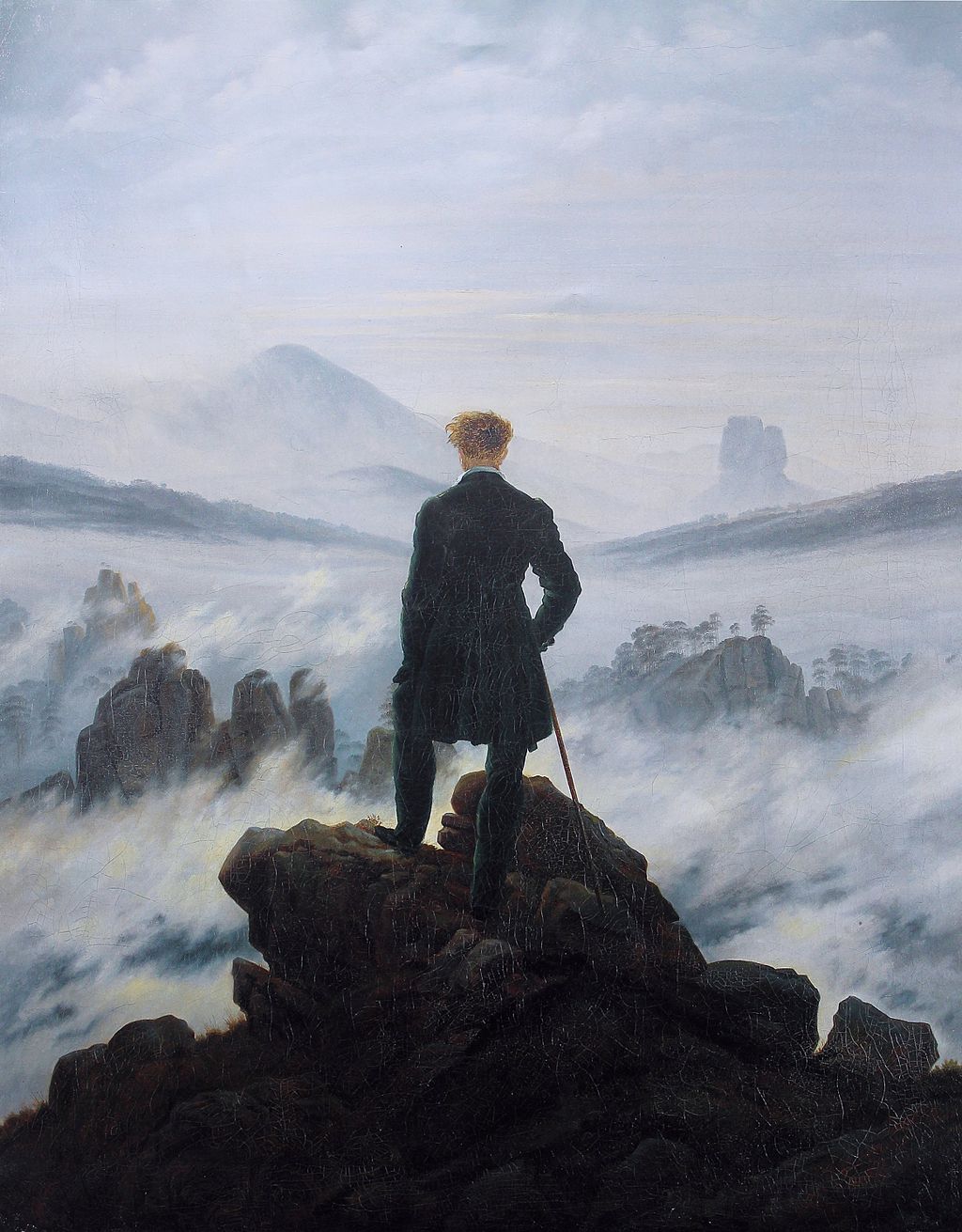
Léo Ferré sang about it, Charles Baudelaire proclaimed it, Caspar David Friedrich painted it, Jean-Paul Sartre thought about it philosophically. It's all about solitude. That beautiful, prickly rose that hurts to grasp, but which we can't do without.
«Who is he who has never been alone at least once in his life? Does he even exist? If man is, by nature, a social being, he also needs, by that very nature, to come face to face with his own mystery, namely himself.
I don't intend to set out here a history of conceptions and representations of solitude through the ages, or to explain it in the light of the theories of the great psychoanalysts. I simply wish to offer a brief reflection on the following question: can solitude be the breeding ground for openness to others?
Depression—particularly the kind that, according to the vast majority, can lead to suicide—is caused by a feeling of being misunderstood and abandoned, which is intimately linked to loneliness. Once love is gone, once my friend has left, and once there is no one left to share life’s daily pains with me, what else do I have left but my misery and its stiff rope with which to hang myself? Exclusive loneliness is unbearable and cannot remain a space open to others, simply because others become invisible. Losing the ability to observe those around me—due to betrayed trust or wounded affection—proves to be a kind of illness, for it spreads like cirrhosis or any other cancer: once one cell is affected, the others are bound to follow; thus, from a wounded otherness, the other becomes a living hell. And loneliness imposes itself, in its darkness and bitterness.
Moreover, everyone wants to be liked. Who am I without anyone’s gaze or regard? What else do I seek but to be loved? Without the other, I am nothing—if only because I do not grow from ’humus« like a tree, but am born from the womb of a woman, whom I call my mother, she who gives me a language, a culture, and a tradition. Emmanuel Levinas articulates this dependence on others very well in his theory of the »vis-à-vis,” in which the meaning of existence unfolds through the face of the other, which transcends me.
And yet! How good it is sometimes to drink from the wellspring of silence, to breathe the air of seclusion, to savor the pleasure of swimming in a pool of solitude. The human person, according to Boethius’s definition, is an individual substance of a rational nature. It is precisely because the individual is evoked within it that my person has intrinsic value and that I must come to know it even in the absence of others. If the gaze of the other reveals something about myself to me, so does my own gaze, because it contains the richness of introspection that no one else can perform in my place. Everything, however, still comes down to striking a balance between total dependence on how others see me and absolute self-absorption, which would prevent me from opening myself to anything beyond the tip of my nose.
Read also: «Solitude, are you good for us?»
Furthermore, in addition to introspection, moderate solitude allows one to experience listening to one’s own silence, which is essential to appreciating the voices of others. How can I even enjoy the presence of a lover if I haven’t learned—beforehand and throughout the relationship—to savor those special moments languidly when she wasn’t there? How can I experience the joy of reuniting with my friend if he never leaves my side after our usual drink at the local bar-tobacco shop? Solitude, which can be frightening, healthily nourishes social connection—and vice versa; in this way, it is beautiful and grants me the capacity for an authentic relationship with others.
Write to the author: [email protected]
Image: Caspar David Friedrich, «Wanderer Above the Sea of Fog» (1817)
You'll also like



 French
  German
  English
1 comment
[…] See also: «On Solitude» […]
Leave a comment