



Tribute to Jean-Philippe Smet
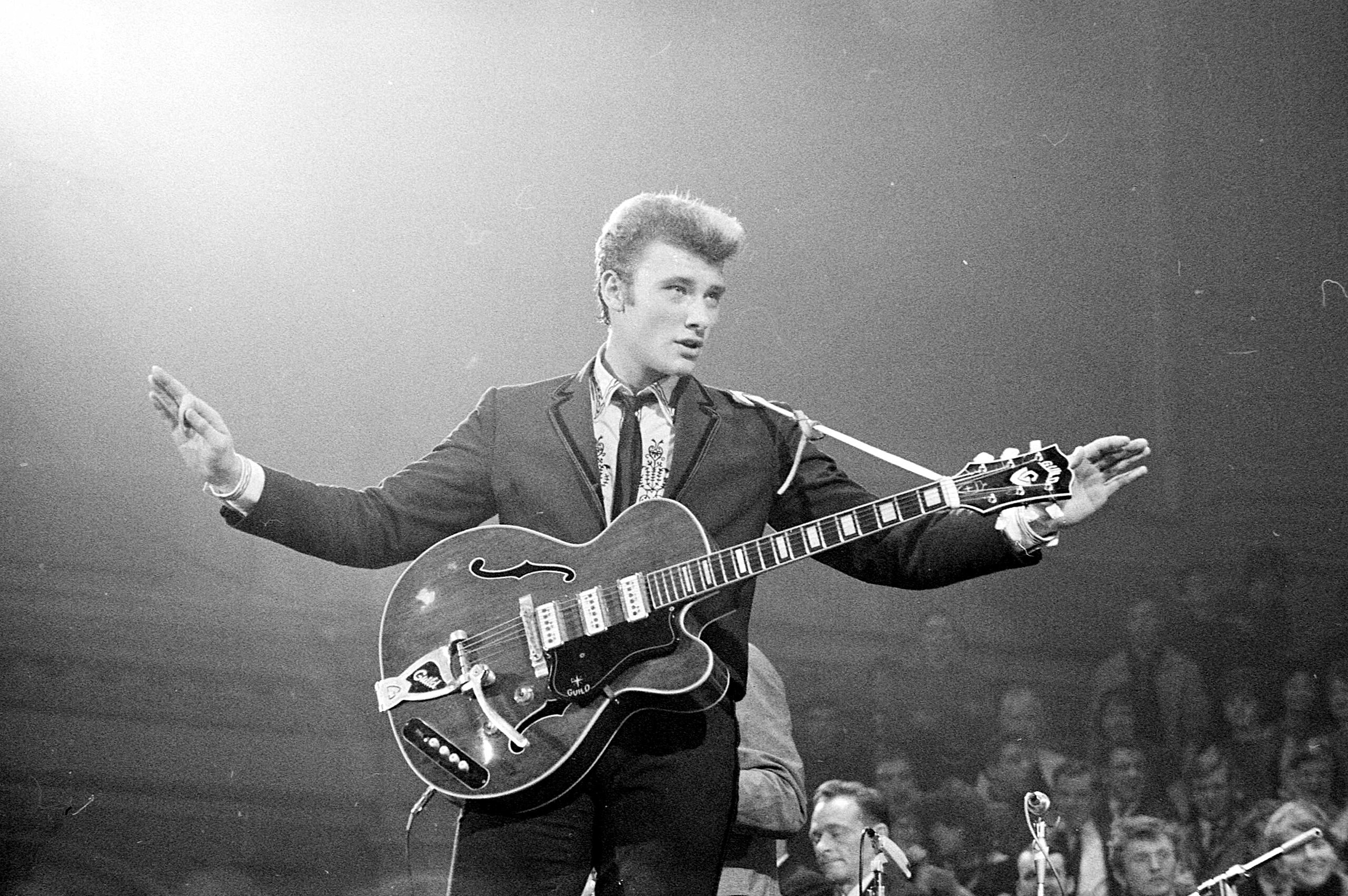
Johnny Hallyday in concert in 1963. Photo: Wikimedia
Johnny Hallyday’s death is like a square circle—it doesn’t exist. And yet, even though his wife Laetitia didn’t believe what she wrote that night, those words broke the news: «My husband is no more.» On the morning of December 6, humanity seemed to discover for the first time the irrevocable reality of death, with the passing of the greatest singer France has ever known.
Johnny Hallyday brings back at least a few memories for each of us, because he was part of our lives—like a family member we don’t see often but whose existence we’re always aware of. His death first took me back to my elementary school years, when, with a friend, we reenacted the music video for the song in our own way Marie. That's when I discovered Johnny, who would never leave my side again.
I also remembered car journeys with my parents in the early 2000s, when the albums What I know and To life and death marked the start of our vacations. In 2006, I attended my first Johnny concert at the Tourbillon Stadium during his Flashback Tour. I saw him again in 2009, in Geneva, on what was supposed to be his final tour. But «final» isn’t part of Johnny’s vocabulary. To stop giving concerts would have meant stopping altogether.
Read also | Johnny Hallyday as you've never seen him before: «J'suis une pute» (I'm a whore)»
In the summer of 2016, I was cheering on the Taulier at the «Sion sous les étoiles» festival. I’ve never had such goosebumps as I did at that phenomenal concert, which was the second-to-last stop on his tour Staying alive. Life, survival—an obsession for Johnny Hallyday. He was the embodiment of it all. Passionate and always determined, Johnny truly lived—in the sense that he forged himself at every moment, constantly evolving and reinventing himself, from his music to his physical appearance.
Excesses of all kinds were inevitable. But what do a few setbacks really amount to in the face of such a noble career spanning fifty-seven years? If today, in the press as well as among the general public, no one considers Johnny a fool anymore, it’s because it’s simply impossible to go from Jean-Philippe Smet to Johnny Hallyday and remain at the top for so long if you were a fool. All those who hadn’t seen it that way seem to be realizing it now.
Once again, whether or not we like his songs, Johnny Hallyday’s greatest moments are part of the shared heritage of our Francophone identity. All you have to do is watch the video for his song The Teen Idol in 1963, to listen to the song I Forgot to Live of 1977, to relive resumption of Don't leave me at Zenith in 1984, look at the the singer's crossing of the Parc des Princes crowd in 1993 or to revise its interpretation of No, I have no regrets in 2000 at the foot of the Eiffel Tower.
Read also | The ideal Johnny Hallyday concert that never existed
These memorable moments draw our attention to an important aspect that has received little mention in this week’s articles: Johnny Hallyday bridged two worlds. a priori incompatible genres: rock «n» roll and French chanson. As we know, Johnny’s heart beat just as strongly for Elvis Presley and Chuck Berry as it did for Georges Brassens—whose entire repertoire he knew by heart—Jacques Brel, his role model on stage, and Charles Aznavour, whom he considered his “spiritual father.”.
This may partly explain the breadth of the audience he has managed to retain since the 1960s. Of course, there’s also an element recognized by everyone: that certain je ne sais quoi—a wild, almost animalistic quality, a superhuman charisma—blended with boundless kindness. The footage of his duet with Patrick Bruel in 1998—which Bruel would later say revived his career—and with Renaud in 2003, when the singer of Mistral wins was in a very bad phase, show just how much Johnny didn't cheat on kindness.
Read also | Country in Johnny Hallyday's repertoire
Friendship was Johnny Hallyday’s guiding principle. His closest companions—Eddy Mitchell and Jean Reno foremost among them—can attest to this. Johnny was a simple man whose happiness came from surrounding himself with friends to laugh, enjoy a good piece of meat, and raise a glass of red wine. In this sense, he is the hero of an entire nation—deeply epicurean and culturally Christian.
From the little Belgian boy abandoned by his father to the sacred monument of French rock, you've always remained the same, and you've made us dream.
Farewell, Mr Jean-Philippe Smet.
Write to the author: [email protected]
Photo credit: © L’Internaute
You have just read an open-access article. Debates, analyses, cultural news: subscribe to support us and access all our content.

You'll also like


 French
 German
 English
2 comments
[...] Read also: «Tribute to Jean-Philippe Smet» [...]
Thank you, Jonas, for paying tribute to him in such a way...
Leave a comment