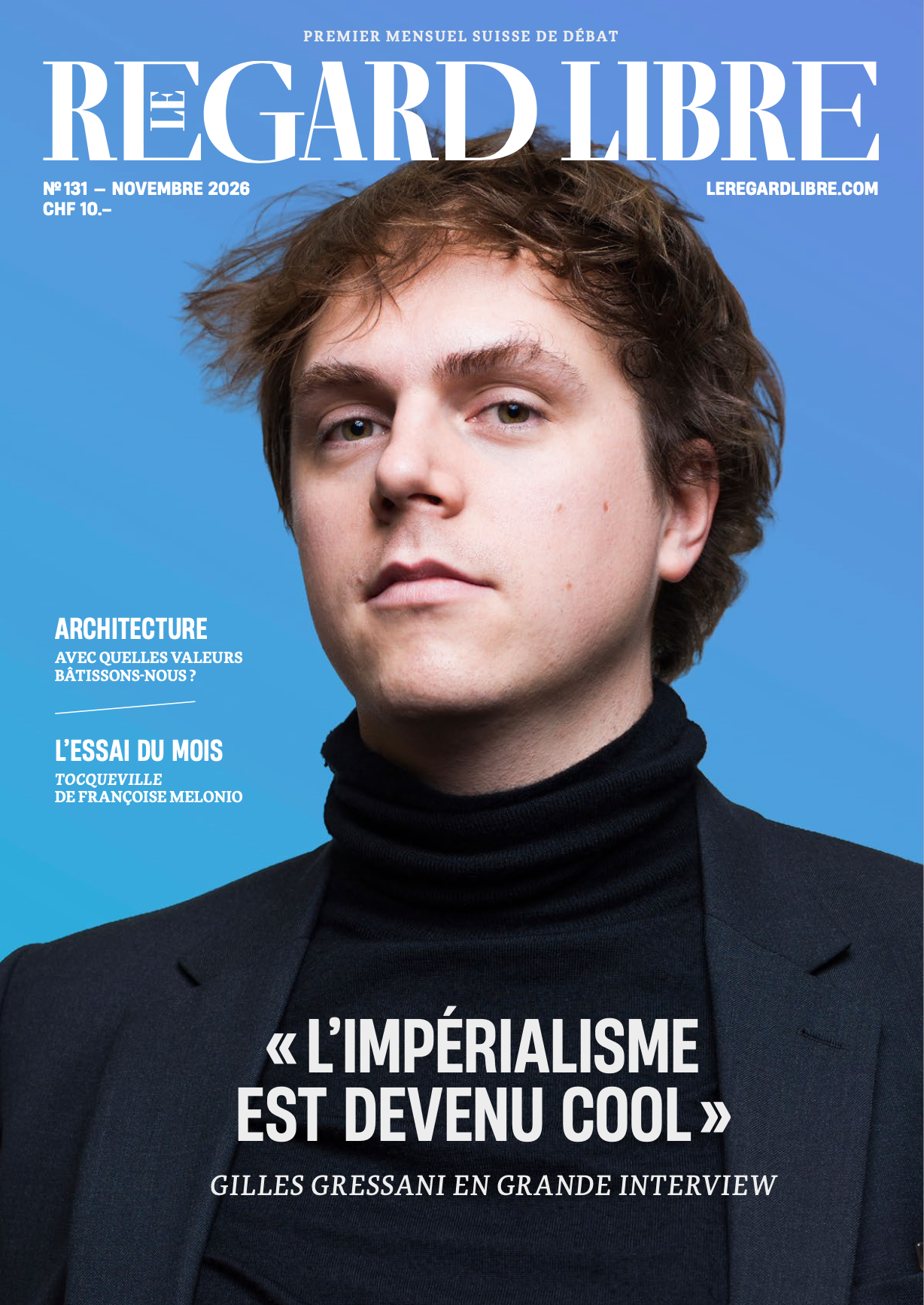




Gilles Gressani: «When you eat a pizza in Naples, you beat Peter Thiel»
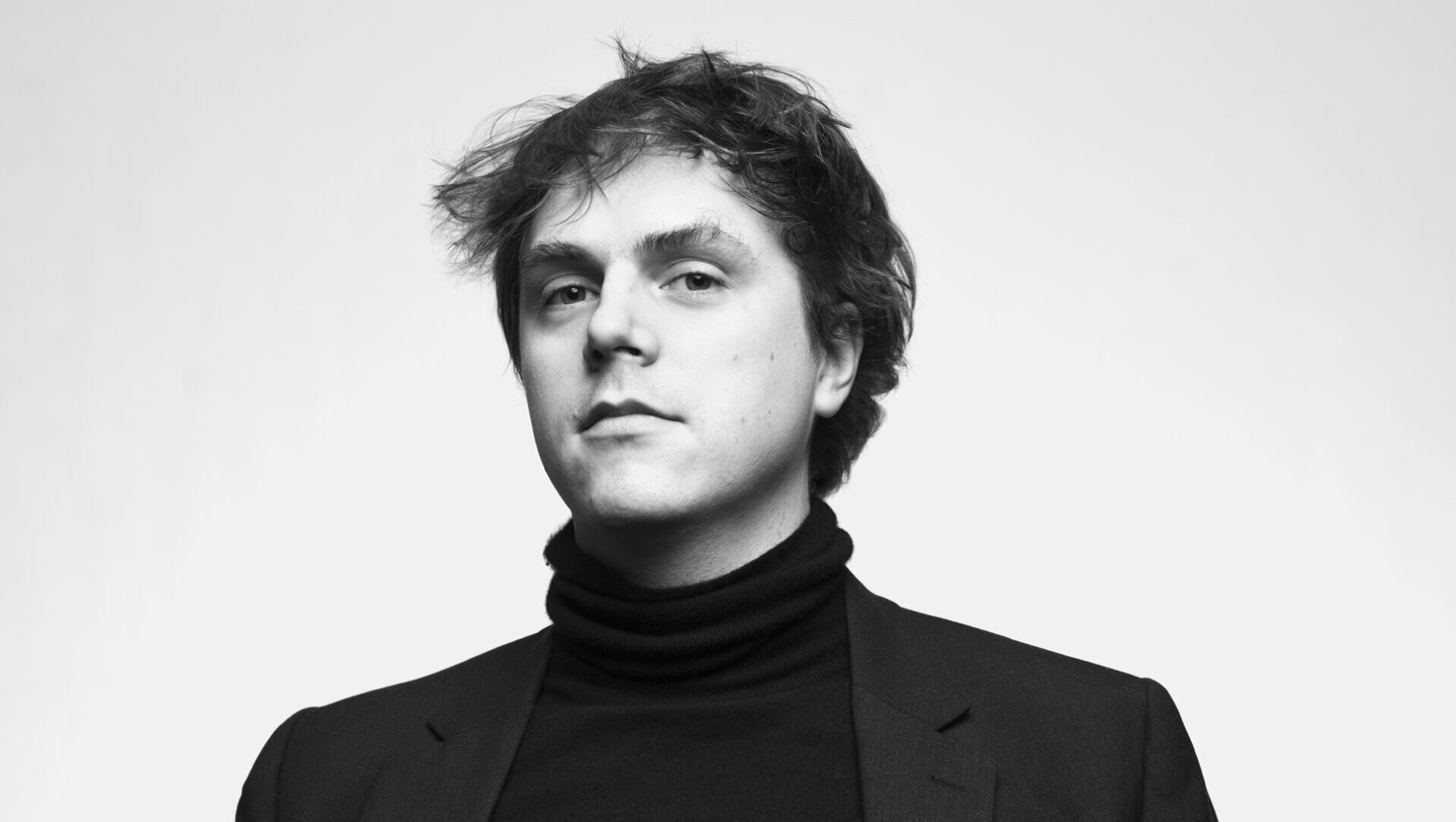
Photo: Grand Continent Summit
As Europe seeks its place in an unstable world, the magazine The Great Continent strives to decipher the ideas and power dynamics that drive the major powers. An interview with its director.
At Cornavin Station, Gilles Gressani is hard to miss. Wearing a pastel turtleneck and sporting a carefully cultivated Italian look, he takes off his large sunglasses and sets them on the table. To accompany our discussion on the future of Europe, he chooses an Argentine empanada. His love for the Old Continent doesn’t preclude the occasional indulgence.
Born in the Aosta Valley, Gilles Gressani moved to Paris to pursue his studies. He attended the École Normale Supérieure before founding the Groupe d’études géopolitiques in 2017, the think tank which publishes The Great Continent. In just a few years, the magazine—whose website receives 20 million visits a year—has established itself as a leading voice in European intellectual discourse, fostering dialogue among academics, writers, diplomats, and political leaders. Between two conferences in Switzerland, he speaks with a mix of calm confidence and passion to Le Regard Libre upheavals on the world stage.
Le Regard Libre: Against the backdrop of a fairly pronounced trend toward identity-based and nationalist withdrawal, what leads you to believe that the European level remains the most relevant framework for understanding the world?
Gilles Gressani: There is a paradox. Almost no national or identity-based movement now advocates a clear break with the continental level. In the European Parliament, the only mainstream party to the right of the European People’s Party group that still advocates leaving the European Union and the euro is Germany’s AfD.
Over the past decade or so, all other nationalist parties have abandoned this perspective, even if they have often done so in an ambiguous, unclear, and at times somewhat forced manner. We therefore find ourselves in a situation that may seem contradictory: the forces to the right of the European People’s Party have never been stronger, while the very idea of leaving the euro or the European Union has never been weaker.
How do you explain that?
When supply changes in politics, we must look at demand. I think a line of reasoning has taken hold. It is not necessarily economic or rational, however; its nature is deeply symbolic. The idea is that the euro is stronger than the franc or the lira. Once you start thinking this way, national sovereignty becomes much harder to defend in Europe: almost no major political force today is convinced that turning inward makes a country stronger.
Trumpism makes this realignment even less likely. It was sometimes portrayed as the great return of national-based isolationism, whereas its scope is in reality clearly imperial. Almost no one today seriously believes that Donald Trump is seeking, through his policies, to strengthen European nations. It is therefore becoming increasingly difficult for European nationalists and sovereigntists not to take a stand against him as well. Furthermore, we are witnessing a profound political realignment that renders old frameworks of analysis much less effective. It is becoming difficult to understand the world by remaining solely at the national level.
In an article published in early October about Marco Rubio’s speech in Athens, you describe the emergence of a «global North» that is redefining «Western civilization through power and recolonization.» What exactly do you mean by that?
The reference to the «Global North» comes from a text by Vladislav Surkov (editor’s note: a Russian businessman considered the Kremlin’s chief political adviser in the 2000s) that we had published. In it, he made a rather surprising prediction: in his view, Moscow, Europe, and Washington would eventually converge.
The article was published at a time when the United States was still deeply committed to supporting Ukraine. It therefore seemed completely countercyclical. Today, however, we can see just how much a realignment is underway. And this is unprecedented in European history: Washington and Moscow are now jointly supporting the German far right.
I think there is a very explicit aspect to this support: to undermine the possibility that Europe might become an autonomous bloc. The strategic interests of these two regions differ, but we are caught up in a dynamic of acute vassalage.
For Moscow, the goal would be to bring part of Europe back into the former Soviet sphere of influence: Ukraine, of course, but more if possible. For the United States, the goal would be to reconfigure the West according to a logic reminiscent of that of the Warsaw Pact: a center in Washington, followed by a region that aligns itself politically and geopolitically, cedes territory if asked to do so, or modifies its regulations if required.
And what about «recolonization»?
There is also this dimension, almost in the literal sense of the word. If we look today at the relationship between Venezuela and the United States, we see a profoundly asymmetrical dynamic, imposed from the outside. It no longer has much to do with the neoconservative logic of exporting democracy. Rather, it is about building an oligarchic system—as in Venezuela—that is dependent enough to accept the conditions imposed on it, within a relationship of subordination and exploitation. A dynamic that, incidentally, increasingly benefits certain clans rather than the American system as a whole.
This drive toward recolonization is also part of a broader trend: the dismantling of any pockets of autonomy. We see this, for example, in the relationship the Trump administration would like to impose on the Catholic Church. There is a form of mutual recognition, but also an attempt at subjugation: the Church is, in a sense, expected to become a component of Trumpism.
Of course, this has met with strong resistance, and this project is far from complete. I often quote this line from the greatest American philosopher of the 20thth In the 20th century, boxer Mike Tyson said, «Everyone has a plan until they get punched in the face.» This project of recolonization—this imperial project—is still far from being realized. Rather, we are entering a phase of confrontation. Our best bet is to take up judo.
Let's look at another region to which you've devoted a great deal of writing and research: China. What is it that Europe still doesn't understand about China?
Here, too, the situation is quite paradoxical. In geopolitical, economic, and industrial terms, China today accounts for a huge share of what matters in the world. And yet, we know very little about it.
In April, with the publication of our annual volume by Gallimard, we launched a sort of game: the «three Chinese test.» It involves asking well-educated people who are interested in international affairs to name three living Chinese people. Many are unable to do so. This is quite striking, because it reveals a structural problem in our public discourse. We live in a democracy, and to take a stand, one must have a minimum level of knowledge.
This information asymmetry has also enabled China to build a relationship in which the economy has become an instrument of power. China’s new industrial surge was made possible, in particular, by the fact that many political systems did not truly understand what was happening.
This lack of understanding is also largely political.
Yes, because we must also take the Chinese system’s own logic seriously. It is partly rooted in a Marxist-Leninist understanding of power that gives the Party control over economic processes and thus turns the economy into an instrument of domination.
So the challenge isn't just economic or commercial, but also ideological?
There is a material reality that we must examine—and that, incidentally, obsesses us. Maps, data… But it’s not just about things. There are also words. If we do not take seriously the ideas that are mobilizing our opponents today, we will simply end up with no ideas of our own. We are taking a stand precisely against a period when it was believed that, to defend the Republic or Europe or even a certain world order, it was enough to rationally demonstrate their superiority.
That's not how it works. We need to return to a more passionate, more political perspective to understand how to put the republican ideal into practice in the 21st century.th century.
A combative rationalism, so to speak?
I am a firm believer in a broad, warm, and embodied conception of reason—the kind espoused, for example, by Raymond Aron, even though he is always portrayed as a cold realist. When he became a member of the Académie Française, he had a quote from Herodotus engraved on his sword—one that I find absolutely magnificent: «No man is so devoid of reason as to prefer war to peace.»
I think that is precisely the reason we must try to cherish. It is not a utopian or naïve reason, one that would imagine a world without enemies, without dangers or risks. It is also a reason rich enough to help us understand that there is value in building concrete forms of peace. An interest that, when properly shaped, when nourished by enlightenment and made tangible, becomes overwhelming. And I am convinced of this at a time when the world is forcing us to think ever more about armaments and defense, and to make a very harsh assessment of what lies ahead.
Unlike those who rebuilt the world after World War II, we feel as though the ruins lie ahead of us.
In the United States, there is a very powerful national narrative, complete with its symbols and mythology. China, too, can draw on a vast historical continuity. What narrative could Europe tell about itself to reclaim its place in the world?
This is almost the perfect time to ask ourselves this question, because we have opponents who are attacking us. It’s always helpful to see which points they target first: that tells us something about our own strengths.
You mentioned Marco Rubio’s speech. He goes to the Acropolis, then to the Pnyx, and chooses these places to deliver his speech. In this way, he is trying to reconstruct a certain image of the West. What strikes me is that we ourselves, in the end, don’t really make much of these symbols. We let them become the backdrop for a discourse that seeks to dismantle us. Perhaps we could transform them into a catalyst for our energy…
So you think this identity already exists, but that we have a hard time embracing it?
Yes. It’s a truism, but a very important one: a European identity clearly exists. It’s something the whole world recognizes, but which—sometimes for good reasons—we have tried to set aside. We see this as well when faced with one of the great challenges of the 21stth century: this American ideology rooted in technology that embodies a certain vision of humanity—one centered on transcending the body and a disembodied, literally inhuman rationality that must be extended through technology.
Yet there is a paradox here that can also give us strength in the face of this Gnostic crisis. Tech giants are undoubtedly among those who have had the most considerable resources at their disposal in human history. And when you look at them, they’re often people who dress poorly, eat poorly, and live poorly.
They offer something overwhelming and staggering in its power, because they strike a chord with the idea of transcending and crossing all boundaries. And yet, when you look at them closely, they’re not very convincing. Not necessarily from a strictly rational standpoint, but from an almost physical one.
I think—and this isn’t just a joke—that you beat Peter Thiel by eating pizza in Naples and drinking a well-made Negroni. That’s also the layer we need to try to reclaim. It’s one of the fundamental ingredients of a narrative that is, by definition, not rational: a narrative about what constitutes human dignity, beauty, and truth.
You talk to us about Neapolitan pizza, Negroni, and the European way of life. But are these aesthetic considerations enough? Isn’t there a risk that Europe will turn its achievements into a source of consolation at the very moment it is missing a major technological and industrial turning point?
In many respects, we have clearly become peripheral. But we also remain at the center of many things. What is considered beautiful around the world? If we look at the value of the luxury industry, «Made in Europe» remains a benchmark. Why do millions of people want to live here? Because there is also a certain European way of understanding dignity and life.
When we seek to construct a narrative, we must start with what already exists and what is already powerful. Truth, justice, and beauty intertwine here in ways that are sometimes contradictory, sometimes critical, yet remain immediately perceptible to the rest of humanity. We have thus, on many issues, become a periphery while remaining the center of something else. We must find a way to refocus this, with a sense of pride.
The problem is that we’ve entrusted the promotion of European soft power not to Milanese designers, but to German lawyers. Obviously, that doesn’t work as well. But we’ve begun to realize that we need to change.
Europe's opponents seem to have succeeded in imposing particularly powerful narratives.
In some countries—Italy, for example—the «Putin narrative» has taken hold, or at least, in terms of narrative momentum, it’s well advanced. And yet, I still don’t know anyone in my circle who says to themselves, “Next year, if I’m lucky, I’m going to move to Moscow.” I think that’s precisely what we lacked in the previous cycle: we stopped reinterpreting the forms in which we live.
There is another important text by Vladislav Surkov—which we had translated and discussed in our pages—in which he attempts to address a rather extraordinary paradox: today, imperialism has become “cool.” Forty years ago, imperialists were generally seen as somewhat strange and marginal figures. It was difficult to use the arsenal of imperialism to propose a mainstream path. Surkov says, essentially, that this has changed because we’ve managed to “rebrand” it. So much so that, from Erdoğan to Trump, everyone has now become like Putin.
What do you mean by «retranslate»?
It is one of the key concepts of humanism that shaped Europe. ’Retranslation” is a technical term that conveys a very simple idea. The Bible, the’Iliad or the’Odyssée have not changed over time. Yet we have translated them on several occasions.
Why retranslate the same text when not a single line has been added to it? Because the feel of the language changes, because literature changes. If we want to give our contemporaries access to the extraordinary energy of a work, we must retranslate it. Without this complex work of’aggiornamento The works are no less powerful, but we lose access to their energy. I have a hunch that this is where our system is falling apart: we have stopped retranslating.
What, exactly, should be retranslated?
What Europe is, what the Republic is, what the law is. Take this summer’s crisis in Ceuta. It is a highly localized migration crisis involving a very specific problem, yet its symbolic power is such that it becomes a continental—or even global—crisis. Why? Because we see images of an invasion.
What’s interesting is that we completely missed this crisis. It’s not entirely clear who organized it, or even if anyone organized it at all. However, we do know that a large number of people who entered Spain—particularly during the first wave—had seen false, malicious, and targeted information on WhatsApp or Instagram. And Instagram and WhatsApp are both owned by the same company: Meta.
We have the legal tools at our disposal to protect our digital border. The European Commission could have used the power of the European market as leverage to obtain responses from Meta within a matter of hours, identify exactly what had happened, and demonstrate that democracy and the rule of law provide protection. That they can be strong enough to bring to heel those who seek to harm us and who use infrastructure whose immense power seeks every day to evade our control.
If we don’t do this, «the rule of law» remains a tedious phrase that seems above all to hinder innovation—something dusty. That is what “re-translation” is all about. It is necessary, it is in demand, and there is incredible energy behind it. Yet we remain trapped by a disconnect between supply and demand that prevents us from moving forward.
You say there is a demand for this «retranslation.» Yet in several European countries, the political climate seems to be characterized more by a rejection of institutions.
I don't see any contradiction. We’re at a point where betting against the institution is almost always a winning strategy, because our lives now unfold in a space for which none of our political institutions were designed. We live in the digital realm, we want to continue living there, and little by little, a form of disruption is taking hold. This logic goes far beyond the European issue alone. Xi Jinping warned his senior officials as early as 2018: if the Party «fails the test of the internet, it will fail the test of maintaining power in the long term.».
Visit Grand Continent brings together academics, diplomats, politicians, and senior civil servants, and you yourself are a graduate of the French grandes écoles. How can we prevent a discussion about the crisis among the elites from itself becoming a closed circle among the elites?
It is difficult to imagine a republican process that does not produce elites and does not seek to organize itself around certain forms of excellence. This in no way means that we should build a system that is closed in on itself.

In fact, this is one of the interesting aspects of the ideology emerging today in parts of Silicon Valley, particularly among people like Alex Karp: the idea that democracy prevents elites from functioning properly and that removing the constraints placed on them would make them more effective.
I believe exactly the opposite. What defined the Enlightenment—and, more broadly, European history—was precisely the ability to link technical and technological progress with shared prosperity. This has involved political and social struggles, constant rivalry, but also a very broad exchange of ideas.
That’s actually what we’re trying to do, even if we don’t always succeed. We’re still a bit like barbarians: a magazine born on the web, which publishes many people who had never written before, places them on the same level as well-established figures, and also seeks out texts written by people who are completely unsavory—and whom we even wish to oppose—in order to understand how they think.
This exchange is essential. I believe that true elites are like oysters: they must absorb a great deal from the world around them.
What intellectual heritage should Europe draw upon if it wants to reclaim its place in the world?
We are living in a time that bears certain similarities to the crisis of the Renaissance. That, in my opinion, is where we can find a wealth of useful insights. I strongly believe that a Europe founded on the republican ideas of Machiavelli would be the Europe of our dreams.
Federal Palace Correspondent for the newspaper L'Agefi, Pablo Sánchez is the editor-in-chief of the Regard Libre. Write to the author: pablo.sanchez@leregardlibre.com.
You have just read an open-access article published in our print edition (Le Regard Libre No. 131). Debates, analyses, cultural news: subscribe to support us and get access to all our content!
You'll also like


 French
 German
 English
Leave a comment