




«La Soupe aux choux»: a tale of roommates and tragedy

Cinema Wednesdays - Special edition: The coronary with Louis de Funès - Danilo Heyer
If there's one instrument by which French cinema has risen to majestic heights, it's comedy. Whether this is due to the light-hearted national character that has bequeathed us, from the Tartuffe from Molière to Candide until Fatalist of Diderot, that strange blend of refined thought and humor; or whether it comes from something else, who cares; let's not hesitate, for once, to thank those people who alone could give birth to The seventh company, to Bronzés font du ski, at Dinner party, and La Soupe aux choux.
A roommate story
La Soupe aux choux fits into a most exquisite sub-genre, one that deals with that most interesting of subjects: the lives of two grown men living together. To a certain extent, I'd bring in what happens in Joey and Chandler's apartment in Friends, and, above all, everything that happens in the excellent Withnail and I. Here's the recipe: take two best friends, who are to each other a little more than a brother, a little less than a wife; put them under the same roof; don't forget to add a lot of alcohol, that indispensable ingredient to such an existence; then confront these two outcasts with a new environment that will do nothing to suit them. The plot is simple, but it's a joy to watch!
Whereas in Withnail and I, From the story of two young Londoners, as broke as they were profligate, who «mistakenly went on vacation to the country», we follow the adventures of two country folk, two old specimens of a race of men on the brink of extinction, a race whose way of life hasn't changed one iota since the invention of agriculture.
On peut dire sans hésiter que ce qu’on appelle la vie simple aura trouvé, au milieu de ce lopin de terre de France, sa parfaite expression: on y mange de la soupe, on y jardine un peu, on se soulage à l’envi et on y vieillit sur un banc, sans plus même devoir subir la discipline d’une épouse; mais surtout, depuis aussi longtemps qu’on s’en souvienne, la journée y trouve son rythme naturel par les coups de «petits canons» («cinq ou six litres») qu’on s’empresse de s’envoyer de chaque côté, comme si la vie en dépendait. Quand Chérasse dit : «bon… c’est pas tout ça le père, mais tu me retardes! L’heure c’est l’heure; et c’est l’heure du perniflard!», il n’y a pas à rechigner avec son taux de diabète; on s’exécute sur-le-champ, et à la maison.
Over the years, friendship, which will always find the official language far too harsh, has taken care to reshape it in its own image: the foreigner is called «La Denrée»; the names «Le Glaude» and «Le Bombé» are used in response; and back in the day, «la Francine» was "arranged". To tell the truth, although we sometimes agree to integrate outsiders, as long as they adjust their flow to local customs, the majority of those who are foreign to this closed circle will see themselves pushed back; for they are well aware that it is only from the outside that catastrophe can arise.

Always a tragic end
Throughout these stories, we are warned, more or less subtly, that the sacred union cannot last, and they conclude with a tragic heartbreak: in Friends, Chandler will find a wife in Monica; in Whitnail and I, the vain appeal of a healthy, active life will eventually separate the two splendid unemployed; indeed, it's the same criminal voice that will drive away La Francine and separate the stuntman from the actor in Once upon a time in Hollywood. There's nothing more dramatic than divorce, since it's only ever desired by one side, since it's a betrayal, since it's only injustice.
In La Soupe aux choux however, it wasn't between the two friends, but with Le Progrès, that monster straight out of the 19th century.th No one was left behind, not even the most remote corners of the Old Continent, from the backward valleys of the Jura to the empty plains of the Bourbonnais.
So it is that the mayor, driven by that vigor proper to the industrious philistine, boasts to anyone who will listen, even to the two «old fossils», that the village lacks a «job-creating economic expansion»; one of those that offer no other prospects than the perpetual affairism already lamented by Thoreau. Housing estates are needed to turn the village into a dormitory town! To keep the newcomers occupied, a leisure park will be built, with restaurants, refreshment stands, swings and even a «monkey rock»! Next to Le Glaude's house, there will be a magnificent «parking lot for four thousand cars»; and on its grounds «ten thousand deckchairs and music»! What effervescence!
Departure or suicide
Au bord d’une crise cardiaque, son fusil de chasse en main, Le Bombé lui donne pour toute réponse cet ordre magistral: « Il vous faut foutre le camp! Il vous faut foutre le camp!» Le destin lui donnera tort; eux seuls devront s’en aller. Il a bien fallu, en effet, se détourner de l’horrible spectacle qu’offrait l’invasion du petit îlot de paix, orchestrée par ces bulldozers «qui vous ronflent les oreilles» et par ces nouveaux toits qui occultaient le Soleil autant qu’ils troublaient la sérénité. Dès lors, pour ne cesser de cultiver cette existence vertueuse, cet art de vivre et ce calme sortis des temps immémoriaux, les deux irréductibles durent se résoudre à partir pour un lieu qui n’existe pas – la planète Oxo, où l’on y vit deux cents ans, et le chat aussi…
Write to the author: [email protected]
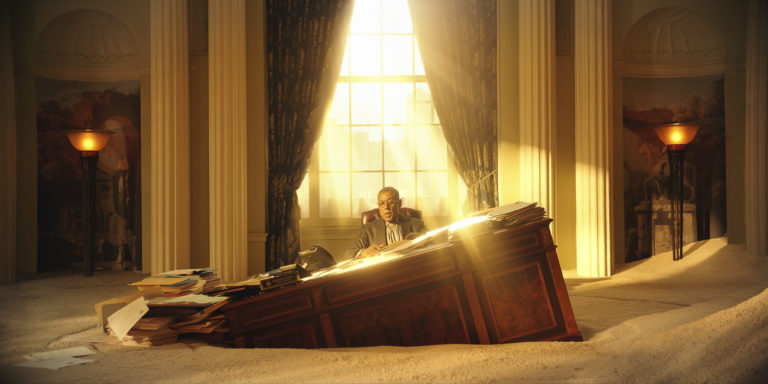
Photo credit: © Films A2
-
 Youth passCHF25.00 / year
 -
Digital subscriptionCHF50.00 / year
-
Standard subscription (Switzerland)CHF100.00 / year
-
Support subscriptionCHF200.00 / year
You'll also like





 French
  German
  English
Leave a comment