




And finally, pragmatism prevails

News Mondays - Nicolas Jutzet
A plebiscite for the Federal Council! Against an international backdrop of revolt against elites who are allegedly out of touch with the realities of people's daily lives, the pragmatic democratic expression that emerged from the ballot boxes on Sunday November 25 is to be welcomed. Victory all round for the «seven wise men».
Despite populism, the Federal Council stays the course
Forced to confront two campaigns of rare intellectual dishonesty, that of the popular initiative «Swiss law instead of foreign judges (initiative for self-determination)» and that aimed at rejecting the modification of the legal basis for the surveillance of insured persons, the executive was able to make itself heard and rally a majority of citizens behind it. A quiet force.
In both cases, the public overwhelmingly rejected a particular approach to politics. One that boils down to stirring up fears, making simplistic claims and denying the complexity of our institutions, which is nonetheless patently obvious in 2018. This is how we came to hear assertions which, whatever our personal opinion, were purely and simply mind-boggling. Some hammered home the point that direct democracy was in danger, while others spoke of the end of the rule of law and mass surveillance à la 1984 in connection with the legal basis for policyholder monitoring. In the end, this hyperbole-filled strategy hit a brick wall: mass rejection. The public seems to have had enough of alarmism, excessive language and ready-made solutions that end up being far more problematic than the pseudo-problems to be solved.
Legal basis for policyholder surveillance: a typical example of a campaign to forget
Initially, even the left-wing parties refused to launch a referendum against the amendment to the legal basis for policyholder monitoring. The issue was not a political priority and, with one year to go before the elections, risked becoming a political millstone around our necks. And so it proved. Although they ended up half-heartedly supporting the referendum, defenders from the Socialist Party were few and far between during the campaign, leaving the field to the party's second knives or beginners.
Their anxiety-inducing campaign, blithely playing with facts (such as demonstrated by a fact-checking on the «Arena» program in German-speaking Switzerland) never really caught on. Priding themselves on being the emanation of a group of citizens, the referendums had to admit limits of their model when the rank and file, after an internal vote, accepted the idea of publishing the poster shown below, in the street and on the various platforms. So much for class and respect for opponents.
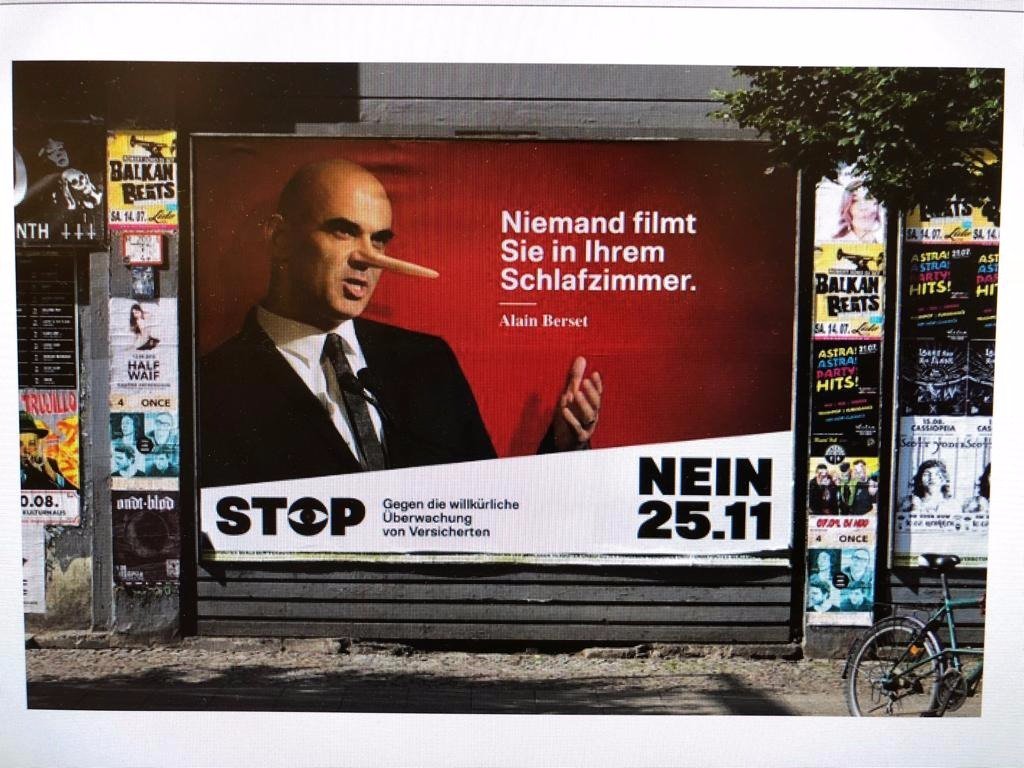
No analysis of this campaign would be complete without mentioning the existence of a «bourgeois» committee opposing the text. This committee used a hashtag (#) to say the least. According to them, their point of view is that of a #echtliberal / #vrailiberal. It's worth noting that the micro party UP!, the only party in Switzerland to defend a consistent liberal line, based on the reading and understanding of the great liberal authors, was... in favour of amending the legal basis.
One might legitimately ask how a motley coalition of Greens, Young Centrists and a few Liberal-Radicals can claim a monopoly (another liberal notion) on the ideals of freedom? For those who know some of them, Milton Friedman and Hayek certainly have no place in their library. Their knowledge of liberalism stops at this hashtag. They spent the campaign relaying press releases calling for more drastic surveillance of tax evaders and other demands from a left-wing that is obviously well known for its understanding and respect for citizens' privacy. Without forgetting to contradict themselves with every second argument.
Between those who wanted to do away with any possibility of administrative procedure, others who wanted the same paraphernalia of measures but with the approval of a judge - remember that the committee was talking about mass surveillance and the end of privacy... but, if a judge suddenly gives his approval, is the private sphere assured? - and the last, not bothered by these factual constraints, all simply mixed everything up while crying out for the end of the rule of law.
Once again, credibility is out the window. It's a pity, because the subject was interesting and would have merited an in-depth debate! Generally speaking, and this is a lesson to be drawn from the massive rejection of both the referendum against the new gambling law and this one, a majority of the population seems to be prepared to live with laws that are imperfect, and refuses to nitpick on a few specific points, as was the case during these two recent campaigns. A blessing in disguise?
Write to the author: nicolas.jutzet@leregardlibre.com
Photo credit: © Pixabay

You'll also like






 French
  German
  English
Leave a comment